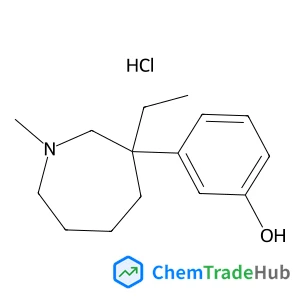
3-(3-Ethyl-1-methyl-3-azepanyl)phenol hydrochloride (1:1)
CAS Number:
59263-76-2
Molecular Formula:
C15H24ClNO
Alla G. Ponomareva, Roman O. Zhurakivsky, Tanja van Mourik
A comprehensive quantum-chemical conformational analysis of two nucleoside analogues, 2′,3′-didehydro-2′,3′-dideoxyuridine (d4U) and 2′,3′-didehydro-2′,3′-dideoxycytidine (d4C), is reported. The electronic structure calculations were performed at the MP2/6-311++G(d,p)//B3LYP/6-31++G(d,p) level of theory. It was found that d4U and d4C adopt 20 conformers and 19 conformers, respectively, which correspond to local minima on the respective potential energy landscapes. QTAIM and NBO analyses show that the d4U and d4C conformers are stabilised by a complicated network of specific intramolecular interactions, which includes conventional (OH⋯O) and non-conventional (CH⋯O, CH⋯HC) H-bonds as well as closed-shell van der Waals (C⋯O) contacts. A satisfactory linear correlation was found between Grunenberg's compliance constants for closed-shell intramolecular interactions and their energy. It is shown that there are no conformational obstacles for incorporation of d4U and d4C into the double helical A and B forms of DNA. The less pronounced biological activity of d4U as compared to 2′,3′-didehydro-2′,3′-dideoxythymidine (d4T) is most likely due to the presence of the bulky methyl group at the 5-position of d4T, which can be recognised by target enzymes.
Xiwen Jiang, Cuiyuan Pan, Qiaowen Wang, Zipeng Yin, Xiao Han
DOI: 10.1039/D2AN01689C
Antje Hermelink, Angelika Brauer, Peter Lasch, Dieter Naumann
DOI: 10.1039/B822574E
D. R. Shobha Jeykumari, S. Sriman Narayanan
DOI: 10.1039/B820040H
Dain Kim, Jiyoung Lee, Jueun Han, Jaewoo Lim
DOI: 10.1039/D2AN01672A
Andrea Dorsa, Qing Xie, Martin Wagner, Xiaoji G. Xu
DOI: 10.1039/D2AN01103D
Hui Xi, Hanlin Jiang, Mario Juhas, Yang Zhang
DOI: 10.1039/D2AN01057G
Pengjing Jing, Chengqi Zhao, Zheng-Zhi Yin, Baozhu Yang, Junyao Li, Wenrong Cai, Yong Kong
DOI: 10.1039/D2AN01445A
Xiaoqin Wu, Juanli Xi, Xuehong Wei, Caixia Yin
DOI: 10.1039/D2AN01865A
Wangbo Qu, Bin Yang, Taiyu Guo, Ruowei Tian, Shuang Qiu, Xinyue Chen, Zhirong Geng, Zhilin Wang
DOI: 10.1039/D2AN01693A
When handling 4-(2-Furylmethyl)thiomorpholine 1,1-dioxide (CAS: 79206-94-3), it ...
When handling 4-Chloro-N-[2-(4-morpholinyl)ethyl]benzamide (CAS: 71320-77-9), it...
Waste containing this compound (CAS: 62921-74-8) should be handled according to ...
Waste containing (S)-Methyl 2-amino-3-cyclohexylpropanoate should be collected i...
This compound can be synthesized using a multi-step process involving the conjug...
There are several alternatives to (2E)-3-(3,4-Dichlorophenyl)acrylic acid in syn...
Ethyl 6-(2-nitrophenyl)imidazo[2,1-b][1,3]thiazole-3-carboxylate (CAS: 925437-84...
Waste containing 2-(1,3-Thiazol-2-yl)ethanamine (CAS: 18453-07-1) should be coll...
Methyl 5-iodo-2-methylbenzoate can be synthesized through the iodination of meth...
5-Chloro[1,2,4]triazolo[1,5-a]pyridine is commonly synthesized via the condensat...

Physical Chemistry Chemical Physics (PCCP) is an international journal co-owned by 19 physical chemistry and physics societies from around the world. This journal publishes original, cutting-edge research in physical chemistry, chemical physics and biophysical chemistry. To be suitable for publication in PCCP, articles must include significant innovation and/or insight into physical chemistry; this is the most important criterion that reviewers and Editors will judge against when evaluating submissions. The journal has a broad scope and welcomes contributions spanning experiment, theory, computation and data science. Topical coverage includes spectroscopy, dynamics, kinetics, statistical mechanics, thermodynamics, electrochemistry, catalysis, surface science, quantum mechanics, quantum computing and machine learning. Interdisciplinary research areas such as polymers and soft matter, materials, nanoscience, energy, surfaces/interfaces, and biophysical chemistry are welcomed if they demonstrate significant innovation and/or insight into physical chemistry. Joined experimental/theoretical studies are particularly appreciated when complementary and based on up-to-date approaches.