












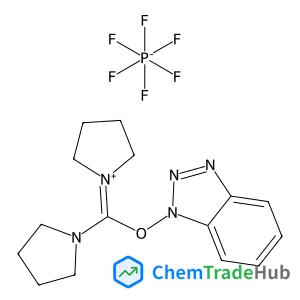
(1H-Benzotriazol-1-yloxy)(di-1-pyrrolidinyl)methylium hexafluorophosphate
CAS Number:
105379-24-6
Molecular Formula:
C15H21F6N5OP
Qiang Li, Yi-Xiang Qiu, Xian-Yang Chen
In order to explore the details of the reaction mechanisms of Nb atoms with acetonitrile molecules, the sextet, quartet, and doublet spin state potential energy surfaces have been investigated. Density functional theory (DFT) with the relativistic zero-order regular approximation at the PW91/TZ2P level has been applied. The complicated minimum energy reaction path involves four transition states (TS), stationary states (1) to (5) and two intersystem crossings from spin sextets to quartets to doublets (indicated by ⇒): 6Nb + NCCH3 → 6Nb η1-NCCH3 (61) → 6TS1/2 ⇒ 4Nb η2-(NC)CH3 (42) → 4TS2/3 → 4NbH η3-(NCCH2) (43) → 4TS3/4 → CNNbCH3 (44) ⇒ 2TS4/5 → CN(NbH)CH2 (25). The minimum energy crossing points were determined with the help of the DFT fractional-occupation-number approach. The first spin inversion leads from the sextet to an energetically low intermediate quartet (42) with final insertion of Nb into the C–C bond. The second one from the quartet to the doublet state facilitates the activation of a C–H bond, lowering the rearrangement-barrier by 44 kJ mol−1. The overall reaction is calculated to be exothermic by about 170–180 kJ mol−1. All intermediate and product species were frequency and NBO analyzed. The species can be rationalized with the help of Lewis type formulas.
M. Seray Ural, Emmanuel Dartois, Jérémie Mathurin, Didier Desmaële, Philippe Collery, Alexandre Dazzi, Ariane Deniset-Besseau, Ruxandra Gref
DOI: 10.1039/D2AN01079H
Luiz Fernando Moreira, Marcos Roberto de Vasconcelos Lanza, Auro Atsushi Tanaka, Maria Del Pilar Taboada Sotomayor
DOI: 10.1039/B902273B
Łukasz Tymecki, Luiza Brodacka, Beata Rozum, Robert Koncki
DOI: 10.1039/B822025E
Guohua Qi, Xing Du, Xuan Yi, Minmin Wang, Hongyan Zhu, Dan Sun
DOI: 10.1039/D2AN01459A
Junqing He, Junyan Wang, Min Zhang, Guoyue Shi
DOI: 10.1039/D2AN01658C
Antje Hermelink, Angelika Brauer, Peter Lasch, Dieter Naumann
DOI: 10.1039/B822574E
Zengming Zhang, Shuhao Zhao, Lei Jiang, Junjun Wu, Wenhan Zhao, Xiaoniu Guo, Niancai Peng, Fei Hu
DOI: 10.1039/D2AN00908K
Zhaozi Lv, Erkang Wang
DOI: 10.1039/B909069J
Yuze Li
DOI: 10.1039/D2AN01756C
When handling 4-(2-Furylmethyl)thiomorpholine 1,1-dioxide (CAS: 79206-94-3), it ...
When handling 4-Chloro-N-[2-(4-morpholinyl)ethyl]benzamide (CAS: 71320-77-9), it...
Waste containing this compound (CAS: 62921-74-8) should be handled according to ...
Waste containing (S)-Methyl 2-amino-3-cyclohexylpropanoate should be collected i...
This compound can be synthesized using a multi-step process involving the conjug...
There are several alternatives to (2E)-3-(3,4-Dichlorophenyl)acrylic acid in syn...
Ethyl 6-(2-nitrophenyl)imidazo[2,1-b][1,3]thiazole-3-carboxylate (CAS: 925437-84...
Waste containing 2-(1,3-Thiazol-2-yl)ethanamine (CAS: 18453-07-1) should be coll...
Methyl 5-iodo-2-methylbenzoate can be synthesized through the iodination of meth...
5-Chloro[1,2,4]triazolo[1,5-a]pyridine is commonly synthesized via the condensat...

Physical Chemistry Chemical Physics (PCCP) is an international journal co-owned by 19 physical chemistry and physics societies from around the world. This journal publishes original, cutting-edge research in physical chemistry, chemical physics and biophysical chemistry. To be suitable for publication in PCCP, articles must include significant innovation and/or insight into physical chemistry; this is the most important criterion that reviewers and Editors will judge against when evaluating submissions. The journal has a broad scope and welcomes contributions spanning experiment, theory, computation and data science. Topical coverage includes spectroscopy, dynamics, kinetics, statistical mechanics, thermodynamics, electrochemistry, catalysis, surface science, quantum mechanics, quantum computing and machine learning. Interdisciplinary research areas such as polymers and soft matter, materials, nanoscience, energy, surfaces/interfaces, and biophysical chemistry are welcomed if they demonstrate significant innovation and/or insight into physical chemistry. Joined experimental/theoretical studies are particularly appreciated when complementary and based on up-to-date approaches.

![1-Naphthalenesulfonic acid, 2-[(2-hydroxy-1-naphthalenyl)azo]-, bariumsalt (2:1) structure](https://static.chemtradehub.com/structs/110/1103-38-4-0b33.webp "1-Naphthalenesulfonic acid, 2-[(2-hydroxy-1-naphthalenyl)azo]-, bariumsalt (2:1) structure")
![[4-(Heptyloxy)phenyl]boronic acid structure](https://static.chemtradehub.com/structs/136/136370-19-9-ad33.webp "[4-(Heptyloxy)phenyl]boronic acid structure")
![5-Acetyl-2,3-dihydrobenzo[b]furan structure](https://static.chemtradehub.com/structs/908/90843-31-5-eea4.webp "5-Acetyl-2,3-dihydrobenzo[b]furan structure")




