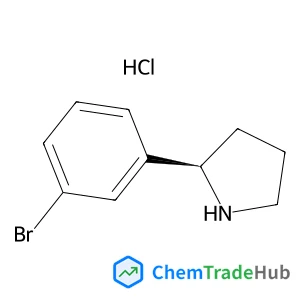
(2R)-2-(3-Bromophenyl)pyrrolidine hydrochloride (1:1)
CAS Number:
1391550-13-2
Molecular Formula:
C10H13BrClN
Evidence is presented for the secondary nucleation of β-L-glutamic acid on the surface of the α-polymorph, using a combination of Scanning Electron Microscopy and Raman spectroscopy.
Dongdong Zhang, Yi Cao, Pan Zhang, Jiankang Liang, Ke Xue, Yong Xia, Zhengjian Qi
DOI: 10.1039/D1CP01526E
Simone Ghidinelli, Giuseppe Mazzeo, Stefan E. Boiadjiev, David A. Lightner
DOI: 10.1039/D1CP02571F
Laura Le Bras, Yves L. Dory, Benoît Champagne
DOI: 10.1039/D1CP02675E
Muhammad Hamid Raza, Nicola Pinna, Nicola Donato, Giovanni Neri
DOI: 10.1039/D1CP00315A
Ying Wang, Yupeng Zhang, Dong Wang, Zhaohu Luo, Fengjiao Zhang
DOI: 10.1039/D1CP02541D
Diandong Tang, Lin Shen, Wei-Hai Fang
DOI: 10.1039/D1CP01374B
Jinyang Jiang, Le Guo, Luping Tang, Yu Zhang
DOI: 10.1039/D1CP03368A
Huimin Guo, Xiaolin Ma, Zhiwen Lei, Yang Qiu, Jianzhang Zhao, Bernhard Dick
DOI: 10.1039/D1CP01201K
Jordan M. Rabus, Robert P. Pellegrinelli, Ali Hassan Abi Khodr, Benjamin J. Bythell, Thomas R. Rizzo, Eduardo Carrascosa
DOI: 10.1039/D1CP01058A
M. Hussein N. Assadi, José Julio Gutiérrez Moreno, Dorian A. H. Hanaor, Hiroshi Katayama-Yoshida
DOI: 10.1039/D1CP02164H
N-(4-Methoxybenzyl)-2-pyridinamine (CAS: 52818-63-0) is increasingly being used ...
When handling Ethyl 4-(2-chlorophenyl)-1,3-thiazole-2-carboxylate, appropriate p...
Diethyldiselane (CAS: 628-39-7) is classified under the Globally Harmonized Syst...
The market for oxocopper (CAS: 12053-18-8) is primarily driven by its use in cat...
The market for 5-{[(2-Methyl-2-propanyl)oxy]carbonyl}-5-azaspiro[2.4]heptane-7-c...
2-(1-Pyrrolidinyl)-4-pyridinamine is a chemical compound with the CAS number 359...
2-(3-Pyridinyl)-1-azabicyclo[2.2.2]octane (CAS: 91556-75-1) is a crystalline sol...
(S)-Alpha-allyl-proline hydrochloride is usually synthesized via a Wittig reacti...
3-Methyl-1,2-oxazole-5-carboxylic acid (CAS: 4857-42-5) is an organic compound w...
Lys-SMCC-DM1 is synthesized via a multi-step process involving the coupling of S...

ChemComm publishes urgent research which is of outstanding significance and interest to experts in the field, while also appealing to the journal’s broad chemistry readership. Our communication format is ideally suited to short, urgent studies that are of such importance that they require accelerated publication. Our scope covers all topics in chemistry, and research at the interface of chemistry and other disciplines (such as materials science, nanoscience, physics, engineering and biology) where there is a significant novelty in the chemistry aspects. Major topic areas covered include: Analytical Chemistry Catalysis Chemical Biology and medicinal chemistry Computational Chemistry and Machine Learning Energy and sustainable chemistry Environmental Chemistry Green Chemistry Inorganic Chemistry Materials Chemistry Nanoscience Organic Chemistry Physical Chemistry Polymer Chemistry Supramolecular Chemistry