












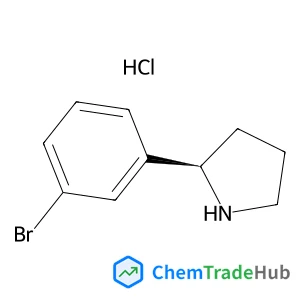
(2R)-2-(3-Bromophenyl)pyrrolidine hydrochloride (1:1)
CAS Number:
1391550-13-2
Molecular Formula:
C10H13BrClN
Muhammad Hamid Raza, Nicola Pinna, Nicola Donato, Giovanni Neri
We report CNT/Al2O3 core–shell nanostructures for the electrochemical detection of dihydroxybenzene (DHB) isomers. Amorphous films of Al2O3 (1.2–15.4 nm in thickness) are uniformly deposited onto the inner and outer walls of CNTs by atomic layer deposition. The effect of the Al2O3 shell thickness on the electrochemical detection of dihydroxybenzene isomers was explored using cyclic and square-wave voltammetry. The best sensing properties are found at a shell thickness of approx. 2.4 nm (CNT/Al2O3(9) sensor), where the oxidation peak currents (sensor-signal) increased ca. 10 times as compared to a sensor fabricated with non-coated CNTs. All of the three DHB isomers (hydroquinone, catechol and resorcinol) are independently detected in the concentration ranges of 2–1000 μmol L−1, 0.5–700 μmol L−1 and 3.5–500 μmol L−1, respectively. The sensors show reliable repeatability, reproducibility, long-term stability, and applicability in the analysis of real samples. Based on these findings, a plausible mechanism is proposed highlighting the role of the Al2O3–shell.
Titus S. Van Erp, Tom P. Caremans, Christine E. A. Kirschhock, Johan A. Martens
DOI: 10.1039/B614980D
Dieter Kranzlmüller, Jens Volkert, Siegfried Höfinger
DOI: 10.1039/B611200E
David C. Clary
DOI: 10.1039/B615660F
Stefan Laubach, Peter C. Schmidt, Andreas Thißen, Francisco Javier Fernandez-Madrigal, Qi-Hui Wu, Wolfram Jaegermann, Matthias Klemm, Siegfried Horn
DOI: 10.1039/B612489E
Fabio Ramondo, Luigi Bencivenni, Ruggero Caminiti, Andrea Pieretti, Lorenzo Gontrani
DOI: 10.1039/B617837E
A. R. W. McKellar, Dong H. Zhang
DOI: 10.1039/B614849B
N-(4-Methoxybenzyl)-2-pyridinamine (CAS: 52818-63-0) is increasingly being used ...
When handling Ethyl 4-(2-chlorophenyl)-1,3-thiazole-2-carboxylate, appropriate p...
Diethyldiselane (CAS: 628-39-7) is classified under the Globally Harmonized Syst...
The market for oxocopper (CAS: 12053-18-8) is primarily driven by its use in cat...
The market for 5-{[(2-Methyl-2-propanyl)oxy]carbonyl}-5-azaspiro[2.4]heptane-7-c...
2-(1-Pyrrolidinyl)-4-pyridinamine is a chemical compound with the CAS number 359...
2-(3-Pyridinyl)-1-azabicyclo[2.2.2]octane (CAS: 91556-75-1) is a crystalline sol...
(S)-Alpha-allyl-proline hydrochloride is usually synthesized via a Wittig reacti...
3-Methyl-1,2-oxazole-5-carboxylic acid (CAS: 4857-42-5) is an organic compound w...
Lys-SMCC-DM1 is synthesized via a multi-step process involving the coupling of S...

Physical Chemistry Chemical Physics (PCCP) is an international journal co-owned by 19 physical chemistry and physics societies from around the world. This journal publishes original, cutting-edge research in physical chemistry, chemical physics and biophysical chemistry. To be suitable for publication in PCCP, articles must include significant innovation and/or insight into physical chemistry; this is the most important criterion that reviewers and Editors will judge against when evaluating submissions. The journal has a broad scope and welcomes contributions spanning experiment, theory, computation and data science. Topical coverage includes spectroscopy, dynamics, kinetics, statistical mechanics, thermodynamics, electrochemistry, catalysis, surface science, quantum mechanics, quantum computing and machine learning. Interdisciplinary research areas such as polymers and soft matter, materials, nanoscience, energy, surfaces/interfaces, and biophysical chemistry are welcomed if they demonstrate significant innovation and/or insight into physical chemistry. Joined experimental/theoretical studies are particularly appreciated when complementary and based on up-to-date approaches.
![(2R,6S)-6-[(Benzyloxy)methyl]-4-{[(2-methyl-2-propanyl)oxy]carbonyl}-2-morpholinecarboxylic acid structure](https://static.chemtradehub.com/structs/109/1093085-91-6-3382.webp "(2R,6S)-6-[(Benzyloxy)methyl]-4-{[(2-methyl-2-propanyl)oxy]carbonyl}-2-morpholinecarboxylic acid structure")




