












First example of a taxane-derived propellane in Taxus canadensis needles
Literature Information
Publication Date
2002-11-28
DOI
10.1039/B209312J
Impact Factor
6.222
Authors
Qing Wen Shi, Françoise Sauriol, Orval Mamer, Lolita O. Zamir
View Original
Abstract
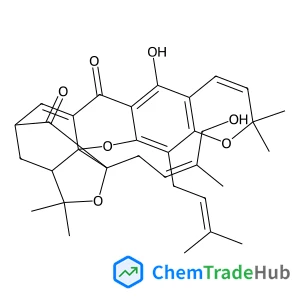
The first example of a propellane isolated from the needles of a yew is reported; the biogenesis from a putative taxane precursor is proposed.
Related Literature
A supercell approach to the doping effect on the thermoelectric properties of SnSe
2015-10-12
Paper
DOI: 10.1039/C5CP05151G
Intraparticulate speciation analysis of soft nanoparticulate metal complexes. The impact of electric condensation on the binding of Cd2+/Pb2+/Cu2+ by humic acids
Raewyn M. Town, Herman P. van Leeuwen
2016-03-17
Paper
DOI: 10.1039/C6CP01229A
A diminutive modification in arylamine electron donors: synthesis, photophysics and solvatochromic analysis – towards the understanding of dye sensitized solar cell performances
Venkatesan Srinivasan, Murugesan Panneer, Madhavan Jaccob, Nagaraj Pavithra, Sambandam Anandan, Arunkumar Kathiravan
2015-09-25
Paper
DOI: 10.1039/C5CP05338B
The making of ring currents
Guglielmo Monaco, Riccardo Zanasi
2016-01-11
Paper
DOI: 10.1039/C5CP07250F
Strong orbital deformation due to CH–π interaction in the benzene–methane complex
Jianfu Li, Rui-Qin Zhang
2015-10-19
Communication
DOI: 10.1039/C5CP04684J
The addition of CO2 to four superbase ionic liquids: a DFT study
Maxime Mercy, S. F. Rebecca Taylor, Johan Jacquemin, Christopher Hardacre, Robert G. Bell
2015-09-25
Paper
DOI: 10.1039/C5CP05153C
Aromatic stabilization of functionalized corannulene cations
Jingbai Li, Andrey Yu. Rogachev
2016-01-07
Paper
DOI: 10.1039/C5CP07002C
Ab initio molecular dynamics determination of competitive O2vs. N2 adsorption at open metal sites of M2(dobdc)
Marie V. Parkes, Jeffery A. Greathouse, David B. Hart, Dorina F. Sava Gallis, Tina M. Nenoff
2016-04-04
Paper
DOI: 10.1039/C6CP00768F
Formation of Li3O4 nano particles in the discharge products of non-aqueous lithium–oxygen batteries leads to lower charge overvoltage
L. Shi, A. Xu, T. S. Zhao
2015-10-02
Paper
DOI: 10.1039/C5CP03886C
Glass polymorphism in glycerol–water mixtures: I. A computer simulation study
David A. Jahn, Jessina Wong, Johannes Bachler, Thomas Loerting
2016-03-17
Paper
DOI: 10.1039/C6CP00075D
You might also like
Compound Q&A
What is the market or research trend for N-(4-Methoxybenzyl)-2-pyridinamine (CAS: 52818-63-0)?
N-(4-Methoxybenzyl)-2-pyridinamine (CAS: 52818-63-0) is increasingly being used ...
52818-63-0N-(4-Methoxybenzyl)-...
Compound Q&A
What precautions should be taken when handling Ethyl 4-(2-chlorophenyl)-1,3-thiazole-2-carboxylate (CAS: 1050507-06-6)?
When handling Ethyl 4-(2-chlorophenyl)-1,3-thiazole-2-carboxylate, appropriate p...
1050507-06-6Ethyl 4-(2-chlorophe...
Compound Q&A
What regulatory guidelines apply to diethyldiselane (CAS: 628-39-7)?
Diethyldiselane (CAS: 628-39-7) is classified under the Globally Harmonized Syst...
628-39-7Diethyldiselane
Compound Q&A
What is the market or research trend for oxocopper (CAS: 12053-18-8)?
The market for oxocopper (CAS: 12053-18-8) is primarily driven by its use in cat...
12053-18-8oxocopper; oxo-(oxoc...
Compound Q&A
What is the market or research trend for 5-{[(2-Methyl-2-propanyl)oxy]carbonyl}-5-azaspiro[2.4]heptane-7-carboxylic acid?
The market for 5-{[(2-Methyl-2-propanyl)oxy]carbonyl}-5-azaspiro[2.4]heptane-7-c...
1268519-54-55-{[(2-Methyl-2-prop...
Compound Q&A
What is 2-(1-Pyrrolidinyl)-4-pyridinamine (CAS: 35981-63-6)?
2-(1-Pyrrolidinyl)-4-pyridinamine is a chemical compound with the CAS number 359...
35981-63-62-(1-Pyrrolidinyl)-4...
Compound Q&A
What are the physical and chemical properties of 2-(3-Pyridinyl)-1-azabicyclo[2.2.2]octane (CAS: 91556-75-1)?
2-(3-Pyridinyl)-1-azabicyclo[2.2.2]octane (CAS: 91556-75-1) is a crystalline sol...
91556-75-12-(3-Pyridinyl)-1-az...
Compound Q&A
How is (S)-Alpha-allyl-proline hydrochloride (CAS: 129704-91-2) typically synthesized?
(S)-Alpha-allyl-proline hydrochloride is usually synthesized via a Wittig reacti...
129704-91-2(S)-Alpha-allyl-prol...
Compound Q&A
What is 3-Methyl-1,2-oxazole-5-carboxylic acid (CAS: 4857-42-5)?
3-Methyl-1,2-oxazole-5-carboxylic acid (CAS: 4857-42-5) is an organic compound w...
4857-42-53-Methyl-1,2-oxazole...
Compound Q&A
How is Lys-SMCC-DM1 (CAS: 1281816-04-3) typically synthesized?
Lys-SMCC-DM1 is synthesized via a multi-step process involving the coupling of S...
1281816-04-3Lys-SMCC-DM1
Source Journal
Chemical Communications

CiteScore:
8.6
Self-citation Rate:
4.7%
Articles per Year:
2458
ChemComm publishes urgent research which is of outstanding significance and interest to experts in the field, while also appealing to the journal’s broad chemistry readership. Our communication format is ideally suited to short, urgent studies that are of such importance that they require accelerated publication. Our scope covers all topics in chemistry, and research at the interface of chemistry and other disciplines (such as materials science, nanoscience, physics, engineering and biology) where there is a significant novelty in the chemistry aspects. Major topic areas covered include: Analytical Chemistry Catalysis Chemical Biology and medicinal chemistry Computational Chemistry and Machine Learning Energy and sustainable chemistry Environmental Chemistry Green Chemistry Inorganic Chemistry Materials Chemistry Nanoscience Organic Chemistry Physical Chemistry Polymer Chemistry Supramolecular Chemistry
Recommended Compounds
![N-{[(2-Methyl-2-propanyl)oxy]carbonyl}-L-methionylglycine structure](https://static.chemtradehub.com/structs/234/23446-03-9-e1e5.webp "N-{[(2-Methyl-2-propanyl)oxy]carbonyl}-L-methionylglycine structure")
N-{[(2-Methyl-2-propanyl)oxy]carbonyl}-L-methionylglycine
CAS Number:
23446-03-9
Molecular Formula:
C12H22N2O5S
Recommended Suppliers







Disclaimer
This page provides academic journal information for reference and research purposes only. We are not affiliated with any journal publishers and do not handle publication submissions. For publication-related inquiries, please contact the respective journal publishers directly.
If you notice any inaccuracies in the information displayed, please contact us at support@chemtradehub.com. We will promptly review and address your concerns.