












Ab initio molecular dynamics determination of competitive O2vs. N2 adsorption at open metal sites of M2(dobdc)
Literature Information
Publication Date
2016-04-04
DOI
10.1039/C6CP00768F
Impact Factor
3.676
Authors
Marie V. Parkes, Jeffery A. Greathouse, David B. Hart, Dorina F. Sava Gallis, Tina M. Nenoff
View Original
Abstract
The separation of oxygen from nitrogen using metal–organic frameworks (MOFs) is of great interest for potential pressure-swing adsorption processes for the generation of purified O2 on industrial scales. This study uses ab initio molecular dynamics (AIMD) simulations to examine for the first time the pure-gas and competitive gas adsorption of O2 and N2 in the M2(dobdc) (M = Cr, Mn, Fe) MOF series with coordinatively unsaturated metal centers. Effects of metal, temperature, and gas composition are explored. This unique application of AIMD allows us to study in detail the adsorption/desorption processes and to visualize the process of multiple guests competitively binding to coordinatively unsaturated metal sites of a MOF.
Related Literature
A highly hydrophilic cation exchange nonwoven with a further modifiable epoxy group prepared by radiation-induced graft polymerization
Xiao-han Pan, Jian-hua Zu
2021-09-17
Paper
DOI: 10.1039/D1PY00866H
Architecture transition of supramolecular polymers through hierarchical self-assembly: from supramolecular polymers to fluorescent materials
Riqiang Li, Wenzhuo Chen, Ying Yang, Hui Li, Fenfen Xu, Zhaozhao Duan, Tongxiang Liang, Herui Wen, Wei Tian
2020-07-30
Paper
DOI: 10.1039/D0PY00829J
Tunable hydantoin and base binary organocatalysts in ring-opening polymerizations
Lei Zhang, Fangyuan Zhou, Zhenjiang Li, Bo Liu, Rui Yan, Jie Li, Yongzhu Hu, Chan Zhang, Zikun Luo, Kai Guo
2020-07-28
Paper
DOI: 10.1039/D0PY00812E
High-performance polyamides with engineered disorder
Julien Cretenoud, Sandor Balog, Véronique Michaud, Jean-Marc Chenal, Olivier Lame, Christopher J. G. Plummer, Holger Frauenrath
2021-10-15
Paper
DOI: 10.1039/D1PY01225H
Propylene homopolymerization and copolymerization with ethylene by acenaphthene-based α-diimine nickel complexes to access EPR-like elastomers
Heng Liu, Chunyu Zhang, Xuequan Zhang
2021-10-12
Paper
DOI: 10.1039/D1PY00923K
Nanoengineering with RAFT polymers: from nanocomposite design to applications
Wentao Peng, Yingying Cai, Luise Fanslau, Philipp Vana
2021-10-20
Review Article
DOI: 10.1039/D1PY01172C
Role of thiol oxidation by air in the mechanism of the self-initiated thermal thiol–ene polymerization
2021-10-29
Paper
DOI: 10.1039/D1PY01301G
Development of physical, mechanical, antibacterial and cell growth properties of poly(glycerol sebacate urethane) (PGSU) with helping of curcumin and hydroxyapatite nanoparticles
Vafa Fakhri, Aliakbar Jafari, Mir Alireza Shafiei, Mohammad Vahid Ehteshamfar, Shima Khalighiyan, Hadi Hosseini, Vahabodin Goodarzi, Frederik R. Wurm, Mehrdad Moosazadeh Moghaddam
2021-10-19
Paper
DOI: 10.1039/D1PY01040A
BODIPY bearing alkylthienyl side chains: a new building block to design conjugated polymers with near infrared absorption for organic photovoltaics
Chuandong Dou
2020-08-05
Paper
DOI: 10.1039/D0PY00868K
You might also like
Compound Q&A
What is the market or research trend for N-(4-Methoxybenzyl)-2-pyridinamine (CAS: 52818-63-0)?
N-(4-Methoxybenzyl)-2-pyridinamine (CAS: 52818-63-0) is increasingly being used ...
52818-63-0N-(4-Methoxybenzyl)-...
Compound Q&A
What precautions should be taken when handling Ethyl 4-(2-chlorophenyl)-1,3-thiazole-2-carboxylate (CAS: 1050507-06-6)?
When handling Ethyl 4-(2-chlorophenyl)-1,3-thiazole-2-carboxylate, appropriate p...
1050507-06-6Ethyl 4-(2-chlorophe...
Compound Q&A
What regulatory guidelines apply to diethyldiselane (CAS: 628-39-7)?
Diethyldiselane (CAS: 628-39-7) is classified under the Globally Harmonized Syst...
628-39-7Diethyldiselane
Compound Q&A
What is the market or research trend for oxocopper (CAS: 12053-18-8)?
The market for oxocopper (CAS: 12053-18-8) is primarily driven by its use in cat...
12053-18-8oxocopper; oxo-(oxoc...
Compound Q&A
What is the market or research trend for 5-{[(2-Methyl-2-propanyl)oxy]carbonyl}-5-azaspiro[2.4]heptane-7-carboxylic acid?
The market for 5-{[(2-Methyl-2-propanyl)oxy]carbonyl}-5-azaspiro[2.4]heptane-7-c...
1268519-54-55-{[(2-Methyl-2-prop...
Compound Q&A
What is 2-(1-Pyrrolidinyl)-4-pyridinamine (CAS: 35981-63-6)?
2-(1-Pyrrolidinyl)-4-pyridinamine is a chemical compound with the CAS number 359...
35981-63-62-(1-Pyrrolidinyl)-4...
Compound Q&A
What are the physical and chemical properties of 2-(3-Pyridinyl)-1-azabicyclo[2.2.2]octane (CAS: 91556-75-1)?
2-(3-Pyridinyl)-1-azabicyclo[2.2.2]octane (CAS: 91556-75-1) is a crystalline sol...
91556-75-12-(3-Pyridinyl)-1-az...
Compound Q&A
How is (S)-Alpha-allyl-proline hydrochloride (CAS: 129704-91-2) typically synthesized?
(S)-Alpha-allyl-proline hydrochloride is usually synthesized via a Wittig reacti...
129704-91-2(S)-Alpha-allyl-prol...
Compound Q&A
What is 3-Methyl-1,2-oxazole-5-carboxylic acid (CAS: 4857-42-5)?
3-Methyl-1,2-oxazole-5-carboxylic acid (CAS: 4857-42-5) is an organic compound w...
4857-42-53-Methyl-1,2-oxazole...
Compound Q&A
How is Lys-SMCC-DM1 (CAS: 1281816-04-3) typically synthesized?
Lys-SMCC-DM1 is synthesized via a multi-step process involving the coupling of S...
1281816-04-3Lys-SMCC-DM1
Source Journal
Physical Chemistry Chemical Physics

CiteScore:
5.5
Self-citation Rate:
10.3%
Articles per Year:
3036
Physical Chemistry Chemical Physics (PCCP) is an international journal co-owned by 19 physical chemistry and physics societies from around the world. This journal publishes original, cutting-edge research in physical chemistry, chemical physics and biophysical chemistry. To be suitable for publication in PCCP, articles must include significant innovation and/or insight into physical chemistry; this is the most important criterion that reviewers and Editors will judge against when evaluating submissions. The journal has a broad scope and welcomes contributions spanning experiment, theory, computation and data science. Topical coverage includes spectroscopy, dynamics, kinetics, statistical mechanics, thermodynamics, electrochemistry, catalysis, surface science, quantum mechanics, quantum computing and machine learning. Interdisciplinary research areas such as polymers and soft matter, materials, nanoscience, energy, surfaces/interfaces, and biophysical chemistry are welcomed if they demonstrate significant innovation and/or insight into physical chemistry. Joined experimental/theoretical studies are particularly appreciated when complementary and based on up-to-date approaches.
Recommended Compounds
![1-{3-[4-Amino-3-(4-phenoxyphenyl)-1H-pyrazolo[3,4-d]pyrimidin-1-yl]-1-piperidinyl}-2,3-dihydroxy-1-propanone structure](https://static.chemtradehub.com/structs/122/1226872-27-0-e037.webp "1-{3-[4-Amino-3-(4-phenoxyphenyl)-1H-pyrazolo[3,4-d]pyrimidin-1-yl]-1-piperidinyl}-2,3-dihydroxy-1-propanone structure")
1-{3-[4-Amino-3-(4-phenoxyphenyl)-1H-pyrazolo[3,4-d]pyrimidin-1-yl]-1-piperidinyl}-2,3-dihydroxy-1-propanone
CAS Number:
1226872-27-0
Molecular Formula:
C25H26N6O4
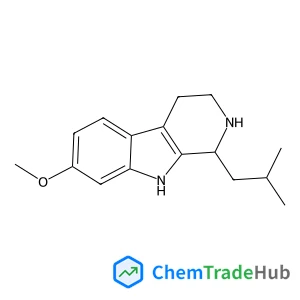
1-Isobutyl-7-methoxy-2,3,4,9-tetrahydro-1H-beta-carboline
CAS Number:
175975-76-5
Molecular Formula:
C16H22N2O
Recommended Suppliers






Disclaimer
This page provides academic journal information for reference and research purposes only. We are not affiliated with any journal publishers and do not handle publication submissions. For publication-related inquiries, please contact the respective journal publishers directly.
If you notice any inaccuracies in the information displayed, please contact us at support@chemtradehub.com. We will promptly review and address your concerns.