












The hydrogen-bonded cluster anions Br−···HCCH and I−···HCCH: results of coupled cluster calculations
Literature Information
Publication Date
2001-04-26
DOI
10.1039/B100549I
Impact Factor
3.676
Authors
Hermann Stoll
View Original
Abstract
Large-scale coupled cluster calculations at the CCSD(T) level of approximation have been carried out for the anionic complexes Br−···HCCH and I−···HCCH, both of which have a linear equilibrium structure. The equilibrium dissociation energies (De) are predicted to be 3126 and 2550 cm−1, respectively. Agreement with available experimental data, obtained through predissociation infrared spectroscopy, is very good. In addition, many predictions are made for spectroscopic properties of various isotopomers of the two species. Particular emphasis is given to the effects of vibrational anharmonicity, conveniently expressed by anharmonicity constants Xij and vibration–rotation coupling constants αr. Transition dipole moments were calculated for various stretching vibrational transitions.
Recommended Journals
Related Literature
Synthesis and reactions of the first fluoroalkylated Ni(ii) N-confused porphyrins
Hua-Wei Jiang, Qing-Yun Chen, Ji-Chang Xiao, Yu-Cheng Gu
2008-09-22
Communication
DOI: 10.1039/B811831K
First synthesis of N-[(aziridin-2-yl)methyl]benzimidazolequinone and analysis of toxicity towards normal and Fanconi anemia cells
Liz O’Donovan, Michael P. Carty, Fawaz Aldabbagh
2008-09-29
Communication
DOI: 10.1039/B814706J
(κ2-P,S)Pt(benzyl) complexes derived from 1/3-PiPr2-2-StBu-indene: facile synthesis of carbanion- and borate-containing zwitterions
Kevin D. Hesp, Robert McDonald, Michael J. Ferguson, Gabriele Schatte, Mark Stradiotto
2008-10-06
Communication
DOI: 10.1039/B813421A
SO2-promoted catalytic N2O removal over iron zeolites
Miguel A. G. Hevia, Sònia Abelló
2008-09-19
Communication
DOI: 10.1039/B811703A
Dendrimer design using CuI-catalyzed alkyne–azide “click-chemistry”
Grégory Franc, Ashok Kakkar
2008-09-17
Feature Article
DOI: 10.1039/B809870K
Bisucaberin biosynthesis: an adenylating domain of the BibC multi-enzyme catalyzes cyclodimerization of N-hydroxy-N-succinylcadaverine
2008-09-22
Communication
DOI: 10.1039/B813029A
Deprotonative cadmation of functionalized aromatics
Jean-Martial L’Helgoual’ch, Floris Chevallier, Mitsuhiro Yonehara, Masanobu Uchiyama, Aïcha Derdour, Florence Mongin
2008-09-17
Communication
DOI: 10.1039/B809543D
Binding enhancement of antigen-functionalized PEGylated gold nanoparticles onto antibody-immobilized surface by increasing the functionalized antigen using α-sulfanyl-ω-amino-PEG
Yuki Hoshino, Takehiko Ishii
2008-09-16
Communication
DOI: 10.1039/B811818C
Covalent surface modification of a metal–organic framework: selective surface engineering viaCuI-catalyzed Huisgen cycloaddition
Tendai Gadzikwa, Guang Lu, Charlotte L. Stern, Scott R. Wilson, Joseph T. Hupp, SonBinh T. Nguyen
2008-10-08
Communication
DOI: 10.1039/B805101A
You might also like
Compound Q&A
What are the main uses of 1H-Indazole-6-carbonitrile (CAS: 141290-59-7)?
1H-Indazole-6-carbonitrile finds applications in pharmaceuticals, where it serve...
141290-59-71H-Indazole-6-carbon...
Compound Q&A
How should waste containing Dioctyl (2E)-2-butenedioate (CAS: 2997-85-5) be handled?
Waste containing Dioctyl (2E)-2-butenedioate (CAS: 2997-85-5) should be collecte...
2997-85-5Dioctyl (2E)-2-buten...
Compound Q&A
What industries use Sodium [(1,2-benzoxazol-3-ylmethyl)sulfonyl]azanide (CAS: 68291-98-5)?
Sodium [(1,2-benzoxazol-3-ylmethyl)sulfonyl]azanide is primarily used in pharmac...
68291-98-5Sodium [(1,2-benzoxa...
Compound Q&A
Are there alternatives to Dimethyl 4-(4,4,5,5-tetramethyl-1,3,2-dioxaborolan-2-yl)-2,6-pyridinedicarboxylate (CAS: 741709-66-0) in synthesis?
Dimethyl 4-(4,4,5,5-tetramethyl-1,3,2-dioxaborolan-2-yl)-2,6-pyridinedicarboxyla...
741709-66-0Dimethyl 4-(4,4,5,5-...
Compound Q&A
How should waste containing 2-Fluoro-6-hydrazinopyridine (CAS: 80714-39-2) be handled?
Waste containing 2-Fluoro-6-hydrazinopyridine (CAS: 80714-39-2) should be manage...
80714-39-22-Fluoro-6-hydrazino...
Compound Q&A
What is 6-Formyl-2-pyridinecarboxylic acid (CAS: 499214-11-8)?
6-Formyl-2-pyridinecarboxylic acid is an organic compound with the molecular for...
499214-11-86-Formyl-2-pyridinec...
Compound Q&A
What is the market or research trend for 3-(3,4-dimethoxyphenyl)-2,5-dimethyl-N-(2-morpholin-4-ylethyl)pyrazolo[1,5-a]pyrimidin-7-amine (CAS: 900874-91-1)?
Research trends for this compound indicate a focus on its potential applications...
900874-91-13-(3,4-dimethoxyphen...
Compound Q&A
How is 9H-Tribenzo[b,d,f]azepine (CAS: 29875-73-8) typically synthesized?
9H-Tribenzo[b,d,f]azepine is typically synthesized via a multi-step process invo...
29875-73-89H-Tribenzo[b,d,f]az...
Compound Q&A
How is 1-Cyclopropyl-7-ethoxy-6-fluoro-8-methoxy-4-oxo-1,4-dihydro-3-quinolinecarboxylic acid (CAS: 1797982-51-4) typically synthesized?
1-Cyclopropyl-7-ethoxy-6-fluoro-8-methoxy-4-oxo-1,4-dihydro-3-quinolinecarboxyli...
1797982-51-41-Cyclopropyl-7-etho...
Compound Q&A
How should waste containing Methyl 3-oxo-1,2,3,4-tetrahydro-6-quinoxalinecarboxylate (CAS: 671820-52-3) be handled?
Waste containing Methyl 3-oxo-1,2,3,4-tetrahydro-6-quinoxalinecarboxylate (CAS: ...
671820-52-3Methyl 3-oxo-1,2,3,4...
Source Journal
Physical Chemistry Chemical Physics

CiteScore:
5.5
Self-citation Rate:
10.3%
Articles per Year:
3036
Physical Chemistry Chemical Physics (PCCP) is an international journal co-owned by 19 physical chemistry and physics societies from around the world. This journal publishes original, cutting-edge research in physical chemistry, chemical physics and biophysical chemistry. To be suitable for publication in PCCP, articles must include significant innovation and/or insight into physical chemistry; this is the most important criterion that reviewers and Editors will judge against when evaluating submissions. The journal has a broad scope and welcomes contributions spanning experiment, theory, computation and data science. Topical coverage includes spectroscopy, dynamics, kinetics, statistical mechanics, thermodynamics, electrochemistry, catalysis, surface science, quantum mechanics, quantum computing and machine learning. Interdisciplinary research areas such as polymers and soft matter, materials, nanoscience, energy, surfaces/interfaces, and biophysical chemistry are welcomed if they demonstrate significant innovation and/or insight into physical chemistry. Joined experimental/theoretical studies are particularly appreciated when complementary and based on up-to-date approaches.
Recommended Compounds
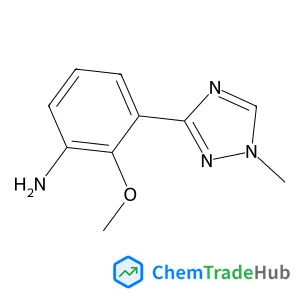
2-Methoxy-3-(1-methyl-1H-1,2,4-triazol-3-yl)aniline
CAS Number:
1609394-10-6
Molecular Formula:
C10H12N4O
Recommended Suppliers








Disclaimer
This page provides academic journal information for reference and research purposes only. We are not affiliated with any journal publishers and do not handle publication submissions. For publication-related inquiries, please contact the respective journal publishers directly.
If you notice any inaccuracies in the information displayed, please contact us at support@chemtradehub.com. We will promptly review and address your concerns.