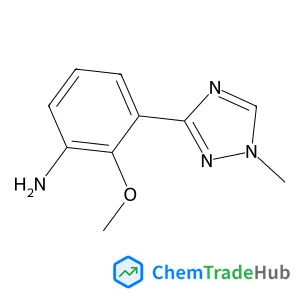
2-Methoxy-3-(1-methyl-1H-1,2,4-triazol-3-yl)aniline
CAS Number:
1609394-10-6
Molecular Formula:
C10H12N4O
Hua-Wei Jiang, Qing-Yun Chen, Ji-Chang Xiao, Yu-Cheng Gu
The first fluoroalkylated Ni(II) N-confused porphyrins were synthesized with high regioselectivity and its further alkylation was studied.
David E. Bergbreiter, Jun Li
DOI: 10.1039/B312368E
Christian Serre, Francis Taulelle, Gérard Ferey
DOI: 10.1039/B304703B
Vitaliy L. Budarin, James H. Clark, Stewart J. Tavener
DOI: 10.1039/B315005D
Lee J. Higham, P. Gabriel Kelly, David M. Corr, Helge Müller-Bunz, Brian J. Walker, Declan G. Gilheany
DOI: 10.1039/B316759C
Renata Bilewicz, Krzysztof Slowinski
DOI: 10.1039/B314815G
Qun Tang, Wenjia Zhou, Jianmin Shen, Wu Zhang, Lingfen Kong
DOI: 10.1039/B313387G
Jung Eun Yeo, Xiuling Yang, Hee Jin Kim, Sangho Koo
DOI: 10.1039/B311951C
Paul D. Beer, David P. Cormode, Jason J. Davis
DOI: 10.1039/B313658B
Ik-Hwan Um, Sang-Eun Jeon, Mi-Hwa Baek, Hye-Ran Park
DOI: 10.1039/B310055C
Ben A. Leita, Boujemaa Moubaraki, Keith S. Murray, Jonathan P. Smith, John D. Cashion
DOI: 10.1039/B311818E
1H-Indazole-6-carbonitrile finds applications in pharmaceuticals, where it serve...
Waste containing Dioctyl (2E)-2-butenedioate (CAS: 2997-85-5) should be collecte...
Sodium [(1,2-benzoxazol-3-ylmethyl)sulfonyl]azanide is primarily used in pharmac...
Dimethyl 4-(4,4,5,5-tetramethyl-1,3,2-dioxaborolan-2-yl)-2,6-pyridinedicarboxyla...
Waste containing 2-Fluoro-6-hydrazinopyridine (CAS: 80714-39-2) should be manage...
6-Formyl-2-pyridinecarboxylic acid is an organic compound with the molecular for...
Research trends for this compound indicate a focus on its potential applications...
9H-Tribenzo[b,d,f]azepine is typically synthesized via a multi-step process invo...
1-Cyclopropyl-7-ethoxy-6-fluoro-8-methoxy-4-oxo-1,4-dihydro-3-quinolinecarboxyli...
Waste containing Methyl 3-oxo-1,2,3,4-tetrahydro-6-quinoxalinecarboxylate (CAS: ...

ChemComm publishes urgent research which is of outstanding significance and interest to experts in the field, while also appealing to the journal’s broad chemistry readership. Our communication format is ideally suited to short, urgent studies that are of such importance that they require accelerated publication. Our scope covers all topics in chemistry, and research at the interface of chemistry and other disciplines (such as materials science, nanoscience, physics, engineering and biology) where there is a significant novelty in the chemistry aspects. Major topic areas covered include: Analytical Chemistry Catalysis Chemical Biology and medicinal chemistry Computational Chemistry and Machine Learning Energy and sustainable chemistry Environmental Chemistry Green Chemistry Inorganic Chemistry Materials Chemistry Nanoscience Organic Chemistry Physical Chemistry Polymer Chemistry Supramolecular Chemistry