












Vacuum ultraviolet photochemistry of methane, silane and germane
Literature Information
Publication Date
2001-04-30
DOI
10.1039/B100248L
Impact Factor
3.676
Authors
Phillip A. Cook, Michael N. R. Ashfold, Yun-Jung Jee, Kyung-Hoon Jung, Stephen Harich, Xueming Yang
View Original
Abstract
The photochemistry of jet-cooled CH4, SiH4 and GeH4 molecules following excitation at the Lyman-α wavelength (121.6 nm) has been investigated by high resolution photofragment translational spectroscopy methods. Complementary ab initio calculations of selected portions of the potential energy surfaces for the various components of the 1T2 and 3T2 excited states arising from the 3sa1←1t2 electron promotion are presented in the case of CH4. The form of the H atom recoil velocity distribution arising in the 121.6 nm photolysis of CH4 is rationalised in terms of initial excitation to both the 21A′ and 11A″ excited states (Jahn–Teller components of the degenerate 1T2 state), followed by a range of decay mechanisms. CH4(21A′) molecules can decay adiabatically, ia sequential extension of first one, then a second, C–H bond with eventual formation of two H atoms and CH2(ã1A1) products, or after internal conversion (IC) to the ground state. The H + CH3() products resulting from the IC process display a recoil velocity distribution characterised by an anisotropy parameter β∽ + 2, implying that the fragmentation involves irreversible extension of the C–H bond along which the transition dipole points at the instant of photon absorption. Fragmentation of CH4(11A″) molecules to H + CH3() products proceeds ia intersystem crossing to the lowest 3A′ potential energy surface. The recoil anisotropy of these products (β∽ − 0.45) implies that this radiationless process also occurs on a timescale that is rapid compared to the parent rotational period. Both single H–C bond fission channels may yield CH3() products with such high levels of internal excitation that they are unstable with respect to further unimolecular decay; any H atoms that result from this secondary decay must contribute to the observed yield of slow H atoms with β∽0. All H atoms resulting from Lyman-α photolysis of both SiH4 and GeH4 have (low) kinetic energies and little or no recoil anisotropy, compatible with their being formed ia three body fragmentation to, primarily, H + H + SiH2/GeH2(1A1) products. Faster H atoms are evident in the total kinetic energy release (TKER) spectra obtained following 157.6 nm photoexcitation of SiH4, but the power dependence of this fast H atom signal implies that these arise as a result of a two photon process involving initial formation of SiH2 + H2 products and subsequent photolysis of the nascent silylene fragments.
Recommended Journals
Related Literature
Quantifying the fraction of glycine and alanine in β-sheet and helical conformations in spider dragline silk using solid-state NMR
Gregory P. Holland, Janelle E. Jenkins, Melinda S. Creager, Randolph V. Lewis, Jeffery L. Yarger
2008-09-29
Communication
DOI: 10.1039/B812928B
Stacking of double bonds for photochemical [2+2] cycloaddition reactions in the solid state
Mangayarkarasi Nagarathinam, Abdul Malik Puthan Peedikakkal, Jagadese J. Vittal
2008-09-01
Feature Article
DOI: 10.1039/B809136F
A simple route to novel D spherosilicones; the first crystallographic structures of D6 and D8 cages
Alan R. Bassindale, Zhihua Liu, Peter G. Taylor, Peter N. Horton, Michael B. Hursthouse
2008-09-29
Communication
DOI: 10.1039/B808456D
Snowman-like silver alkynyl cluster consolidated by templating chloride and peripheral trifluoroacetates
Shu-Dan Bian, Quan-Ming Wang
2008-09-25
Communication
DOI: 10.1039/B812451E
Developing DNA tiles for oligonucleotide hybridization assay with higher accuracy and efficiency
Yonggang Ke, Jeanette Nangreave, Hao Yan, Stuart Lindsay, Yan Liu
2008-09-29
Communication
DOI: 10.1039/B811332G
Fabrication of porous carbon nanotube network
Jun-Wei Su, Shu-Juan Fu, Shangjr Gwo, Kuna-Jiuh Lin
2008-10-08
Communication
DOI: 10.1039/B812868E
(κ2-P,S)Pt(benzyl) complexes derived from 1/3-PiPr2-2-StBu-indene: facile synthesis of carbanion- and borate-containing zwitterions
Kevin D. Hesp, Robert McDonald, Michael J. Ferguson, Gabriele Schatte, Mark Stradiotto
2008-10-06
Communication
DOI: 10.1039/B813421A
99m-Technetium carbohydrate conjugates as potential agents in molecular imaging
Meryn L. Bowen, Chris Orvig
2008-09-12
Feature Article
DOI: 10.1039/B809365B
You might also like
Compound Q&A
What are the main uses of 1H-Indazole-6-carbonitrile (CAS: 141290-59-7)?
1H-Indazole-6-carbonitrile finds applications in pharmaceuticals, where it serve...
141290-59-71H-Indazole-6-carbon...
Compound Q&A
How should waste containing Dioctyl (2E)-2-butenedioate (CAS: 2997-85-5) be handled?
Waste containing Dioctyl (2E)-2-butenedioate (CAS: 2997-85-5) should be collecte...
2997-85-5Dioctyl (2E)-2-buten...
Compound Q&A
What industries use Sodium [(1,2-benzoxazol-3-ylmethyl)sulfonyl]azanide (CAS: 68291-98-5)?
Sodium [(1,2-benzoxazol-3-ylmethyl)sulfonyl]azanide is primarily used in pharmac...
68291-98-5Sodium [(1,2-benzoxa...
Compound Q&A
Are there alternatives to Dimethyl 4-(4,4,5,5-tetramethyl-1,3,2-dioxaborolan-2-yl)-2,6-pyridinedicarboxylate (CAS: 741709-66-0) in synthesis?
Dimethyl 4-(4,4,5,5-tetramethyl-1,3,2-dioxaborolan-2-yl)-2,6-pyridinedicarboxyla...
741709-66-0Dimethyl 4-(4,4,5,5-...
Compound Q&A
How should waste containing 2-Fluoro-6-hydrazinopyridine (CAS: 80714-39-2) be handled?
Waste containing 2-Fluoro-6-hydrazinopyridine (CAS: 80714-39-2) should be manage...
80714-39-22-Fluoro-6-hydrazino...
Compound Q&A
What is 6-Formyl-2-pyridinecarboxylic acid (CAS: 499214-11-8)?
6-Formyl-2-pyridinecarboxylic acid is an organic compound with the molecular for...
499214-11-86-Formyl-2-pyridinec...
Compound Q&A
What is the market or research trend for 3-(3,4-dimethoxyphenyl)-2,5-dimethyl-N-(2-morpholin-4-ylethyl)pyrazolo[1,5-a]pyrimidin-7-amine (CAS: 900874-91-1)?
Research trends for this compound indicate a focus on its potential applications...
900874-91-13-(3,4-dimethoxyphen...
Compound Q&A
How is 9H-Tribenzo[b,d,f]azepine (CAS: 29875-73-8) typically synthesized?
9H-Tribenzo[b,d,f]azepine is typically synthesized via a multi-step process invo...
29875-73-89H-Tribenzo[b,d,f]az...
Compound Q&A
How is 1-Cyclopropyl-7-ethoxy-6-fluoro-8-methoxy-4-oxo-1,4-dihydro-3-quinolinecarboxylic acid (CAS: 1797982-51-4) typically synthesized?
1-Cyclopropyl-7-ethoxy-6-fluoro-8-methoxy-4-oxo-1,4-dihydro-3-quinolinecarboxyli...
1797982-51-41-Cyclopropyl-7-etho...
Compound Q&A
How should waste containing Methyl 3-oxo-1,2,3,4-tetrahydro-6-quinoxalinecarboxylate (CAS: 671820-52-3) be handled?
Waste containing Methyl 3-oxo-1,2,3,4-tetrahydro-6-quinoxalinecarboxylate (CAS: ...
671820-52-3Methyl 3-oxo-1,2,3,4...
Source Journal
Physical Chemistry Chemical Physics

CiteScore:
5.5
Self-citation Rate:
10.3%
Articles per Year:
3036
Physical Chemistry Chemical Physics (PCCP) is an international journal co-owned by 19 physical chemistry and physics societies from around the world. This journal publishes original, cutting-edge research in physical chemistry, chemical physics and biophysical chemistry. To be suitable for publication in PCCP, articles must include significant innovation and/or insight into physical chemistry; this is the most important criterion that reviewers and Editors will judge against when evaluating submissions. The journal has a broad scope and welcomes contributions spanning experiment, theory, computation and data science. Topical coverage includes spectroscopy, dynamics, kinetics, statistical mechanics, thermodynamics, electrochemistry, catalysis, surface science, quantum mechanics, quantum computing and machine learning. Interdisciplinary research areas such as polymers and soft matter, materials, nanoscience, energy, surfaces/interfaces, and biophysical chemistry are welcomed if they demonstrate significant innovation and/or insight into physical chemistry. Joined experimental/theoretical studies are particularly appreciated when complementary and based on up-to-date approaches.
Recommended Compounds
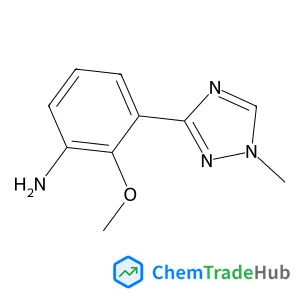
2-Methoxy-3-(1-methyl-1H-1,2,4-triazol-3-yl)aniline
CAS Number:
1609394-10-6
Molecular Formula:
C10H12N4O
Recommended Suppliers




Disclaimer
This page provides academic journal information for reference and research purposes only. We are not affiliated with any journal publishers and do not handle publication submissions. For publication-related inquiries, please contact the respective journal publishers directly.
If you notice any inaccuracies in the information displayed, please contact us at support@chemtradehub.com. We will promptly review and address your concerns.