












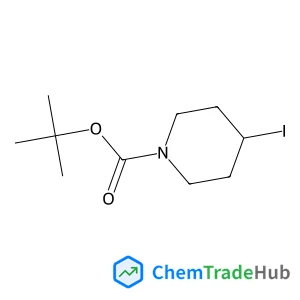
2-Methyl-2-propanyl 4-iodo-1-piperidinecarboxylate
CAS Number:
301673-14-3
Molecular Formula:
C10H18INO2
R. Becerra, J. P. Cannady, R. Walsh
Time-resolved studies of the title reaction, employing both SiH2 and SiD2, have been carried out over the pressure range 1–100 Torr (with SF6 as bath gas) at five temperatures in the range 297–599 K, using laser flash photolysis to generate and monitor both silylene species. The second order rate constants obtained were pressure dependent indicating that the reaction is a third-body assisted association process. The high pressure rate constants, obtained by extrapolation, gave the following Arrhenius parameters: log(A/cm3 molecule−1 s−1) = − 10.10 ± 0.06, Ea = − 3.91 ± 0.47 kJ mol−1, where the uncertainties are single standard deviations. The parameters are consistent with a fast association process occurring at close to the collision rate. RRKM modelling, based on a transition state appropriate to formation of a three-membered ring product, 3-methylsiloxirane, and employing a weak collisional deactivation model gives reasonable fits to the pressure dependent curves for ΔH°/kJ mol−1 in the range − 215 to − 245. Ab initio calculations at the G2 level indicate the inital formation of a silacarbonyl ylid which can then either form the siloxirane by ring closure, rearrange to form siloxyethene or give ethoxysilylene. Fuller details of the potential surface are given. The energetics are reasonably consistent with siloxirane formation representing the main pathway. The isotope effects are small and close to unity, indicating that secondary isotopic label scrambling, by the reversible ring opening of the siloxirane to ethoxysilylene is not occurring. Differences with the silirane system can be explained by the stabilization of a silylene by an alkoxy substituent.
John L. Provis, Breaunnah Bloomer, Neil J. Henson, Katharine Page
DOI: 10.1039/C3CP44342F
Anna Kubacka, Ana Iglesias-Juez, M. Di Michiel, Mark A. Newton, Marcos Fernández-García
DOI: 10.1039/C3CP44293D
Rajamani Krishna, Jasper M. van Baten
DOI: 10.1039/C3CP50449B
Jakub Goclon, Bernd Meyer
DOI: 10.1039/C3CP44546A
George Hasegawa, Mai Sannohe, Yuya Ishihara, Kazuyoshi Kanamori, Kazuki Nakanishi, Takeshi Abe
DOI: 10.1039/C3CP50352F
Yuriy I. Prylutskyy, Anatoly S. Buchelnikov, Dmitry P. Voronin, Viktor V. Kostjukov, Uwe Ritter, John A. Parkinson, Maxim P. Evstigneev
DOI: 10.1039/C3CP50187F
Andrew J. Atkins, Matthias Bauer, Christoph R. Jacob
DOI: 10.1039/C3CP50999K
Jonathan Keating, Gopinathan Sankar, Timothy I. Hyde, Shinji Kohara, Koji Ohara
DOI: 10.1039/C3CP50600B
Gitanjali Rai, Anil Kumar
DOI: 10.1039/C3CP50314C
Ane K. di Gennaro, Leonid Gurevich, Esben Skovsen, Michael T. Overgaard, Peter Fojan
DOI: 10.1039/C3CP50742D
Waste containing (6-Bromo-2-naphthyl)oxy](dimethyl)(2-methyl-2-propanyl)silane (...
7-Fluoro-4-isoquinolinecarboxylic acid can be synthesized via a multi-step proce...
2,3,5,6-Tetrabromothieno[3,2-b]thiophene is a crystalline compound with a high m...
1-[4-(Benzylamino)-7,8-dihydro-5H-pyrano[4,3-d]pyrimidin-2-yl]-2-methyl-1H-indol...
The market for imidazo[5,1-d]-1,2,3,5-tetrazine-8-carboxylic acid, 3,4-dihydro-3...
3-(Triisopropylsilyl)propiolaldehyde is a synthetic organic compound with the CA...
6-Nitro-2H-1,4-benzoxazin-3(4H)-one (CAS: 81721-87-1) is subject to various regu...
Waste containing (3-Fluorophenyl)(4-{[(2-methyl-2-propanyl)oxy]carbonyl}-1-piper...
N,N'-4,4'-Biphenyldiyldiisonicotinamide is a white crystalline solid with a mole...
6-Bromo-8-fluoro-2-quinazolinol is primarily used in the pharmaceutical industry...

Physical Chemistry Chemical Physics (PCCP) is an international journal co-owned by 19 physical chemistry and physics societies from around the world. This journal publishes original, cutting-edge research in physical chemistry, chemical physics and biophysical chemistry. To be suitable for publication in PCCP, articles must include significant innovation and/or insight into physical chemistry; this is the most important criterion that reviewers and Editors will judge against when evaluating submissions. The journal has a broad scope and welcomes contributions spanning experiment, theory, computation and data science. Topical coverage includes spectroscopy, dynamics, kinetics, statistical mechanics, thermodynamics, electrochemistry, catalysis, surface science, quantum mechanics, quantum computing and machine learning. Interdisciplinary research areas such as polymers and soft matter, materials, nanoscience, energy, surfaces/interfaces, and biophysical chemistry are welcomed if they demonstrate significant innovation and/or insight into physical chemistry. Joined experimental/theoretical studies are particularly appreciated when complementary and based on up-to-date approaches.
![5-Bromoimidazo[1,2-a]pyridine structure](https://static.chemtradehub.com/structs/692/69214-09-1-d8e2.webp "5-Bromoimidazo[1,2-a]pyridine structure")




