












Complex vibrational correlation functions extracted from the resolved ν2 band of liquid acetonitrile
Literature Information
Publication Date
2001-04-06
DOI
10.1039/B009501J
Impact Factor
3.676
Authors
Dmitry Nerukh, Trevor R. Griffiths
View Original
Abstract
The development of a sophisticated model is presented for fitting the experimental Raman spectra of liquid acetonitrile. A new approach for extracting all possible band shape details of highly overlapping spectral bands is derived and implemented. A unique, statistically justified resolution is obtained of the ν2 vibrational band into its components at 25, 50 and 75°C. The parameters of both the real and imaginary parts of the vibrational correlation functions are reported for the first time together with their confidence intervals. The quantitative characteristics obtained of the ν2 mode dynamics can be considered as experimental data and used for testing theoretical models of vibrational relaxation.
Related Literature
99m-Technetium carbohydrate conjugates as potential agents in molecular imaging
Meryn L. Bowen, Chris Orvig
2008-09-12
Feature Article
DOI: 10.1039/B809365B
Heterocirculenes as a new class of organic semiconductors
Fabio Cicoira, Konstantin Yu. Chernichenko, Elizabeth S. Balenkova, Federico Rosei, Valentine G. Nenajdenko, Dmitrii F. Perepichka
2008-09-19
Communication
DOI: 10.1039/B809259A
Crystallographic characterization and identification of a minor isomer of C84fullerene
Lars Epple, Konstantin Amsharov, Kalin Simeonov, Ina Dix, Martin Jansen
2008-09-26
Communication
DOI: 10.1039/B811872H
Synthesis of 3-hydroxy-1-alkenylboronates viaphosphine stabilized borylzirconacyclopropenes‡
Alina Botvinik, Abraham Rubinstein, Morris Srebnik
2008-09-29
Communication
DOI: 10.1039/B811287H
Bisucaberin biosynthesis: an adenylating domain of the BibC multi-enzyme catalyzes cyclodimerization of N-hydroxy-N-succinylcadaverine
2008-09-22
Communication
DOI: 10.1039/B813029A
A two-step spin crossover mononuclear iron(ii) complex with a [HS–LS–LS] intermediate phase
Sylvestre Bonnet, Maxime A. Siegler, José Sánchez Costa, Gábor Molnár, Azzedine Bousseksou, Anthony L. Spek, Patrick Gamez, Jan Reedijk
2008-09-29
Communication
DOI: 10.1039/B811746B
Enhanced carbohydrate structural selectivity in ion mobility-mass spectrometry analyses by boronic acid derivatization
Larissa S. Fenn, John A. McLean
2008-09-22
Communication
DOI: 10.1039/B810421B
The first chemoselective tandem acylation of the Blaise reaction intermediate: a novel method for the synthesis of α-acyl-β-enamino esters, key intermediate for pyrazoles
Yu Sung Chun, Ki Kon Lee, Young Ok Ko, Hyunik Shin, Sang-gi Lee
2008-09-23
Communication
DOI: 10.1039/B813369G
You might also like
Compound Q&A
What are the main uses of 1H-Indazole-6-carbonitrile (CAS: 141290-59-7)?
1H-Indazole-6-carbonitrile finds applications in pharmaceuticals, where it serve...
141290-59-71H-Indazole-6-carbon...
Compound Q&A
How should waste containing Dioctyl (2E)-2-butenedioate (CAS: 2997-85-5) be handled?
Waste containing Dioctyl (2E)-2-butenedioate (CAS: 2997-85-5) should be collecte...
2997-85-5Dioctyl (2E)-2-buten...
Compound Q&A
What industries use Sodium [(1,2-benzoxazol-3-ylmethyl)sulfonyl]azanide (CAS: 68291-98-5)?
Sodium [(1,2-benzoxazol-3-ylmethyl)sulfonyl]azanide is primarily used in pharmac...
68291-98-5Sodium [(1,2-benzoxa...
Compound Q&A
Are there alternatives to Dimethyl 4-(4,4,5,5-tetramethyl-1,3,2-dioxaborolan-2-yl)-2,6-pyridinedicarboxylate (CAS: 741709-66-0) in synthesis?
Dimethyl 4-(4,4,5,5-tetramethyl-1,3,2-dioxaborolan-2-yl)-2,6-pyridinedicarboxyla...
741709-66-0Dimethyl 4-(4,4,5,5-...
Compound Q&A
How should waste containing 2-Fluoro-6-hydrazinopyridine (CAS: 80714-39-2) be handled?
Waste containing 2-Fluoro-6-hydrazinopyridine (CAS: 80714-39-2) should be manage...
80714-39-22-Fluoro-6-hydrazino...
Compound Q&A
What is 6-Formyl-2-pyridinecarboxylic acid (CAS: 499214-11-8)?
6-Formyl-2-pyridinecarboxylic acid is an organic compound with the molecular for...
499214-11-86-Formyl-2-pyridinec...
Compound Q&A
What is the market or research trend for 3-(3,4-dimethoxyphenyl)-2,5-dimethyl-N-(2-morpholin-4-ylethyl)pyrazolo[1,5-a]pyrimidin-7-amine (CAS: 900874-91-1)?
Research trends for this compound indicate a focus on its potential applications...
900874-91-13-(3,4-dimethoxyphen...
Compound Q&A
How is 9H-Tribenzo[b,d,f]azepine (CAS: 29875-73-8) typically synthesized?
9H-Tribenzo[b,d,f]azepine is typically synthesized via a multi-step process invo...
29875-73-89H-Tribenzo[b,d,f]az...
Compound Q&A
How is 1-Cyclopropyl-7-ethoxy-6-fluoro-8-methoxy-4-oxo-1,4-dihydro-3-quinolinecarboxylic acid (CAS: 1797982-51-4) typically synthesized?
1-Cyclopropyl-7-ethoxy-6-fluoro-8-methoxy-4-oxo-1,4-dihydro-3-quinolinecarboxyli...
1797982-51-41-Cyclopropyl-7-etho...
Compound Q&A
How should waste containing Methyl 3-oxo-1,2,3,4-tetrahydro-6-quinoxalinecarboxylate (CAS: 671820-52-3) be handled?
Waste containing Methyl 3-oxo-1,2,3,4-tetrahydro-6-quinoxalinecarboxylate (CAS: ...
671820-52-3Methyl 3-oxo-1,2,3,4...
Source Journal
Physical Chemistry Chemical Physics

CiteScore:
5.5
Self-citation Rate:
10.3%
Articles per Year:
3036
Physical Chemistry Chemical Physics (PCCP) is an international journal co-owned by 19 physical chemistry and physics societies from around the world. This journal publishes original, cutting-edge research in physical chemistry, chemical physics and biophysical chemistry. To be suitable for publication in PCCP, articles must include significant innovation and/or insight into physical chemistry; this is the most important criterion that reviewers and Editors will judge against when evaluating submissions. The journal has a broad scope and welcomes contributions spanning experiment, theory, computation and data science. Topical coverage includes spectroscopy, dynamics, kinetics, statistical mechanics, thermodynamics, electrochemistry, catalysis, surface science, quantum mechanics, quantum computing and machine learning. Interdisciplinary research areas such as polymers and soft matter, materials, nanoscience, energy, surfaces/interfaces, and biophysical chemistry are welcomed if they demonstrate significant innovation and/or insight into physical chemistry. Joined experimental/theoretical studies are particularly appreciated when complementary and based on up-to-date approaches.
Recommended Compounds
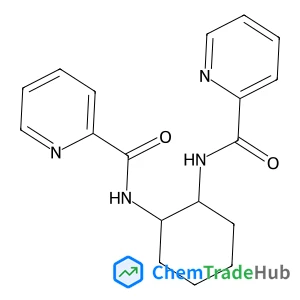
N,N'-(1R,2R)-1,2-Cyclohexanediyldi(2-pyridinecarboxamide)
CAS Number:
218290-24-5
Molecular Formula:
C18H20N4O2

Recommended Suppliers





Disclaimer
This page provides academic journal information for reference and research purposes only. We are not affiliated with any journal publishers and do not handle publication submissions. For publication-related inquiries, please contact the respective journal publishers directly.
If you notice any inaccuracies in the information displayed, please contact us at support@chemtradehub.com. We will promptly review and address your concerns.