



Investigation of spectral shifts of monomeric and J-aggregated cyanine dyes at high pressure by UV/Vis spectroscopy
Literature Information
Publication Date
2001-02-19
DOI
10.1039/B009185P
Impact Factor
3.676
Authors
Bernd Neumann, Peter Pollmann
View Original
Abstract
The solvent-induced and pressure-induced shifts (ν and Δν, respectively) of the absorption spectra of four different cyanine dyes (PIC, DYE A, C and D) in monomeric and J-aggregated form were investigated by UV/Vis spectroscopy. For the monomers, it has been confirmed that the refractive index, n, is of major influence when interpreting the spectral shifts. Quantitative analysis of the shifts of the monomeric dyes was performed in terms of Bayliss-parameters, F(n) = (n2 − 1)/(2n2 + 1), in the case of solvent variation and F′(n) = ρ/ρ0(n2 − 1)/(2n2 + 1) in the case of pressure variation. The respective shift coefficients of the monomers, dν/dF(n), were found to be the same within experimental error (−3700 ± 800 cm−1). The same is valid for dΔν/dF′(n), measured in ethane-1,2-diol (−2000 ± 200 cm−1). Additionally, the pressure coefficients, dΔν/dp, were evaluated for both the monomeric and the J-aggregated dyes for better comparison to literature data. In contrast to the monomer values (−20 cm−1 kbar−1), the pressure coefficients for the J-aggregates obtained from measurements in water (−30 cm−1 kbar−1) are larger, in agreement with recent literature values. The different pressure behaviours of the monomers, compared to that of the J-aggregates, were attributed to the electronic interactions and changes in the specific arrangement of the molecules within the aggregates. For the pressure coefficients of the J-aggregates, a linear correlation has been found between dΔν/dp and an approximate dipolar coupling constant, J*, derived from the peak positions of the absorption spectra. Moreover, by extrapolation of the dΔν/dp values to J* = 0, the mean value equal to the same quantity for the monomers was found within experimental error. Comparison of this finding with recent literature values gave rough agreement. A supplemented form factor analysis of light scattering data for two representative J-aggregated dyes (PIC and DYE A) in aqueous solution at atmospheric pressure is consistent with rod-, worm- and coil-like aggregate structures, depending on the length of the aggregates.
Recommended Journals

Acta Metallurgica Sinica-English Letters

Bioorganic & Medicinal Chemistry Letters

Journal of the Indian Institute of Science

Cellulose

Critical Reviews in Solid State and Materials Sciences

Topics in Catalysis

Journal of Asian Natural Products Research

Colloid Journal

Heteroatom Chemistry

Polycyclic Aromatic Compounds
Related Literature
Silica nanoparticle monolayers on a macroion modified surface: formation mechanism and stability
M. Morga, Z. Adamczyk, D. Kosior
2017-07-27
Paper
DOI: 10.1039/C7CP03876C
Polarization transfer efficiency in PHIP experiments
M. Emondts, J. F. P. Colell, B. Blümich
2017-08-01
Communication
DOI: 10.1039/C7CP04296E
Unusual cis-diprotonated forms and fluorescent aggregates of non-peripherally alkoxy-substituted metallophthalocyanines
P. Kasprzycki, L. Sobotta, S. Lijewski, M. Wierzchowski, T. Goslinski, J. Mielcarek, C. Radzewicz, P. Fita
2017-07-24
Paper
DOI: 10.1039/C7CP04321J
Extending charge separation lifetime and distance in patterned dye-sensitized SnO2–TiO2 μm-thin films
Valeria Saavedra Becerril, Elin Sundin, Mokhtar Mapar, Maria Abrahamsson
2017-08-10
Paper
DOI: 10.1039/C7CP04486K
Long-range surface plasmon resonance and surface-enhanced Raman scattering on X-shaped gold plasmonic nanohole arrays
Daniel David Galvan, Guowen Meng, Qiuming Yu
2017-08-15
Paper
DOI: 10.1039/C7CP04564F
In situ probing of the crystallization kinetics of rr-P3HT on single layer graphene as a function of temperature
Nicolas Boulanger, Victor Yu, Michael Hilke, Michael F. Toney, David R. Barbero
2017-02-28
Paper
DOI: 10.1039/C6CP08589J
Complexation induced aggregation and deaggregation of acridine orange with sulfobutylether-β-cyclodextrin
Mhejabeen Sayed, Shruti Jha, Haridas Pal
2017-08-17
Paper
DOI: 10.1039/C7CP03135A
Cyclodextrin-assisted modulation of the photophysical properties and acidity constant of pyrene-armed calix[4]arene
V. S. Kalyani, D. D. Malkhede
2017-07-25
Paper
DOI: 10.1039/C7CP01894K
Tunable AIEE fluorescence constructed from a triphenylamine luminogen containing quinoline – application in a reversible and tunable pH sensor
Mengmeng Zhang, Wen Yang, Tingfeng Gong, Weiqun Zhou, Renyu Xue
2017-07-18
Paper
DOI: 10.1039/C7CP03234J
Graphitic carbon coupled poly(anthraquinone) for proton shuttle flow-in-a-cell application
Selvam Mathi, Rudra Kumar, Rajaram K. Nagarale, Ashutosh Sharma
2017-02-22
Paper
DOI: 10.1039/C6CP08419B
You might also like
Compound Q&A
What are the main uses of 4-Nitrophenyl phosphate disodium salt hexahydrate (CAS: 333338-18-4)?
4-Nitrophenyl phosphate disodium salt hexahydrate is primarily used as a substra...
333338-18-44-Nitrophenyl phosph...
Compound Q&A
What are the main uses of 2-(Trifluoromethyl)-1,3-oxazole-4-carboxylic Acid (CAS: 1060816-01-4)?
2-(Trifluoromethyl)-1,3-oxazole-4-carboxylic Acid (CAS: 1060816-01-4) is widely ...
1060816-01-42-(Trifluoromethyl)-...
Compound Q&A
How should 2-Fluoro-4-biphenylcarboxylic acid (CAS: 137045-30-8) be stored?
2-Fluoro-4-biphenylcarboxylic acid should be stored in a cool, dry place at room...
137045-30-82-Fluoro-4-biphenylc...
Compound Q&A
What industries use Prednisolone-21-Carboxylic Acid (CAS: 61549-70-0)?
Prednisolone-21-Carboxylic Acid is primarily used in the pharmaceutical industry...
61549-70-0Prednisolone-21-Carb...
Compound Q&A
How should 4-(Hydrazinomethyl)-1,2,3-benzenetriol (CAS: 3614-72-0) be stored?
4-(Hydrazinomethyl)-1,2,3-benzenetriol (CAS: 3614-72-0) should be stored in a co...
3614-72-04-(Hydrazinomethyl)-...
Compound Q&A
What industries use 4-Amino-1-methyl-1H-pyrazole-5-carboxylic acid hydrochloride (CAS: 92534-70-8)?
4-Amino-1-methyl-1H-pyrazole-5-carboxylic acid hydrochloride (CAS: 92534-70-8) i...
92534-70-84-Amino-1-methyl-1H-...
Compound Q&A
What regulatory guidelines apply to dehydropachymic acid (CAS: 77012-31-8)?
Dehydropachymic acid (CAS: 77012-31-8) is regulated by various agencies. It fall...
77012-31-8Dehydropachymic acid
Compound Q&A
What is the market or research trend for 6-[(2,2-Dimethylpropanoyl)amino]nicotinic acid (CAS: 898561-66-5)?
The market and research trends for 6-[(2,2-Dimethylpropanoyl)amino]nicotinic aci...
898561-66-56-[(2,2-Dimethylprop...
Compound Q&A
How should 1,10-Phenanthroline-2,9-dicarbaldehyde (CAS: 57709-62-3) be stored?
1,10-Phenanthroline-2,9-dicarbaldehyde should be stored in a cool, dry place awa...
57709-62-31,10-Phenanthroline-...
Compound Q&A
How is 5-Carbamoyl-11-oxo-10,11-dihydro-5H-dibenzo[b,f]azepin-10-yl acetate (CAS: 113952-21-9) typically synthesized?
5-Carbamoyl-11-oxo-10,11-dihydro-5H-dibenzo[b,f]azepin-10-yl acetate can be synt...
113952-21-95-Carbamoyl-11-oxo-1...
Source Journal
Physical Chemistry Chemical Physics

CiteScore:
5.5
Self-citation Rate:
10.3%
Articles per Year:
3036
Physical Chemistry Chemical Physics (PCCP) is an international journal co-owned by 19 physical chemistry and physics societies from around the world. This journal publishes original, cutting-edge research in physical chemistry, chemical physics and biophysical chemistry. To be suitable for publication in PCCP, articles must include significant innovation and/or insight into physical chemistry; this is the most important criterion that reviewers and Editors will judge against when evaluating submissions. The journal has a broad scope and welcomes contributions spanning experiment, theory, computation and data science. Topical coverage includes spectroscopy, dynamics, kinetics, statistical mechanics, thermodynamics, electrochemistry, catalysis, surface science, quantum mechanics, quantum computing and machine learning. Interdisciplinary research areas such as polymers and soft matter, materials, nanoscience, energy, surfaces/interfaces, and biophysical chemistry are welcomed if they demonstrate significant innovation and/or insight into physical chemistry. Joined experimental/theoretical studies are particularly appreciated when complementary and based on up-to-date approaches.
Recommended Compounds
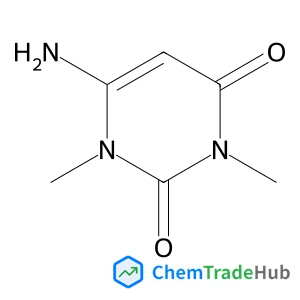
6-amino-1,3-dimethyl-1,2,3,4-tetrahydropyrimidine-2,4-dione
CAS Number:
6642-31-5
Molecular Formula:
C6H9N3O2
Recommended Suppliers






Disclaimer
This page provides academic journal information for reference and research purposes only. We are not affiliated with any journal publishers and do not handle publication submissions. For publication-related inquiries, please contact the respective journal publishers directly.
If you notice any inaccuracies in the information displayed, please contact us at support@chemtradehub.com. We will promptly review and address your concerns.