












Equilibrium and out-of-equilibrium (hysteretic) behavior of fluids in disordered porous materials: Theoretical predictions
Literature Information
Publication Date
2001-03-02
DOI
10.1039/B008636N
Impact Factor
3.676
Authors
View Original
Abstract
We study the relation between out-of-equilibrium (hysteretic) and equilibrium behavior in the capillary condensation of fluids in disordered mesoporous solids. Using mean-field density functional theory, we show that a simple lattice-gas model can reproduce the major experimental observations and that the classical van der Waals picture of metastability fails due the appearance of many metastable states. We find that (i) a true equilibrium capillary phase transition may occur when the perturbation induced by the solid is sufficiently small; (ii) hysteresis does not necessarily imply the existence of this phase transition; (iii) the disappearance of the hysteresis loop is not associated with capillary criticality; and (iv) thermodynamic consistency is violated along the adsorption–desorption isotherms.
Recommended Journals
Related Literature
Characterization of secondary phosphine oxide ligands on the surface of iridium nanoparticles
Israel Cano, Luis M. Martínez-Prieto, Pier F. Fazzini, Bruno Chaudret, Piet W. N. M. van Leeuwen
2017-07-28
Paper
DOI: 10.1039/C7CP03439C
Dispersion interactions in silicon allotropes
Antti J. Karttunen, Denis Usvyat, Martin Schütz, Lorenzo Maschio
2017-02-20
Paper
DOI: 10.1039/C6CP08873B
Coexistence of ice clusters and liquid-like water clusters on the Ru(0001) surface
Feng Liu, J. M. Sturm, Chris J. Lee, Fred Bijkerk
2017-02-24
Paper
DOI: 10.1039/C6CP07369G
Does the endohedral borospherene supersalt FLi2@B39 maintain the “super” properties of its subunits?
A. J. Stasyuk, M. Solà
2017-07-24
Communication
DOI: 10.1039/C7CP02550E
Surface configuration and wettability of nickel(oxy)hydroxides: a first-principles investigation
Axel Groß, Michael Eikerling
2017-07-25
Paper
DOI: 10.1039/C7CP03396F
Regulation of transport properties by polytypism: a computational study on bilayer MoS2
Swastika Banerjee, Cheol Seong Hwang, Jung-Hae Choi, Seung-Cheol Lee
2017-07-20
Communication
DOI: 10.1039/C7CP02973J
Unveiling anomalous CO2-to-N2 selectivity of graphene oxide
Ji Hoon Lee, Hyeon Jeong Lee, Jang Wook Choi
2017-08-08
Paper
DOI: 10.1039/C7CP04318J
On the critical Casimir interaction between anisotropic inclusions on a membrane
Jorge Benet, Fabien Paillusson, Halim Kusumaatmaja
2017-08-25
Paper
DOI: 10.1039/C7CP03874G
Ferrocene and ferrocenium inclusion compounds with cucurbiturils: a study of metal atom dynamics probed by Mössbauer spectroscopy
Clara I. R. Magalhães, Ana C. Gomes, André D. Lopes, Isabel S. Gonçalves, Martyn Pillinger, Eunyoung Jin, Ikjin Kim, Young Ho Ko, Israel Nowik, Rolfe H. Herber
2017-08-02
Paper
DOI: 10.1039/C7CP04416J
Mechanistic investigations of confinement effects on the self-assembly of symmetric amphiphilic copolymers in thin films
Dan Mu, Jian-Quan Li, Sheng-Yu Feng
2017-06-05
Paper
DOI: 10.1039/C7CP02019H
You might also like
Compound Q&A
What are the main uses of 4-Nitrophenyl phosphate disodium salt hexahydrate (CAS: 333338-18-4)?
4-Nitrophenyl phosphate disodium salt hexahydrate is primarily used as a substra...
333338-18-44-Nitrophenyl phosph...
Compound Q&A
What are the main uses of 2-(Trifluoromethyl)-1,3-oxazole-4-carboxylic Acid (CAS: 1060816-01-4)?
2-(Trifluoromethyl)-1,3-oxazole-4-carboxylic Acid (CAS: 1060816-01-4) is widely ...
1060816-01-42-(Trifluoromethyl)-...
Compound Q&A
How should 2-Fluoro-4-biphenylcarboxylic acid (CAS: 137045-30-8) be stored?
2-Fluoro-4-biphenylcarboxylic acid should be stored in a cool, dry place at room...
137045-30-82-Fluoro-4-biphenylc...
Compound Q&A
What industries use Prednisolone-21-Carboxylic Acid (CAS: 61549-70-0)?
Prednisolone-21-Carboxylic Acid is primarily used in the pharmaceutical industry...
61549-70-0Prednisolone-21-Carb...
Compound Q&A
How should 4-(Hydrazinomethyl)-1,2,3-benzenetriol (CAS: 3614-72-0) be stored?
4-(Hydrazinomethyl)-1,2,3-benzenetriol (CAS: 3614-72-0) should be stored in a co...
3614-72-04-(Hydrazinomethyl)-...
Compound Q&A
What industries use 4-Amino-1-methyl-1H-pyrazole-5-carboxylic acid hydrochloride (CAS: 92534-70-8)?
4-Amino-1-methyl-1H-pyrazole-5-carboxylic acid hydrochloride (CAS: 92534-70-8) i...
92534-70-84-Amino-1-methyl-1H-...
Compound Q&A
What regulatory guidelines apply to dehydropachymic acid (CAS: 77012-31-8)?
Dehydropachymic acid (CAS: 77012-31-8) is regulated by various agencies. It fall...
77012-31-8Dehydropachymic acid
Compound Q&A
What is the market or research trend for 6-[(2,2-Dimethylpropanoyl)amino]nicotinic acid (CAS: 898561-66-5)?
The market and research trends for 6-[(2,2-Dimethylpropanoyl)amino]nicotinic aci...
898561-66-56-[(2,2-Dimethylprop...
Compound Q&A
How should 1,10-Phenanthroline-2,9-dicarbaldehyde (CAS: 57709-62-3) be stored?
1,10-Phenanthroline-2,9-dicarbaldehyde should be stored in a cool, dry place awa...
57709-62-31,10-Phenanthroline-...
Compound Q&A
How is 5-Carbamoyl-11-oxo-10,11-dihydro-5H-dibenzo[b,f]azepin-10-yl acetate (CAS: 113952-21-9) typically synthesized?
5-Carbamoyl-11-oxo-10,11-dihydro-5H-dibenzo[b,f]azepin-10-yl acetate can be synt...
113952-21-95-Carbamoyl-11-oxo-1...
Source Journal
Physical Chemistry Chemical Physics

CiteScore:
5.5
Self-citation Rate:
10.3%
Articles per Year:
3036
Physical Chemistry Chemical Physics (PCCP) is an international journal co-owned by 19 physical chemistry and physics societies from around the world. This journal publishes original, cutting-edge research in physical chemistry, chemical physics and biophysical chemistry. To be suitable for publication in PCCP, articles must include significant innovation and/or insight into physical chemistry; this is the most important criterion that reviewers and Editors will judge against when evaluating submissions. The journal has a broad scope and welcomes contributions spanning experiment, theory, computation and data science. Topical coverage includes spectroscopy, dynamics, kinetics, statistical mechanics, thermodynamics, electrochemistry, catalysis, surface science, quantum mechanics, quantum computing and machine learning. Interdisciplinary research areas such as polymers and soft matter, materials, nanoscience, energy, surfaces/interfaces, and biophysical chemistry are welcomed if they demonstrate significant innovation and/or insight into physical chemistry. Joined experimental/theoretical studies are particularly appreciated when complementary and based on up-to-date approaches.
Recommended Compounds
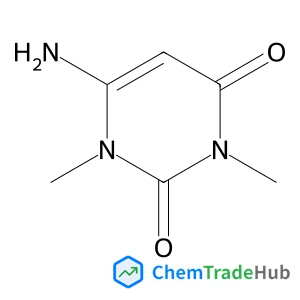
6-amino-1,3-dimethyl-1,2,3,4-tetrahydropyrimidine-2,4-dione
CAS Number:
6642-31-5
Molecular Formula:
C6H9N3O2
![5-Bromo-1H-pyrrolo[2,3-b]pyridine structure](https://static.chemtradehub.com/structs/183/183208-35-7-2d72.webp "5-Bromo-1H-pyrrolo[2,3-b]pyridine structure")
Recommended Suppliers




Disclaimer
This page provides academic journal information for reference and research purposes only. We are not affiliated with any journal publishers and do not handle publication submissions. For publication-related inquiries, please contact the respective journal publishers directly.
If you notice any inaccuracies in the information displayed, please contact us at support@chemtradehub.com. We will promptly review and address your concerns.