












Photoinduced electron transfer from excited [tris(2,2′-bipyridine)ruthenium(II)]2+ to a series of anthraquinones with small positive or negative Gibbs energy of reaction. Marcus behavior and negative activation enthalpies
Literature Information
Publication Date
DOI
10.1039/A902486G
Impact Factor
3.676
Authors
View Original
Abstract
In the electron transfer (ET) quenching reactions of electronically excited *Ru(bpy)32+ in acetonitrile an increase of the rate constant kq is observed in the series of 2-methyl-, 1-chloro-, and 1-nitro-anthraquinone as quenchers. If alkali salts are used as supporting electrolytes the AQ- radical anions are found to form specific associates with the alkali cations. In the presence of non-associating tetraalkylammonium salts the system follows the predictions of Marcus theory. Numerical methods are developed which allow the determination of the rate constants of the conventional reaction scheme. This analysis shows that the quantum yield of free AQ- radical anion formation is governed by the interplay of forward, reverse and back ET. Negative activation enthalpies are found for the activation controlled quenching reactions. From the numerical analysis of the system of rate constants it is inferred that this phenomenon is due to the elementary ET step in the reaction sequence. We discuss the pre-equilibrium and elementary reaction models for reactions with negative activation enthalpy and present, to our knowledge, the first example of successful discrimination between them.
Related Literature
Yttrium alkyl complexes with a sterically demanding benzamidinate ligand: synthesis, structure and catalytic ethene polymerisation
Sergio Bambirra, Daan van Leusen, Auke Meetsma, Bart Hessen, Jan H. Teuben
2003-01-17
Communication
DOI: 10.1039/B208502J
Porphyrin hetero-dimer as charge separating system for photocurrent generation
Akihiro Nomoto, Hiroaki Mitsuoka, Hidekane Ozeki, Yoshiaki Kobuke
2003-04-02
Communication
DOI: 10.1039/B300456B
May GSH and l-His contribute to intracellular binding of zinc? Thermodynamic and solution structural study of a ternary complex
Artur Krężel, Jacek Wójcik, Maciej Maciejczyk, Wojciech Bal
2003-02-21
Communication
DOI: 10.1039/B300632H
Anionic triazacyclononanes: new supporting ligands in main group and transition metal organometallic chemistry
Joseph A. R. Schmidt, Garth R. Giesbrecht, Chunming Cui, John Arnold
2002-11-28
Feature Article
DOI: 10.1039/B208525A
A ruthenium catalyst that does not require an N–H ligand to achieve high enantioselectivity for hydrogenation of an alkyl-aryl ketone
Carolyn G. Leong, Okwado M. Akotsi, Michael J. Ferguson, Steven H. Bergens
2003-02-25
Communication
DOI: 10.1039/B212544G
Biocatalytic reduction of ketones by a semi-continuous flow process using supercritical carbon dioxide
Tomoko Matsuda, Kazunori Watanabe, Takashi Kamitanaka, Tadao Harada, Kaoru Nakamura
2003-04-22
Communication
DOI: 10.1039/B301452E
Synthesis, spectroscopic characterisation and structure of the first chiral heteroleptic bis(phthalocyaninato) rare earth complexes
Yongzhong Bian, Rongming Wang, Jianzhuang Jiang, Chi-Hang Lee, Jinzhi Wang, Dennis K. P. Ng
2003-04-17
Communication
DOI: 10.1039/B301139A
Cooperative effects in the complexation of anions and Lewis bases by a heteronuclear bifunctional Lewis acid
James D. Hoefelmeyer, François P. Gabbaï
2003-02-14
Communication
DOI: 10.1039/B212127A
Construction of extended networks with a trimeric pyrazole synthon
Ishtvan Boldog, Eduard B. Rusanov, Joachim Sieler, Steffen Blaurock, Konstantin V. Domasevitch
2003-02-25
Communication
DOI: 10.1039/B212540D
The first organically templated 1D lithioberyllofluoride chain, [LiBe2F7][C4N2H12][H2O]1.5
Lee A. Gerrard, Mark T. Weller
2003-02-17
Communication
DOI: 10.1039/B210894A
You might also like
Compound Q&A
What precautions should be taken when handling 4-(2-Furylmethyl)thiomorpholine 1,1-dioxide (CAS: 79206-94-3)?
When handling 4-(2-Furylmethyl)thiomorpholine 1,1-dioxide (CAS: 79206-94-3), it ...
79206-94-34-(2-Furylmethyl)thi...
Compound Q&A
What precautions should be taken when handling 4-Chloro-N-[2-(4-morpholinyl)ethyl]benzamide (CAS: 71320-77-9)?
When handling 4-Chloro-N-[2-(4-morpholinyl)ethyl]benzamide (CAS: 71320-77-9), it...
71320-77-94-Chloro-N-[2-(4-mor...
Compound Q&A
How should waste containing 2-[2-(2-Methoxyethoxy)ethoxy]ethyl 4-methylbenzenesulfonate (CAS: 62921-74-8) be handled?
Waste containing this compound (CAS: 62921-74-8) should be handled according to ...
62921-74-82-[2-(2-Methoxyethox...
Compound Q&A
How should waste containing (S)-Methyl 2-amino-3-cyclohexylpropanoate be handled?
Waste containing (S)-Methyl 2-amino-3-cyclohexylpropanoate should be collected i...
40056-18-6(S)-Methyl 2-amino-3...
Compound Q&A
How is 5-({4-[(2S,4R)-4-Hydroxy-2-methyltetrahydro-2H-pyran-4-yl]-2-thienyl}sulfanyl)-1-methyl-1,3-dihydro-2H-indol-2-one (CAS: 166882-70-8) typically synthesized?
This compound can be synthesized using a multi-step process involving the conjug...
166882-70-85-({4-[(2S,4R)-4-Hyd...
Compound Q&A
Are there alternatives to (2E)-3-(3,4-Dichlorophenyl)acrylic acid (CAS: 7312-27-8) in synthesis?
There are several alternatives to (2E)-3-(3,4-Dichlorophenyl)acrylic acid in syn...
7312-27-8(2E)-3-(3,4-Dichloro...
Compound Q&A
How should Ethyl 6-(2-nitrophenyl)imidazo[2,1-b][1,3]thiazole-3-carboxylate (CAS: 925437-84-9) be stored?
Ethyl 6-(2-nitrophenyl)imidazo[2,1-b][1,3]thiazole-3-carboxylate (CAS: 925437-84...
925437-84-9Ethyl 6-(2-nitrophen...
Compound Q&A
How should waste containing 2-(1,3-Thiazol-2-yl)ethanamine (CAS: 18453-07-1) be handled?
Waste containing 2-(1,3-Thiazol-2-yl)ethanamine (CAS: 18453-07-1) should be coll...
18453-07-12-(1,3-Thiazol-2-yl)...
Compound Q&A
How is Methyl 5-iodo-2-methylbenzoate (CAS: 103440-54-6) typically synthesized?
Methyl 5-iodo-2-methylbenzoate can be synthesized through the iodination of meth...
103440-54-6Methyl 5-iodo-2-meth...
Compound Q&A
How is 5-Chloro[1,2,4]triazolo[1,5-a]pyridine (CAS: 1427399-34-5) typically synthesized?
5-Chloro[1,2,4]triazolo[1,5-a]pyridine is commonly synthesized via the condensat...
1427399-34-55-Chloro[1,2,4]triaz...
Source Journal
Physical Chemistry Chemical Physics

CiteScore:
5.5
Self-citation Rate:
10.3%
Articles per Year:
3036
Physical Chemistry Chemical Physics (PCCP) is an international journal co-owned by 19 physical chemistry and physics societies from around the world. This journal publishes original, cutting-edge research in physical chemistry, chemical physics and biophysical chemistry. To be suitable for publication in PCCP, articles must include significant innovation and/or insight into physical chemistry; this is the most important criterion that reviewers and Editors will judge against when evaluating submissions. The journal has a broad scope and welcomes contributions spanning experiment, theory, computation and data science. Topical coverage includes spectroscopy, dynamics, kinetics, statistical mechanics, thermodynamics, electrochemistry, catalysis, surface science, quantum mechanics, quantum computing and machine learning. Interdisciplinary research areas such as polymers and soft matter, materials, nanoscience, energy, surfaces/interfaces, and biophysical chemistry are welcomed if they demonstrate significant innovation and/or insight into physical chemistry. Joined experimental/theoretical studies are particularly appreciated when complementary and based on up-to-date approaches.
Recommended Compounds
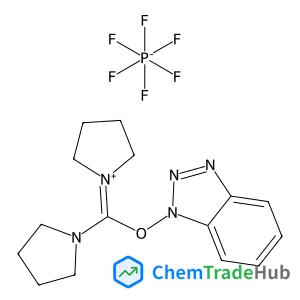
(1H-Benzotriazol-1-yloxy)(di-1-pyrrolidinyl)methylium hexafluorophosphate
CAS Number:
105379-24-6
Molecular Formula:
C15H21F6N5OP
![4-{2-[4-(2-Methyl-2-propanyl)phenyl]ethoxy}quinazoline structure](https://static.chemtradehub.com/structs/120/120928-09-8-d3db.webp "4-{2-[4-(2-Methyl-2-propanyl)phenyl]ethoxy}quinazoline structure")
4-{2-[4-(2-Methyl-2-propanyl)phenyl]ethoxy}quinazoline
CAS Number:
120928-09-8
Molecular Formula:
C20H22N2O
Recommended Suppliers






Disclaimer
This page provides academic journal information for reference and research purposes only. We are not affiliated with any journal publishers and do not handle publication submissions. For publication-related inquiries, please contact the respective journal publishers directly.
If you notice any inaccuracies in the information displayed, please contact us at support@chemtradehub.com. We will promptly review and address your concerns.