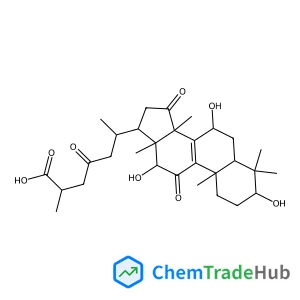
(3beta,7beta,12beta)-3,7,12-Trihydroxy-11,15,23-trioxolanost-8-en-26-oic acid
CAS Number:
98665-22-6
Molecular Formula:
C30H44O8
Ishtvan Boldog, Eduard B. Rusanov, Joachim Sieler, Steffen Blaurock, Konstantin V. Domasevitch
A H-bonded pyrazole trimeric motif drives the self-association of bifunctional tetramethyl-4,4′-bipyrazole, yielding highly interpenetrated 3D frameworks and allowing the engineering by design of a novel supramolecular isomer.

Bioorganic & Medicinal Chemistry

Electroanalysis

Topics in Catalysis

Journal of Asian Natural Products Research

Bioorganic & Medicinal Chemistry Letters

NDT & E International

Heteroatom Chemistry

Chinese Journal of Chemistry

Journal of the Indian Institute of Science

Herald of the Russian Academy of Sciences
Andrzej L. Sobolewski, Raffaele Borrelli, Wolfgang Domcke
DOI: 10.1039/C3CP44585B
Maryam Tahmasebpoor, Lilian de Martín, Mojgan Talebi, Navid Mostoufi, J. Ruud van Ommen
DOI: 10.1039/C3CP43687J
DOI: 10.1039/C2CP24044K
Jaroslaw J. Szymczak, Franziska D. Hofmann
DOI: 10.1039/C3CP44465A
Tao Wang, Yanyan Bu, Caixia Kan, Yuan Chen
DOI: 10.1039/C2CP40523G
Ting-ting You, Peng-gang Yin, Li Jiang, Xiu-feng Lang, Lin Guo
DOI: 10.1039/C2CP24147A
Takumi Nakamura, Satoshi Takeuchi, Tetsuya Taketsugu, Tahei Tahara
DOI: 10.1039/C2CP23959K
Daniel G. Kuroda, Robin M. Hochstrasser
DOI: 10.1039/C2CP23892F
When handling 4-(2-Furylmethyl)thiomorpholine 1,1-dioxide (CAS: 79206-94-3), it ...
When handling 4-Chloro-N-[2-(4-morpholinyl)ethyl]benzamide (CAS: 71320-77-9), it...
Waste containing this compound (CAS: 62921-74-8) should be handled according to ...
Waste containing (S)-Methyl 2-amino-3-cyclohexylpropanoate should be collected i...
This compound can be synthesized using a multi-step process involving the conjug...
There are several alternatives to (2E)-3-(3,4-Dichlorophenyl)acrylic acid in syn...
Ethyl 6-(2-nitrophenyl)imidazo[2,1-b][1,3]thiazole-3-carboxylate (CAS: 925437-84...
Waste containing 2-(1,3-Thiazol-2-yl)ethanamine (CAS: 18453-07-1) should be coll...
Methyl 5-iodo-2-methylbenzoate can be synthesized through the iodination of meth...
5-Chloro[1,2,4]triazolo[1,5-a]pyridine is commonly synthesized via the condensat...

ChemComm publishes urgent research which is of outstanding significance and interest to experts in the field, while also appealing to the journal’s broad chemistry readership. Our communication format is ideally suited to short, urgent studies that are of such importance that they require accelerated publication. Our scope covers all topics in chemistry, and research at the interface of chemistry and other disciplines (such as materials science, nanoscience, physics, engineering and biology) where there is a significant novelty in the chemistry aspects. Major topic areas covered include: Analytical Chemistry Catalysis Chemical Biology and medicinal chemistry Computational Chemistry and Machine Learning Energy and sustainable chemistry Environmental Chemistry Green Chemistry Inorganic Chemistry Materials Chemistry Nanoscience Organic Chemistry Physical Chemistry Polymer Chemistry Supramolecular Chemistry