



AD
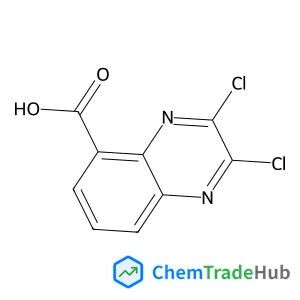
2,3-Dichloroquinoxaline-5-carboxylic acid(CAS: 933726-33-1)
CAS Number
Related Products
methyl}benzamide](https://static.chemtradehub.com/structs/224/2247491-97-8-c197.webp)
![4-Amino-2-({[(2-methyl-2-propanyl)oxy]carbonyl}amino)butanoic acid](https://static.chemtradehub.com/structs/289/2899-79-8-863a.webp)
![2-Methyl-2-propanyl 7-(4,4,5,5-tetramethyl-1,3,2-dioxaborolan-2-yl)-2-azaspiro[4.4]nonane-2-carboxylate](https://static.chemtradehub.com/structs/230/2304631-27-2-21b7.webp)
![Methyl 3-(4-{3-[3-(trifluoromethyl)phenyl]-1H-pyrazol-5-yl}-1-piperidinyl)propanoate](https://static.chemtradehub.com/structs/103/1030386-15-2-7851.webp)
Other Suppliers for 2,3-Dichloroquinoxaline-5-carboxylic acid




Basic Information
Molecular Formula
C9H4Cl2N2O2
Molecular Weight
243.05 g/mol
Chemical Identifiers
SMILES
C1=CC(=C2C(=C1)N=C(C(=N2)Cl)Cl)C(=O)O
InChIKey
NMYQKGFEKBEDKB-UHFFFAOYSA-N
Database References
MDL Number
MFCD22571787
FAQ
2,3-Dichloroquinoxaline-5-carboxylic acid is a crystalline solid with a molecular weight of approximately 229.03 g/mol. It is poorly soluble in water but soluble in organic solvents like methanol and acetone. The compound shows limited reactivity under normal conditions, but it can undergo hydrolysis in basic media. It has a melting point around 210-212°C. This acid is typically stable under normal storage conditions but should be handled with care due to its reactivity.
2,3-Dichloroquinoxaline-5-carboxylic acid is typically synthesized through the reaction of 2,3-dichloroquinoxaline with carboxylation reagents. Common methods involve treating the quinoxaline with carbon dioxide in the presence of a base such as sodium carbonate. The reaction is selective, yielding the acid with good yield. This process usually occurs under mild conditions, making it a feasible method for industrial synthesis.
2,3-Dichloroquinoxaline-5-carboxylic acid finds applications in the pharmaceutical industry due to its potential as a starting material for the synthesis of drug candidates. It also has uses in the polymer industry as a monomer for the production of certain polymers. Additionally, this compound is used in the field of sensors for its unique chemical properties and in the semiconductor industry for its electronic characteristics.
When handling 2,3-Dichloroquinoxaline-5-carboxylic acid, it is important to use appropriate personal protective equipment (PPE) such as gloves, goggles, and a lab coat. Work should be conducted in a well-ventilated area or a fume hood to prevent inhalation of the substance. Spills should be cleaned up immediately using appropriate absorbent materials. Always refer to the safety data sheet (SDS) for detailed guidance on safe handling and disposal procedures.
Safety Notice
Please verify product specifications and safety data before use. Contact the supplier for detailed safety information.
Always follow proper handling procedures
Contact Information
Contact Person
Manager Gu
sales@gh-reagent.com
Mobile
18939883912
Telephone
021-34536277
Visit Website
https://www.gh-reagent.com/Address
No. 91, Building 2, Block 537, Sanada Road, Minhang District, Pujiang Town, Shanghai