












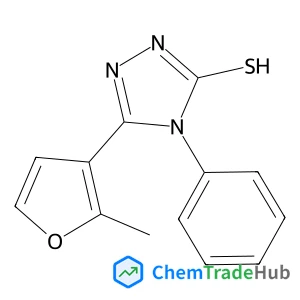
5-(2-Methyl-3-furyl)-4-phenyl-2,4-dihydro-3H-1,2,4-triazole-3-thione
CAS Number:
346464-59-3
Molecular Formula:
C13H11N3OS
A graphical abstract is available for this content
F. Poidevin, M. H. Mathon
DOI: 10.1039/C0CP00967A
Lingling Xue, Bin Qiu, Zhenyu Lin, Donghwan Kim, Guonan Chen
DOI: 10.1039/C004277C
I. Pagonabarraga, J. M. Ortiz de Zárate, J. V. Sengers
DOI: 10.1039/C0CP00289E
Chandrashekara R. Haramagatti, Felix H. Schacher, Axel H. E. Müller, Jürgen Köhler
DOI: 10.1039/C0CP01658F
Florian Heym, Bastian J. M. Etzold, Christoph Kern, Andreas Jess
DOI: 10.1039/C0CP00097C
Anita Lagutschenkov, Judith Langer, Giel Berden, Otto Dopfer
DOI: 10.1039/C0CP02133D
Hynek Němec, Irena Kratochvílová, Petr Kužel, Anna Kochalska, Juraj Nožár, Stanislav Nešpůrek
DOI: 10.1039/C0CP00774A
Qinggang He, Xiaofang Yang, Wei Chen, Sanjeev Mukerjee, Bruce Koel, Shaowei Chen
DOI: 10.1039/C0CP00433B
Yan-Wen Tan, Haw Yang
DOI: 10.1039/C0CP02412K
Grant J. McIntosh, Peter J. Swedlund, Tilo Söhnel
DOI: 10.1039/C0CP01664K
When handling lithium chloride hydrate (1:1:1) (CAS: 16712-20-2), it is importan...
4-(4H-1,2,4-Triazol-4-yl)piperidine is generally considered safe for use in phar...
Waste containing 1,3-Thiazole-2-carboxamide (CAS: 16733-85-0) should be collecte...
5-(Difluoromethyl)-2-fluorobenzonitrile (CAS: 934175-58-3) is subject to regulat...
Methyl 3-acetamido-2-thiophenecarboxylate can be synthesized by the reaction of ...
4-Isoquinolinecarbonitrile is a chemical compound with the CAS number 34846-65-6...
Store Methyl 1H-1,2,3-triazole-4-carboxylate (CAS: 877309-59-6) in a cool, dry p...
6-Bromo[1,3]thiazolo[5,4-b]pyridin-2-amine (CAS: 1160791-13-8) is subject to the...
(2S,3S)-2-Ammonio-3-(3,4-dihydroxyphenyl)-3-hydroxypropanoate (CAS: 23651-95-8) ...
7-Bromo-3-methyl-3,4-dihydroquinazolin-4-one is a solid with a crystalline form....
Nanoscale Horizons is a leading journal for the publication of exceptionally high-quality, innovative nanoscience and nanotechnology. The journal places an emphasis on original research that demonstrates a new concept or a new way of thinking (a conceptual advance), rather than primarily reporting technological improvements. However, outstanding articles featuring truly breakthrough developments such as record performance alone may also be published in the journal. For work to be published it must be of significant general interest to our community-spanning readership. Topics covered in the journal include, but are not limited to: Synthesis of nanostructured and nanoscale materials Quantum materials 2D materials Layered materials Layered quantum materials Characterisation of functional nanoscale materials and bio-assemblies Properties of nanoscale materials Self-assembly and molecular organisation Complex hybrid nanostructures Nanocomposites, nanoparticles, nanocrystalline materials, and nanoclusters Nanotubes, molecular nanowires and nanocrystals Molecular nanoscience Nanocatalysis Theoretical modelling Single-molecules Plasmonics Nanoelectronics and molecular electronics Nanophotonics Nanochips, nanosensors, nanofluidics and nanofabrication Carbon-based nanoscale materials and devices Biomimetic materials Nanobiotechnology/bionanomaterials Nanomedicine Regulatory approaches and risk assessment
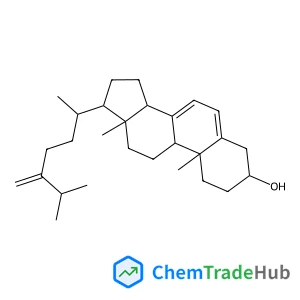

![5,10-Dihydroindeno[2,1-a]indene structure](https://static.chemtradehub.com/structs/654/6543-29-9-71ca.webp "5,10-Dihydroindeno[2,1-a]indene structure")
![8-Bromo-6-fluoro[1,2,4]triazolo[1,5-a]pyridin-2-amine structure](https://static.chemtradehub.com/structs/125/1257705-51-3-9f4a.webp "8-Bromo-6-fluoro[1,2,4]triazolo[1,5-a]pyridin-2-amine structure")





