












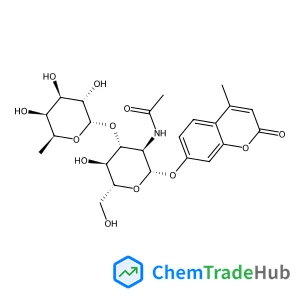
4-Methyl-2-oxo-2H-chromen-7-yl 2-acetamido-2-deoxy-3-O-(6-deoxy-alpha-L-galactopyranosyl)-beta-D-glucopyranoside
CAS Number:
383160-12-1
Molecular Formula:
C24H31NO12
I. Pagonabarraga, J. M. Ortiz de Zárate, J. V. Sengers
We show how the law of mass action can be derived from a thermodynamic basis, in the presence of temperature gradients, chemical potential gradients and hydrodynamic flow. The solution gives the law of mass action for the forward and the reverse contributions to the net chemical reaction. In addition we derive the fluctuation–dissipation theorem for the fluctuating contributions to the reaction rate, heat flux and mass fluxes. All these results arise without any other assumptions than those which are common in mesoscopic non-equilibrium thermodynamics; namely quasi-stationary transport across a high activation energy barrier, and local equilibrium along the reaction coordinate. Arrhenius-type behaviour of the kinetic coefficients is recovered. The thermal conductivity, Soret coefficient and diffusivity are significantly influenced by the presence of a chemical reaction. We thus demonstrate how chemical reactions can be fully reconciled with non-equilibrium thermodynamics.
Zhuoling Deng, Maria Zober, Manfred Wagner, Karen Lienkamp, Frederik R. Wurm
DOI: 10.1039/C7PY01777D
Lei Xu, Ning Ren, Ji Pang, Hongping Deng, Xinyuan Zhu, Mo Sun, Deyue Yan
DOI: 10.1039/C7PY00963A
Qingwei Li, Ziquan Cao, Guojie Wang
DOI: 10.1039/C7PY01822C
Sanjib Banerjee, Sara Taddei, Elisa Martinelli, Elisa Passaglia, Bruno Ameduri
DOI: 10.1039/C7PY01693J
Coralie M. Backlund, Federica Sgolastra, Ronja Otter, Toshihide Takeuchi, Shiroh Futaki
DOI: 10.1039/C7PY90169K
Siming Chen, Haixin Wang, Zhenjiang Li, Fulan Wei, Hui Zhu, Songquan Xu, Jiaxi Xu, Jingjing Liu, Hailemariam Gebru, Kai Guo
DOI: 10.1039/C7PY02086D
Vasiliki Nikolaou, Fehaid Alsubaie, Alexandre Simula, David J. Fox, David M. Haddleton
DOI: 10.1039/C7PY90190A
Christina Schwarzenböck, Andreas Schaffer, Philipp Pahl, Peter J. Nelson, Ralf Huss, Bernhard Rieger
DOI: 10.1039/C7PY01796K
When handling lithium chloride hydrate (1:1:1) (CAS: 16712-20-2), it is importan...
4-(4H-1,2,4-Triazol-4-yl)piperidine is generally considered safe for use in phar...
Waste containing 1,3-Thiazole-2-carboxamide (CAS: 16733-85-0) should be collecte...
5-(Difluoromethyl)-2-fluorobenzonitrile (CAS: 934175-58-3) is subject to regulat...
Methyl 3-acetamido-2-thiophenecarboxylate can be synthesized by the reaction of ...
4-Isoquinolinecarbonitrile is a chemical compound with the CAS number 34846-65-6...
Store Methyl 1H-1,2,3-triazole-4-carboxylate (CAS: 877309-59-6) in a cool, dry p...
6-Bromo[1,3]thiazolo[5,4-b]pyridin-2-amine (CAS: 1160791-13-8) is subject to the...
(2S,3S)-2-Ammonio-3-(3,4-dihydroxyphenyl)-3-hydroxypropanoate (CAS: 23651-95-8) ...
7-Bromo-3-methyl-3,4-dihydroquinazolin-4-one is a solid with a crystalline form....

Physical Chemistry Chemical Physics (PCCP) is an international journal co-owned by 19 physical chemistry and physics societies from around the world. This journal publishes original, cutting-edge research in physical chemistry, chemical physics and biophysical chemistry. To be suitable for publication in PCCP, articles must include significant innovation and/or insight into physical chemistry; this is the most important criterion that reviewers and Editors will judge against when evaluating submissions. The journal has a broad scope and welcomes contributions spanning experiment, theory, computation and data science. Topical coverage includes spectroscopy, dynamics, kinetics, statistical mechanics, thermodynamics, electrochemistry, catalysis, surface science, quantum mechanics, quantum computing and machine learning. Interdisciplinary research areas such as polymers and soft matter, materials, nanoscience, energy, surfaces/interfaces, and biophysical chemistry are welcomed if they demonstrate significant innovation and/or insight into physical chemistry. Joined experimental/theoretical studies are particularly appreciated when complementary and based on up-to-date approaches.
![N-[2-(2-Pyridinyl)ethyl]-1-propanamine structure](https://static.chemtradehub.com/structs/554/55496-57-6-22b4.webp "N-[2-(2-Pyridinyl)ethyl]-1-propanamine structure")




