


In situ forming, mechanically resilient hydrogels prepared from 4a-[PEG-b-PTMC-Ac] and thiolated chondroitin sulfate for nucleus pulposus cell delivery
Literature Information
Publication Date
2023-12-21
DOI
10.1039/D3TB02574H
Impact Factor
6.331
Authors
Hossein Riahinezhad, Brian G. Amsden
View Original
Abstract
Intervertebral disk degeneration (IVDD) is a common condition that causes severe back pain and affects patients’ mobility and life quality considerably. IVDD originates within the central region of the disk called the nucleus pulposus (NP). Removing the damaged tissue and replacing it with NP cells (NPCs) delivered within an in situ forming hydrogel is a promising treatment approach. Herein we describe a hydrogel formulation based on 4-arm [poly(ethylene glycol)-b-poly(trimethylene carbonate)-acrylate] (4a[PEG-b-PTMC-Ac]) crosslinked with thiolated chondroitin sulfate via Michael-type reaction for this purpose. A library of hydrogels based on 15 kDa 4a-[PEG] with PTMC blocks of varying molecular weight were prepared and characterized. The instantaneous moduli of the hydrogels were adjustable from 24 to 150 kPa depending on the length of the PTMC block and the polymer volume fraction. The influence of each of these parameters was effectively explained using both scaling or mean field theories of polyelectrolyte hydrogels. The hydrogels were resistant to cyclic compressive loading and degraded gradually over 70 days in vitro. A hydrogel formulation with an instantaneous modulus at the high end of the range of values reported for human NP tissue was chosen to assess the ability of these hydrogels for delivering NPCs. The prepolymer solution was injectable and formed a hydrogel within 30 minutes at 37 °C. Bovine NPCs were encapsulated within this hydrogel with high viability and proliferated throughout a 28 day, hypoxic culture period. The encapsulated NPCs formed clusters and deposited collagen type II but no collagen type I within the hydrogels. Despite an initial gradual decrease, a steady-state modulus was reached at the end of the 28 day culture period that was within the range reported for healthy human NP tissue. This in situ forming hydrogel formulation is a promising approach and with further development could be a viable clinical treatment for IVDD.
Recommended Journals

Nature

Kinetics and Catalysis

Organic Preparations and Procedures International

Israel Journal of Chemistry

Fibre Chemistry

Journal of Physics and Chemistry of Solids

European Journal of Wood and Wood Products

Russian Chemical Reviews

Science Progress

Proceedings of the National Academy of Sciences of the United States of America
Related Literature
Individual graphene oxide platelets through direct molecular exfoliation with globular amphiphilic hyperbranched polymers
Shi-Min Shau, Tzong-Yuan Juang, Han-Sheng Lin, Cheng-Liang Huang, Chi-Fa Hsieh, Jeng-Yue Wu, Ru-Jong Jeng
2012-03-14
Paper
DOI: 10.1039/C2PY00006G
Hierarchical self-assembly and secondary structures of linear polypeptides graft onto POSS in the side chain through click chemistry
Yung-Chih Lin, Shiao-Wei Kuo
2011-11-15
Paper
DOI: 10.1039/C1PY00381J
Cationic polyesters bearing pendent amino groups prepared by thiol–ene chemistry
Vincent Darcos, Sarah Antoniacomi, Cédric Paniagua, Jean Coudane
2011-11-21
Paper
DOI: 10.1039/C1PY00414J
In situ monitoring of enzyme-catalyzed (co)polymerizations by Raman spectroscopy‡
Matthew T. Hunley, Santanu Kundu, Peter M. Johnson, Michael S. Waters, Richard A. Gross, Kathryn L. Beers
2011-11-30
Communication
DOI: 10.1039/C1PY00447F
Controlled biomimetic silica formation using star-shaped poly(l-lysine)
Qinrong Wang, Jun Yu, Yunsong Yan, Shaoqiang Xu, Fangfang Wang, Qingnan Li, Jinzhi Wang, Xin Zhang, Daojun Liu
2012-03-21
Paper
DOI: 10.1039/C2PY20070H
Facile synthesis of novel poly(α-aminonitrile) networks through one-pot Strecker reactions
Jiacheng Wang, Yoichi Masui, Makoto Onaka
2012-02-08
Communication
DOI: 10.1039/C2PY00002D
Facile synthesis of cross-linked patchy fluorescent conjugated polymernanoparticles by click reactions
Vüsala İbrahimova, Seyma Ekiz, Özlem Gezici, Dönüs Tuncel
2011-10-12
Paper
DOI: 10.1039/C1PY00332A
You might also like
Compound Q&A
What industries use 4-(4-tert-Butylphenyl)-1H-pyrazol-3-amine (CAS: 1015845-73-4)?
4-(4-tert-Butylphenyl)-1H-pyrazol-3-amine finds applications in various industri...
1015845-73-44-(4-tert-Butylpheny...
Compound Q&A
What industries use H3TATAB (CAS: 63557-10-8)?
H3TATAB is used in the pharmaceutical industry for the synthesis of certain orga...
63557-10-8H3TATAB
Compound Q&A
What are the main uses of 1-Ethyl-3-fluorobenzene (CAS: 696-39-9)?
1-Ethyl-3-fluorobenzene (CAS: 696-39-9) is primarily used as a precursor in the ...
696-39-91-Ethyl-3-fluorobenz...
Compound Q&A
What are the main uses of 1-(tert-Butoxycarbonyl)-4-(4-methoxyphenyl)pyrrolidine-3-carboxylic acid (CAS: 851484-94-1)?
1-(tert-Butoxycarbonyl)-4-(4-methoxyphenyl)pyrrolidine-3-carboxylic acid is prim...
851484-94-11-(tert-Butoxycarbon...
Compound Q&A
What are the physical and chemical properties of 1-Cyclobutyl-4-piperidinone (CAS: 359880-05-0)?
1-Cyclobutyl-4-piperidinone (CAS: 359880-05-0) is a colorless or white crystalli...
359880-05-01-Cyclobutyl-4-piper...
Compound Q&A
What is Pyridine-2,6-dicarboxylic acid mono-tert-butyl ester (CAS: 575433-76-0)?
Pyridine-2,6-dicarboxylic acid mono-tert-butyl ester (CAS: 575433-76-0) is a che...
575433-76-0Pyridine-2,6-dicarbo...
Compound Q&A
What is the market or research trend for 2,3-Difluorophenylalanine (CAS: 236754-62-4)?
The market for 2,3-Difluorophenylalanine (CAS: 236754-62-4) is growing with incr...
236754-62-42,3-Difluorophenylal...
Compound Q&A
How is (2-Hydroxy-1-naphthyl)boronic acid (CAS: 898257-48-2) typically synthesized?
(2-Hydroxy-1-naphthyl)boronic acid can be synthesized through the reduction of 2...
898257-48-2(2-Hydroxy-1-naphthy...
Compound Q&A
What are the physical and chemical properties of tert-Butyl (5-bromo-6-methyl-3-(4,4,5,5-tetramethyl-1,3,2-dioxaborolan-2-yl)pyridin-2-yl)carbamate (CAS: 1315351-28-0)?
This compound is a crystalline solid with a molecular weight of approximately 52...
1315351-28-0tert-Butyl (5-bromo-...
Compound Q&A
Are there alternatives to 5,7-Dihydroxy-4-oxo-2-(3,4,5-trihydroxyphenyl)-4H-chromen-3-yl beta-D-glucopyranoside (CAS: 19833-12-6) in synthesis?
While 5,7-Dihydroxy-4-oxo-2-(3,4,5-trihydroxyphenyl)-4H-chromen-3-yl beta-D-gluc...
19833-12-65,7-Dihydroxy-4-oxo-...
Source Journal
Journal of Materials Chemistry B
CiteScore:
12
Self-citation Rate:
4.9%
Articles per Year:
831
Journal of Materials Chemistry A, B & C cover high quality studies across all fields of materials chemistry. The journals focus on those theoretical or experimental studies that report new understanding, applications, properties and synthesis of materials. The journals have a strong history of publishing quality reports of interest to interdisciplinary communities and providing an efficient and rigorous service through peer review and publication. The journals are led by an international team of Editors-in-Chief and Associate Editors who are all active researchers in their fields. Journal of Materials Chemistry A, B & C are separated by the intended application of the material studied. Broadly, applications in energy and sustainability are of interest to Journal of Materials Chemistry A, applications in biology and medicine are of interest to Journal of Materials Chemistry B, and applications in optical, magnetic and electronic devices are of interest to Journal of Materials Chemistry C. More than one Journal of Materials Chemistry journal may be suitable for certain fields and researchers are encouraged to submit their paper to the journal that they feel best fits for their particular article. Example topic areas within the scope of Journal of Materials Chemistry B are listed below. This list is neither exhaustive nor exclusive. Antifouling coatings Biocompatible materials Bioelectronics Bioimaging Biomimetics Biomineralisation Bionics Biosensors Diagnostics Drug delivery Gene delivery Immunobiology Nanomedicine Regenerative medicine & Tissue engineering Scaffolds Soft robotics Stem cells Therapeutic devices image block All articles published in Journal of Materials Chemistry B from 2019 onwards will be indexed in MEDLINE®. Articles that primarily focus on providing insight into the underlying science and performance of biomaterials within a biological environment are more suited to our companion journal, Biomaterials Science.
Recommended Compounds
![6-Nitro-2-(4-nitrophenyl)imidazo[1,2-a]pyridine structure](https://static.chemtradehub.com/structs/118/118000-57-0-cb82.webp "6-Nitro-2-(4-nitrophenyl)imidazo[1,2-a]pyridine structure")
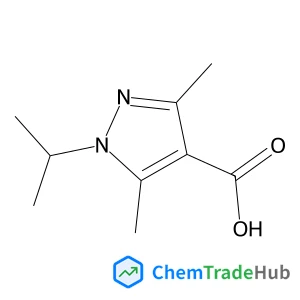
1-isopropyl-3,5-dimethyl-1H-pyrazole-4-carboxylic acid
CAS Number:
1007542-01-9
Molecular Formula:
C9H14N2O2
Recommended Suppliers





Disclaimer
This page provides academic journal information for reference and research purposes only. We are not affiliated with any journal publishers and do not handle publication submissions. For publication-related inquiries, please contact the respective journal publishers directly.
If you notice any inaccuracies in the information displayed, please contact us at support@chemtradehub.com. We will promptly review and address your concerns.