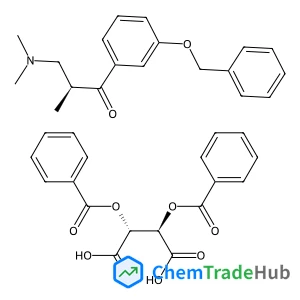
(S)-1-(3-(Benzyloxy)phenyl)-3-(dimethylamino)-2-methylpropan-1-one (2r,3r)-2,3-bis(benzoyloxy)succinate
CAS Number:
1004315-81-4
Molecular Formula:
C37H37NO10
Xiaoxue Dong, Zongwei Zhu, Qian Sun, Hongqian Zhang, Chuanxu Yang
The development of a theranostic platform that integrates both diagnostic and therapeutic capabilities is in great need for precise and personalized medicine. Here, we present a novel nanoplatform (AuNS@CS-hpDNA) formulated by chitosan functionalized gold nanostar composites and further complexed with fluorescent hairpin DNA (hpDNA) probes for tumor-related miRNA imaging and photothermal therapy (PTT). The optimized AuNS@CS-hpDNA nanoplatform mediated efficient hpDNA probe loading and intracellular delivery. Subsequently, the cytosol transfer of the hpDNA probe enabled specific hybridization using the targeted miRNA, which triggered the recovery of fluorescence for the precise detection of biomarker miR21 in living cells and realized the distinguishing cancer cell line MCF-7 and normal cells. Meanwhile, the AuNS@CS-hpDNA nanoplatform exhibited excellent photothermal conversion properties, which induced efficient cancer cell killing under laser irradiation. Thus, the developed AuNS@CS-hpDNA nanoplatform could simultaneously realize the precise detection of cancer cells and accurately initiate efficient PTT, which represents a promising strategy for precise cancer therapy.
Da-Peng Qin, Qian-Qian Di, Ying Liu, Wei-Lin Chen, Shu-Mei Wang, Yong-Xian Cheng
DOI: 10.1039/C9QO01046G
Dana Kaizerman-Kane, Maya Hadar, Eran Granot, Fernando Patolsky, Yoram Cohen
DOI: 10.1039/C9QO00717B
Deying Yang, Zhongqiu Liu
DOI: 10.1039/C9QO00486F
Hidemasa Hikawa, Yuuki Matsuura, Shoko Kikkawa, Isao Azumaya
DOI: 10.1039/C9QO00831D
Xiaoyan Chen, Hao Zhou, Zhiyuan Chen
DOI: 10.1039/C9QO00880B
Carlos A. Echeverry-Gonzalez, Carlos E. Puerto-Galvis, Carlos H. Borca, Martín A. Mosquera, Andrés F. Luis-Robles, Vladimir V. Kouznetsov
DOI: 10.1039/C9QO00870E
Mengmeng Lan, Guodong Cui, Hongwei Zhang
DOI: 10.1039/C9QO00685K
6-(3-Fluorophenyl)picolinic acid is generally considered safe for laboratory use...
(3R)-3-Pyrrolidinol is used in the pharmaceutical industry as a precursor for dr...
When handling (4R,5R)-4,5-Diethoxycarbonyl-2,2-dimethyldioxolane (CAS: 59779-75-...
1-(6-Chloroimidazo[1,2-b]pyridazin-3-yl)ethanone is often synthesized via a mult...
The market for N-Ethyl-3,4-dimethylbenzylamine (CAS: 39180-83-1) remains steady,...
Tert-butyl 3-(pyrrolidin-1-yl)azetidine-1-carboxylate is a chemical compound wit...
1-Bromo-3-chloro-2,4-dimethoxybenzene (CAS: 1228956-93-1) falls under the classi...
The safety of 8-Bromo-2-methyl-3,4-dihydroisoquinolin-1(2H)-one (CAS: 1368622-07...
Benzyl [(3S)-2,6-dioxo-3-piperidinyl]carbamate is generally safe when handled wi...
1-{[4-(4,4,5,5-Tetramethyl-1,3,2-dioxaborolan-2-yl)phenyl]sulfonyl}pyrrolidine s...
Journal of Materials Chemistry A, B & C cover high quality studies across all fields of materials chemistry. The journals focus on those theoretical or experimental studies that report new understanding, applications, properties and synthesis of materials. The journals have a strong history of publishing quality reports of interest to interdisciplinary communities and providing an efficient and rigorous service through peer review and publication. The journals are led by an international team of Editors-in-Chief and Associate Editors who are all active researchers in their fields. Journal of Materials Chemistry A, B & C are separated by the intended application of the material studied. Broadly, applications in energy and sustainability are of interest to Journal of Materials Chemistry A, applications in biology and medicine are of interest to Journal of Materials Chemistry B, and applications in optical, magnetic and electronic devices are of interest to Journal of Materials Chemistry C. More than one Journal of Materials Chemistry journal may be suitable for certain fields and researchers are encouraged to submit their paper to the journal that they feel best fits for their particular article. Example topic areas within the scope of Journal of Materials Chemistry B are listed below. This list is neither exhaustive nor exclusive. Antifouling coatings Biocompatible materials Bioelectronics Bioimaging Biomimetics Biomineralisation Bionics Biosensors Diagnostics Drug delivery Gene delivery Immunobiology Nanomedicine Regenerative medicine & Tissue engineering Scaffolds Soft robotics Stem cells Therapeutic devices image block All articles published in Journal of Materials Chemistry B from 2019 onwards will be indexed in MEDLINE®. Articles that primarily focus on providing insight into the underlying science and performance of biomaterials within a biological environment are more suited to our companion journal, Biomaterials Science.

![(3R,4aR,7aS,9aR,10S,11R,13aR,13bS,15aS,15bR)-3,11-Dihydroxy-10-(hydroxymethyl)-4,4,7a,10,13a,15b-hexamethyl-1,2,3,4,4a,7,7a,8,9,9a,10,11,12,13,13a,13b,14,15,15a,15b-icosahydro-5H-naphtho[2',1':4,5]cyc
lohepta[1,2-a]naphthalen-5-one structure](https://static.chemtradehub.com/structs/538/53800-21-8-9f18.webp "(3R,4aR,7aS,9aR,10S,11R,13aR,13bS,15aS,15bR)-3,11-Dihydroxy-10-(hydroxymethyl)-4,4,7a,10,13a,15b-hexamethyl-1,2,3,4,4a,7,7a,8,9,9a,10,11,12,13,13a,13b,14,15,15a,15b-icosahydro-5H-naphtho[2',1':4,5]cyc
lohepta[1,2-a]naphthalen-5-one structure")