












Distinguishing anti-PEG antibodies by specificity for the PEG terminus using nanoarchitectonics-based antibiofouling cello-oligosaccharide platforms
Literature Information
Publication Date
2023-12-03
DOI
10.1039/D3TB01723K
Impact Factor
6.331
Authors
Kai Sugiura, Toshiki Sawada, Yuuki Hata, Hiroshi Tanaka, Takeshi Serizawa
View Original
Abstract
The conjugation of poly(ethylene glycol) (PEG) to therapeutic proteins or nanoparticles is a widely used pharmaceutical strategy to improve their therapeutic efficacy. However, conjugation can make PEG immunogenic and induce the production of anti-PEG antibodies, which decreases both the therapeutic efficacy after repeated dosing and clinical safety. To address these concerns, it is essential to analyze the binding characteristics of anti-PEG antibodies to PEG. However, distinguishing anti-PEG antibodies is still a difficult task. Herein, we demonstrate the use of antibiofouling cello-oligosaccharide assemblies tethering one-terminal methoxy oligo(ethylene glycol) (OEG) ligands for distinguishing anti-PEG antibodies in a simple manner. The OEG ligand-tethering two-dimensional crystalline cello-oligosaccharide assemblies were stably dispersed in a buffer solution and had antibiofouling properties against nonspecific protein adsorption. These characteristics allowed enzyme-linked immunosorbent assays (ELISAs) to be simply performed by cycles of centrifugation/redispersion of aqueous dispersions of the assemblies. The simple assays revealed that the specific OEG ligand-tethering assemblies could distinguish anti-PEG antibodies to detect a specific antibody that preferentially binds to the methoxy terminus of the PEG chain with 3 repeating ethylene glycol units. Furthermore, quantitative detection of the antibodies was successfully performed with high sensitivity even in the presence of serum. The detectable and quantifiable range of antibody concentrations covered those required clinically. Our findings open a new avenue for analyzing the binding characteristics of anti-PEG antibodies in biological samples.
Recommended Journals
Related Literature
From miscible to partially miscible biodegradable double crystalline poly(ethylene succinate)-b-poly(butylene succinate) multiblock copolymers
Jian-Bing Zeng, Qun-Ying Zhu, Xi Lu, Yi-Song He, Yu-Zhong Wang
2011-12-01
Paper
DOI: 10.1039/C1PY00456E
An improved grafting technique for producing imprinted thin film composite beads
Mahadeo R. Halhalli, Carla S. A. Aureliano, Eric Schillinger, Claudia Sulitzky, M. Magdalena Titirici, Börje Sellergren
2012-02-06
Paper
DOI: 10.1039/C2PY00544A
From a benzodiazaborole-based compound to donor–acceptor polymervia electropolymerization
Shotaro Hayashi, Toshio Koizumi
2012-01-16
Communication
DOI: 10.1039/C2PY00563H
Synthesis and characterization of a biodegradable polymer prepared viaradical copolymerization of 2-(acetoacetoxy)ethyl methacrylate and molecular oxygen
Sunirmal Pal, Amit Das, Sankar Maiti, Priyadarsi De
2011-10-26
Paper
DOI: 10.1039/C1PY00419K
Facile glycosylation of dendrimers for eliciting specific cell–material interactions
Xiaopeng Liu, Jie Liu, Ying Luo
2011-11-29
Communication
DOI: 10.1039/C1PY00404B
Host–guest driven supramolecular assembly of reversible comb-shaped polymers in aqueous solution
Martina Stenzel
2011-11-29
Paper
DOI: 10.1039/C1PY00478F
Facile synthesis of cross-linked patchy fluorescent conjugated polymernanoparticles by click reactions
Vüsala İbrahimova, Seyma Ekiz, Özlem Gezici, Dönüs Tuncel
2011-10-12
Paper
DOI: 10.1039/C1PY00332A
Upgrading of bio-oil and subsequent co-processing under FCC conditions for fuel production
Udo Armbruster, Hanan Atia, Ursula Bentrup, Binh Minh Quoc Phan, Reinhard Eckelt, Luong Huu Nguyen, Duc Anh Nguyen, Andreas Martin
2015-12-14
Paper
DOI: 10.1039/C5RE00068H
Two-dimensional copolymers with D–A type side chains for organic thin-film transistors: Synthesis and properties
Dugang Chen, Yan Zhao, Cheng Zhong, Gui Yu, Yunqi Liu, Jingui Qin
2011-10-07
Paper
DOI: 10.1039/C1PY00331C
Novel soluble polyazomethines with pendant carbazole and triphenylamine derivatives: preparation, characterization, and optical, electrochemical and electrochromic properties
Jiwei Cai, Cheng Wang, Xuduo Bai, Wen Wang
2011-10-05
Paper
DOI: 10.1039/C1PY00237F
You might also like
Compound Q&A
What industries use 4-(4-tert-Butylphenyl)-1H-pyrazol-3-amine (CAS: 1015845-73-4)?
4-(4-tert-Butylphenyl)-1H-pyrazol-3-amine finds applications in various industri...
1015845-73-44-(4-tert-Butylpheny...
Compound Q&A
What industries use H3TATAB (CAS: 63557-10-8)?
H3TATAB is used in the pharmaceutical industry for the synthesis of certain orga...
63557-10-8H3TATAB
Compound Q&A
What are the main uses of 1-Ethyl-3-fluorobenzene (CAS: 696-39-9)?
1-Ethyl-3-fluorobenzene (CAS: 696-39-9) is primarily used as a precursor in the ...
696-39-91-Ethyl-3-fluorobenz...
Compound Q&A
What are the main uses of 1-(tert-Butoxycarbonyl)-4-(4-methoxyphenyl)pyrrolidine-3-carboxylic acid (CAS: 851484-94-1)?
1-(tert-Butoxycarbonyl)-4-(4-methoxyphenyl)pyrrolidine-3-carboxylic acid is prim...
851484-94-11-(tert-Butoxycarbon...
Compound Q&A
What are the physical and chemical properties of 1-Cyclobutyl-4-piperidinone (CAS: 359880-05-0)?
1-Cyclobutyl-4-piperidinone (CAS: 359880-05-0) is a colorless or white crystalli...
359880-05-01-Cyclobutyl-4-piper...
Compound Q&A
What is Pyridine-2,6-dicarboxylic acid mono-tert-butyl ester (CAS: 575433-76-0)?
Pyridine-2,6-dicarboxylic acid mono-tert-butyl ester (CAS: 575433-76-0) is a che...
575433-76-0Pyridine-2,6-dicarbo...
Compound Q&A
What is the market or research trend for 2,3-Difluorophenylalanine (CAS: 236754-62-4)?
The market for 2,3-Difluorophenylalanine (CAS: 236754-62-4) is growing with incr...
236754-62-42,3-Difluorophenylal...
Compound Q&A
How is (2-Hydroxy-1-naphthyl)boronic acid (CAS: 898257-48-2) typically synthesized?
(2-Hydroxy-1-naphthyl)boronic acid can be synthesized through the reduction of 2...
898257-48-2(2-Hydroxy-1-naphthy...
Compound Q&A
What are the physical and chemical properties of tert-Butyl (5-bromo-6-methyl-3-(4,4,5,5-tetramethyl-1,3,2-dioxaborolan-2-yl)pyridin-2-yl)carbamate (CAS: 1315351-28-0)?
This compound is a crystalline solid with a molecular weight of approximately 52...
1315351-28-0tert-Butyl (5-bromo-...
Compound Q&A
Are there alternatives to 5,7-Dihydroxy-4-oxo-2-(3,4,5-trihydroxyphenyl)-4H-chromen-3-yl beta-D-glucopyranoside (CAS: 19833-12-6) in synthesis?
While 5,7-Dihydroxy-4-oxo-2-(3,4,5-trihydroxyphenyl)-4H-chromen-3-yl beta-D-gluc...
19833-12-65,7-Dihydroxy-4-oxo-...
Source Journal
Journal of Materials Chemistry B

CiteScore:
12
Self-citation Rate:
4.9%
Articles per Year:
831
Journal of Materials Chemistry A, B & C cover high quality studies across all fields of materials chemistry. The journals focus on those theoretical or experimental studies that report new understanding, applications, properties and synthesis of materials. The journals have a strong history of publishing quality reports of interest to interdisciplinary communities and providing an efficient and rigorous service through peer review and publication. The journals are led by an international team of Editors-in-Chief and Associate Editors who are all active researchers in their fields. Journal of Materials Chemistry A, B & C are separated by the intended application of the material studied. Broadly, applications in energy and sustainability are of interest to Journal of Materials Chemistry A, applications in biology and medicine are of interest to Journal of Materials Chemistry B, and applications in optical, magnetic and electronic devices are of interest to Journal of Materials Chemistry C. More than one Journal of Materials Chemistry journal may be suitable for certain fields and researchers are encouraged to submit their paper to the journal that they feel best fits for their particular article. Example topic areas within the scope of Journal of Materials Chemistry B are listed below. This list is neither exhaustive nor exclusive. Antifouling coatings Biocompatible materials Bioelectronics Bioimaging Biomimetics Biomineralisation Bionics Biosensors Diagnostics Drug delivery Gene delivery Immunobiology Nanomedicine Regenerative medicine & Tissue engineering Scaffolds Soft robotics Stem cells Therapeutic devices image block All articles published in Journal of Materials Chemistry B from 2019 onwards will be indexed in MEDLINE®. Articles that primarily focus on providing insight into the underlying science and performance of biomaterials within a biological environment are more suited to our companion journal, Biomaterials Science.
Recommended Compounds
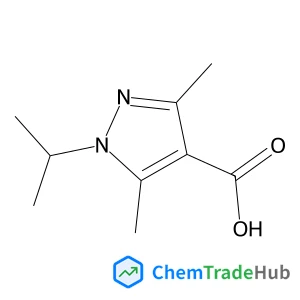
1-isopropyl-3,5-dimethyl-1H-pyrazole-4-carboxylic acid
CAS Number:
1007542-01-9
Molecular Formula:
C9H14N2O2
![6-Nitro-2-(4-nitrophenyl)imidazo[1,2-a]pyridine structure](https://static.chemtradehub.com/structs/118/118000-57-0-cb82.webp "6-Nitro-2-(4-nitrophenyl)imidazo[1,2-a]pyridine structure")
![6-[2-(Trifluoromethoxy)phenyl]-2-pyridinecarboxylic acid structure](https://static.chemtradehub.com/structs/887/887983-48-4-f6ac.webp "6-[2-(Trifluoromethoxy)phenyl]-2-pyridinecarboxylic acid structure")
6-[2-(Trifluoromethoxy)phenyl]-2-pyridinecarboxylic acid
CAS Number:
887983-48-4
Molecular Formula:
C13H8F3NO3
![(3aR,7R,7aR)-2,2-Diethyl-3a,6,7,7a-tetrahydro-7-[(methylsulfonyl)oxy]-1,3-benzodioxole-5-carboxylic Acid Ethyl Ester structure](https://static.chemtradehub.com/structs/204/204254-90-0-7172.webp "(3aR,7R,7aR)-2,2-Diethyl-3a,6,7,7a-tetrahydro-7-[(methylsulfonyl)oxy]-1,3-benzodioxole-5-carboxylic Acid Ethyl Ester structure")
(3aR,7R,7aR)-2,2-Diethyl-3a,6,7,7a-tetrahydro-7-[(methylsulfonyl)oxy]-1,3-benzodioxole-5-carboxylic Acid Ethyl Ester
CAS Number:
204254-90-0
Molecular Formula:
C15H24O7S
Recommended Suppliers





Disclaimer
This page provides academic journal information for reference and research purposes only. We are not affiliated with any journal publishers and do not handle publication submissions. For publication-related inquiries, please contact the respective journal publishers directly.
If you notice any inaccuracies in the information displayed, please contact us at support@chemtradehub.com. We will promptly review and address your concerns.