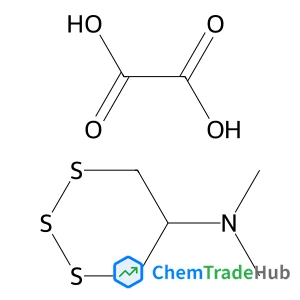
Oxalic acid compound with cyclohexylsulfamothioic O-acid (11)
CAS Number:
31895-22-4
Molecular Formula:
C7H13NO4S3
Udo Armbruster, Hanan Atia, Ursula Bentrup, Binh Minh Quoc Phan, Reinhard Eckelt, Luong Huu Nguyen, Duc Anh Nguyen, Andreas Martin
Hydrodeoxygenation of fast pyrolysis oil was first investigated on bimetallic catalysts (homogeneous Ni–Co alloy) supported on various carriers (HZSM-5, HBeta, HY and ZrO2). The bimetallic catalyst 10Ni10Co/HZSM-5 outperformed the corresponding monometallic catalysts and Ni–Co supported on other support materials (HBeta, HY and ZrO2) with 39% deoxygenation degree and 37 wt% (wet basis) oil yield. 13C-NMR spectroscopy, GC, GC-MS, and elemental analysis revealed that the chemical composition of the product changed significantly and the higher heating value increased substantially from 23.6 to 33.3 MJ kg−1. The upgraded bio-oil was subsequently co-fed with a conventional feed (atmospheric distillation residue) using a commercial micro activity test setup under FCC conditions with an equilibrated commercial refinery catalyst to demonstrate a possible route for production of fuel from biomass. These tests showed similar conversion for both the conventional and co-processed feeds, whereas the latter case revealed a reduction of heavy cycle oil and a slight increase of gasoline, gas and light cycle oil yields.
Kathryn L. Jenko, Yanfeng Zhang, Yulia Kostenko, Yongfeng Fan, Consuelo Garcia-Rodriguez, Jianlong Lou, James D. Marks, Susan M. Varnum
DOI: 10.1039/C4AN01270D
Chenge Li, Saroj Kumar, Andreas Barth
DOI: 10.1039/C4AN00483C
David Smith, Alicia J. El Haj
DOI: 10.1039/C4AN01102C
Dilip B. Parmar, Gopala Ram Bhadu
DOI: 10.1039/C4AN01405G
Wanzhen Li, Longhua Ding, Qiaohong Wang, Bin Su
DOI: 10.1039/C4AN00605D
Xianghu Tang
DOI: 10.1039/C4AN01084A
Ying Zhang, Wei Zhang, Qing Zhang, Kaiyang Li, Wei Liu, Yong Liu, Craig E. Banks
DOI: 10.1039/C4AN00957F
Raffaela Biesuz, Giovanni Emma, Chiara Milanese, Giacomo Dacarro, Angelo Taglietti, Valeria Marina Nurchi, Giancarla Alberti
DOI: 10.1039/C4AN00179F
Marek Smoluch, Przemyslaw Mielczarek, Edward Reszke, Gary M. Hieftje
DOI: 10.1039/C3AN02067C
Waste containing (6-Bromo-2-naphthyl)oxy](dimethyl)(2-methyl-2-propanyl)silane (...
7-Fluoro-4-isoquinolinecarboxylic acid can be synthesized via a multi-step proce...
2,3,5,6-Tetrabromothieno[3,2-b]thiophene is a crystalline compound with a high m...
1-[4-(Benzylamino)-7,8-dihydro-5H-pyrano[4,3-d]pyrimidin-2-yl]-2-methyl-1H-indol...
The market for imidazo[5,1-d]-1,2,3,5-tetrazine-8-carboxylic acid, 3,4-dihydro-3...
3-(Triisopropylsilyl)propiolaldehyde is a synthetic organic compound with the CA...
6-Nitro-2H-1,4-benzoxazin-3(4H)-one (CAS: 81721-87-1) is subject to various regu...
Waste containing (3-Fluorophenyl)(4-{[(2-methyl-2-propanyl)oxy]carbonyl}-1-piper...
N,N'-4,4'-Biphenyldiyldiisonicotinamide is a white crystalline solid with a mole...
6-Bromo-8-fluoro-2-quinazolinol is primarily used in the pharmaceutical industry...

Reaction Chemistry & Engineering is an interdisciplinary journal reporting cutting-edge research focused on enhancing the understanding and efficiency of reactions. Reaction engineering leverages the interface where fundamental molecular chemistry meets chemical engineering and technology. Challenges in chemistry can be overcome by the application of new technologies, while engineers may find improved solutions for process development from the latest developments in reaction chemistry. Reaction Chemistry & Engineering is a unique forum for researchers whose interests span the broad areas of chemical engineering and chemical sciences to come together in solving problems of importance to wider society. All papers should be written to be approachable by readers across the engineering and chemical sciences. Papers that consider multiple scales, from the laboratory up to and including plant scale, are particularly encouraged.
![2,2'-{2,2-Propanediylbis[(2,6-dibromo-4,1-phenylene)oxy]}diethanol structure](https://static.chemtradehub.com/structs/416/4162-45-2-b3d6.webp "2,2'-{2,2-Propanediylbis[(2,6-dibromo-4,1-phenylene)oxy]}diethanol structure")