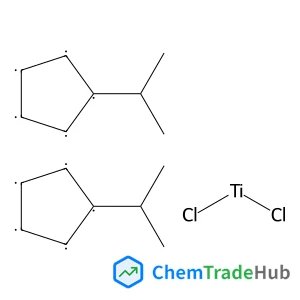
BIS(I-PROPYLCYCLOPENTADIENYL)TITANIUM DICHLORIDE
CAS Number:
12130-65-3
Molecular Formula:
C16H22Cl2Ti
Wei Cao, Zezhi Lin, Daoyi Zheng, Jianjun Zhang, Weili Heng, Yuanfeng Wei, Yuan Gao, Shuai Qian
Metal–organic gels (MOGs) are a type of functional soft substance with a three-dimensional (3D) network structure and solid-like rheological behavior, which are constructed by metal ions and bridging ligands formed under the driving force of coordination interactions or other non-covalent interactions. As the homologous substances of metal–organic frameworks (MOFs) and gels, they exhibit the potential advantages of high porosity, flexible structure, and adjustable mechanical properties, causing them to attract extensive research interest in the pharmaceutical field. For instance, MOGs are often used as excellent vehicles for intelligent drug delivery and programmable drug release to improve the clinical curative effect with reduced side effects. Also, MOGs are often applied as advanced biomedical materials for the repair and treatment of pathological tissue and sensitive detection of drugs or other molecules. However, despite the vigorous research on MOGs in recent years, there is no systematic summary of their applications in the pharmaceutical field to date. The present review systematically summarize the recent research progress on MOGs in the pharmaceutical field, including drug delivery systems, drug detection, pharmaceutical materials, and disease therapies. In addition, the formation principles and classification of MOGs are complemented and refined, and the techniques for the characterization of the structures/properties of MOGs are overviewed in this review.
Jiying Liang, Xue Yu, Tiangang Yang, Menglu Li, Li Shen, Yue Jin, Hongyun Liu
DOI: 10.1039/C7CP04030J
S. M. Corrêa, D. F. S. Ferreira, M. R. S. Siqueira, J. C. Reis-Silva, J. F. P. Leal, C. A. B. da Silva, Jr, J. Del Nero
DOI: 10.1039/C7CP03080K
Jeffrey J. Black, Maximo C. Elias, Bruno Gélinas, Dominic Rochefort
DOI: 10.1039/C7CP04322H
Zixuan Guan, Di Chen, William C. Chueh
DOI: 10.1039/C7CP03654J
Ioannis G. Kevrekidis
DOI: 10.1039/C7CP03260A
Jun Peng, Kai Xu, Mingcai Chen
DOI: 10.1039/C7CP03325G
Charusheela Ramanan, Marco Ferretti, Henny van Roon, Vladimir I. Novoderezhkin, Rienk van Grondelle
DOI: 10.1039/C7CP03038J
J. M. Carnerero, A. Sánchez-Coronilla, E. I. Martín, A. Jimenez-Ruiz, R. Prado-Gotor
DOI: 10.1039/C7CP03692B
Alberto Figueroba, Albert Bruix, Gábor Kovács
DOI: 10.1039/C7CP02820B
6-(3-Fluorophenyl)picolinic acid is generally considered safe for laboratory use...
(3R)-3-Pyrrolidinol is used in the pharmaceutical industry as a precursor for dr...
When handling (4R,5R)-4,5-Diethoxycarbonyl-2,2-dimethyldioxolane (CAS: 59779-75-...
1-(6-Chloroimidazo[1,2-b]pyridazin-3-yl)ethanone is often synthesized via a mult...
The market for N-Ethyl-3,4-dimethylbenzylamine (CAS: 39180-83-1) remains steady,...
Tert-butyl 3-(pyrrolidin-1-yl)azetidine-1-carboxylate is a chemical compound wit...
1-Bromo-3-chloro-2,4-dimethoxybenzene (CAS: 1228956-93-1) falls under the classi...
The safety of 8-Bromo-2-methyl-3,4-dihydroisoquinolin-1(2H)-one (CAS: 1368622-07...
Benzyl [(3S)-2,6-dioxo-3-piperidinyl]carbamate is generally safe when handled wi...
1-{[4-(4,4,5,5-Tetramethyl-1,3,2-dioxaborolan-2-yl)phenyl]sulfonyl}pyrrolidine s...
Journal of Materials Chemistry A, B & C cover high quality studies across all fields of materials chemistry. The journals focus on those theoretical or experimental studies that report new understanding, applications, properties and synthesis of materials. The journals have a strong history of publishing quality reports of interest to interdisciplinary communities and providing an efficient and rigorous service through peer review and publication. The journals are led by an international team of Editors-in-Chief and Associate Editors who are all active researchers in their fields. Journal of Materials Chemistry A, B & C are separated by the intended application of the material studied. Broadly, applications in energy and sustainability are of interest to Journal of Materials Chemistry A, applications in biology and medicine are of interest to Journal of Materials Chemistry B, and applications in optical, magnetic and electronic devices are of interest to Journal of Materials Chemistry C. More than one Journal of Materials Chemistry journal may be suitable for certain fields and researchers are encouraged to submit their paper to the journal that they feel best fits for their particular article. Example topic areas within the scope of Journal of Materials Chemistry B are listed below. This list is neither exhaustive nor exclusive. Antifouling coatings Biocompatible materials Bioelectronics Bioimaging Biomimetics Biomineralisation Bionics Biosensors Diagnostics Drug delivery Gene delivery Immunobiology Nanomedicine Regenerative medicine & Tissue engineering Scaffolds Soft robotics Stem cells Therapeutic devices image block All articles published in Journal of Materials Chemistry B from 2019 onwards will be indexed in MEDLINE®. Articles that primarily focus on providing insight into the underlying science and performance of biomaterials within a biological environment are more suited to our companion journal, Biomaterials Science.
![5-Bromo-3-isopropyl-1H-pyrrolo[2,3-b]pyridine structure](https://static.chemtradehub.com/structs/125/1256819-54-1-8620.webp "5-Bromo-3-isopropyl-1H-pyrrolo[2,3-b]pyridine structure")
![(3R,4aR,7aS,9aR,10S,11R,13aR,13bS,15aS,15bR)-3,11-Dihydroxy-10-(hydroxymethyl)-4,4,7a,10,13a,15b-hexamethyl-1,2,3,4,4a,7,7a,8,9,9a,10,11,12,13,13a,13b,14,15,15a,15b-icosahydro-5H-naphtho[2',1':4,5]cyc
lohepta[1,2-a]naphthalen-5-one structure](https://static.chemtradehub.com/structs/538/53800-21-8-9f18.webp "(3R,4aR,7aS,9aR,10S,11R,13aR,13bS,15aS,15bR)-3,11-Dihydroxy-10-(hydroxymethyl)-4,4,7a,10,13a,15b-hexamethyl-1,2,3,4,4a,7,7a,8,9,9a,10,11,12,13,13a,13b,14,15,15a,15b-icosahydro-5H-naphtho[2',1':4,5]cyc
lohepta[1,2-a]naphthalen-5-one structure")