



Fluorescence probes for lung carcinoma diagnosis and clinical application
Literature Information
Publication Date
2023-06-15
DOI
10.1039/D3SD00029J
Impact Factor
0
Authors
Xinyu Song
View Original
Abstract
Lung carcinoma is the largest cause of mortality globally, making it the biggest public health issue and a significant barrier to extending human life expectancy. The specific etiology and production process of lung carcinoma are not yet known, and it has a relatively complex and multi-stage occurrence. Early detection and treatment of lung carcinoma can greatly improve the five-year survival rate. Because pre-carcinomatous tumors are small and uncharacteristic in form, early carcinomas are challenging to immediately diagnose with magnetic resonance imaging (MRI), X-ray photography, computed tomography (CT), positron emission tomography (PET), or ultrasonography (US). In order to capitalize on the particular characteristics of carcinoma, methods that can emphasize the molecular distinction between carcinoma and healthy tissue are desperately needed. With the development of bioimaging technology, fluorescent probes present a potential solution to this clinical problem. Fluorescent probes have been considered to be effective chemistry tools for achieving early detection and identification of tumor lesions, because molecular imaging technology can explicitly illustrate lesion boundary information during surgery. Fluorescent probes can also qualitatively and quantitatively analyze the lesion state at the cellular and molecular levels in the living body. This review will cover and provide an overview of the most recent developments in fluorescence probe technology for the accurate detection and clinical therapy of lung carcinoma. We anticipate that this review will serve as a spark for the development of intelligent molecular fluorescent probes for lung carcinoma clinical image-guided surgery and imaging diagnosis.
Recommended Journals

Cement and Concrete Research

Accounts of Chemical Research

Chemical Reviews

Chemical & Pharmaceutical Bulletin

Doklady Chemistry

Anti-Corrosion Methods and Materials

Advances in Colloid and Interface Science

Journal of the Chinese Chemical Society

Australian Journal of Chemistry

Chemistry of Heterocyclic Compounds
Related Literature
Halogen-like properties of the Al13 cluster mimicking astatine
B. Molina, J. R. Soto, J. J. Castro
2018-04-04
Communication
DOI: 10.1039/C8CP00494C
Ultrasonication-induced sp3 hybridization defects in Langmuir–Schaefer layers of turbostratic graphene
K. Rytel, M. Widelicka, D. Łukawski, F. Lisiecki, K. Kędzierski, D. Wróbel
2018-04-13
Paper
DOI: 10.1039/C8CP01363B
Thickness dependent Raman spectra and interfacial interaction between Ag and epitaxial graphene on 6H-SiC(0001)
Xiangtai Liu, Qinglong Fang, Tingwei Hu, Dayan Ma, Xiaohe Zhang, Shuai Liu, Fei Ma
2018-02-02
Paper
DOI: 10.1039/C7CP07338K
Local crystal structure in the vicinity of Cr in doped AlN thin films studied by X-ray absorption spectroscopy
Padmalochan Panda, R. Ramaseshan, Madhusmita Sahoo, Nanda Gopala Krishna, A. K. Yadav, S. N. Jha, D. Bhattacharyya
2018-04-24
Paper
DOI: 10.1039/C8CP01686K
Optical absorption and photoconductivity in iodine-excess ionic liquids: the case of 1-alkyl-3-methyl imidazolium iodides
Masami Aono, Hisashi Miyazaki, Takahiro Takekiyo, Seiji Tsuzuki, Hiroshi Abe
2018-01-25
Paper
DOI: 10.1039/C7CP07387A
Tuning the singlet fission relevant energetic levels of quinoidal bithiophene compounds by means of backbone modifications and functional group introduction
Li Shen, Xuemin Wang, Heyuan Liu, Xiyou Li
2018-01-23
Paper
DOI: 10.1039/C7CP08313K
Electrochemically controlled winding and unwinding of substrate-supported carbon nanoscrolls
H. Tarábková, Z. Zelinger, P. Janda
2018-01-25
Paper
DOI: 10.1039/C7CP08018B
Maxwell-Hall access resistance in graphene nanopores
Michael Zwolak
2018-01-24
Communication
DOI: 10.1039/C7CP07924A
You might also like
Compound Q&A
What are the main uses of 1-(3-Aminophenyl)-3-[(3R)-1-(3,3-dimethyl-2-oxobutyl)-2-oxo-5-(2-pyridinyl)-2,3-dihydro-1H-1,4-benzodiazepin-3-yl]urea (CAS: 155412-88-7)?
This compound is mainly used as an intermediate in the synthesis of antipsychoti...
155412-88-71-(3-Aminophenyl)-3-...
Compound Q&A
How should waste containing 1-(D-Ribofuranosyl)-1,4-dihydro-3-pyridinecarboxamide (CAS: 19132-12-8) be handled?
Waste containing 1-(D-Ribofuranosyl)-1,4-dihydro-3-pyridinecarboxamide (CAS: 191...
19132-12-81-(D-Ribofuranosyl)-...
Compound Q&A
What regulatory guidelines apply to 2-Methyl-2-propanyl 3-bromo-3-(hydroxymethyl)-1-azetidinecarboxylate (CAS: 2007919-81-3)?
2-Methyl-2-propanyl 3-bromo-3-(hydroxymethyl)-1-azetidinecarboxylate (CAS: 20079...
2007919-81-32-Methyl-2-propanyl ...
Compound Q&A
What is N-(4-Chloro-2-pyridinyl)acetamide (CAS: 245056-66-0)?
N-(4-Chloro-2-pyridinyl)acetamide (CAS: 245056-66-0) is a chemical compound with...
245056-66-0N-(4-Chloro-2-pyridi...
Compound Q&A
What is 5-Chloro-2-hydroxybenzoic acid (CAS: 321-14-2)?
5-Chloro-2-hydroxybenzoic acid, also known as 5-chlorosalicylic acid, is an arom...
321-14-25-Chloro-2-hydroxybe...
Compound Q&A
What precautions should be taken when handling 1,1-Dichloro-1-fluoroethane (CAS: 1717-00-6)?
When handling 1,1-Dichloro-1-fluoroethane (CAS: 1717-00-6), it is important to u...
1717-00-61,1-Dichloro-1-fluor...
Compound Q&A
What are the physical and chemical properties of Fmoc-(2S,3R)-3-phenylpyrrolidine-2-carboxylic acid (CAS: 281655-32-1)?
Fmoc-(2S,3R)-3-phenylpyrrolidine-2-carboxylic acid is a white crystalline solid ...
281655-32-1Fmoc-(2S,3R)-3-pheny...
Compound Q&A
What are the main uses of 4-Amino-5-bromo-2-pyridinecarboxylic acid (CAS: 1363381-01-4)?
4-Amino-5-bromo-2-pyridinecarboxylic acid is primarily used as a precursor in th...
1363381-01-44-Amino-5-bromo-2-py...
Compound Q&A
What precautions should be taken when handling (S)-tert-butyl 2-((2-(4-bromophenyl)-2-oxoethyl)carbamoyl)pyrrolidine-1-carboxylate (CAS: 1007881-98-2)?
Handling this compound should be done with personal protective equipment (PPE) i...
1007881-98-2(S)-tert-butyl 2-((2...
Compound Q&A
What precautions should be taken when handling 8-bromo-2,2-dimethyl-3,4-dihydro-2H-1,4-benzoxazin-3-one (CAS: 688363-73-7)?
When handling 8-bromo-2,2-dimethyl-3,4-dihydro-2H-1,4-benzoxazin-3-one, use prop...
688363-73-78-bromo-2,2-dimethyl...
Source Journal
Recommended Compounds
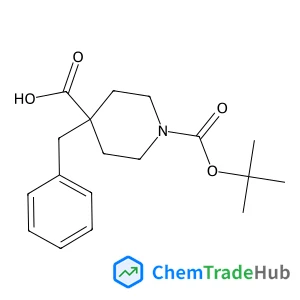
4-Benzyl-1-(tert-butoxycarbonyl)piperidine-4-carboxylic acid
CAS Number:
170838-87-6
Molecular Formula:
C18H25NO4
Recommended Suppliers






Disclaimer
This page provides academic journal information for reference and research purposes only. We are not affiliated with any journal publishers and do not handle publication submissions. For publication-related inquiries, please contact the respective journal publishers directly.
If you notice any inaccuracies in the information displayed, please contact us at support@chemtradehub.com. We will promptly review and address your concerns.