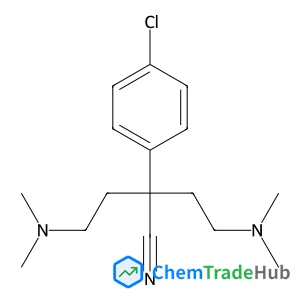
2-(4-Chlorophenyl)-4-(dimethylamino)-2-(2-(dimethylamino)ethyl)butanenitrile
CAS Number:
1246816-57-8
Molecular Formula:
C16H24ClN3
Masami Aono, Hisashi Miyazaki, Takahiro Takekiyo, Seiji Tsuzuki, Hiroshi Abe
We investigated the optical absorption and photoconductivity of iodine-excess ionic liquids (ILs) based on 1-alkyl-3-methyl imidazolium iodide ([Cnmim][I]; n = 3, 4, and 6). The iodide concentration m was 2 ≦ m ≦ 8, which was determined by the molar fraction [Cnmim]+ : [Im]− = 1 : m. By adding iodine, an absorption edge shifted from 282 nm in the UV region to around 600 nm in the visible-light region. The optical bandgaps Eo decreased gradually from 2.3 eV to 1.9 eV with increasing m from 2 to 8. The alkyl-side chain lengths of the cations have little effect on the Eo. This experimental result was confirmed by ab initio molecular orbital calculations. The effects were reflected in the photoconductivity of the ILs, as expected. [C4mim][Im] exhibited greater photo-induced electron generation compared with [C3mim][Im] and [C6mim][Im]. The photoconductivity in both [C3mim][Im] and [C6mim][Im] increased slightly with increasing m. The trend of photoconductivity in [C4mim][Im] exhibited an N-shaped form. The highest photoconductivity 1.6 was observed in [C4mim][I8].
Yuki Mimura, Sayaka Kitamura, Motohiro Shizuma, Mizuki Kitamatsu, Yoshitane Imai
DOI: 10.1039/C8OB01869C
Chang Gao, Xiaoting Gu, Xin Wang, Huikun Cao, Bin Lin, Youping Liu, Xin Di
DOI: 10.1039/C8OB02194E
Zhi-Lin Ren, Ping He, Wen-Ting Lu, Mei Sun, Ming-Wu Ding
DOI: 10.1039/C8OB01728J
Coralie De Schutter, Vincent Roy, Patrick Favetta, Corentin Pavageau, Stéphane Maisonneuve, Nicolas Bogliotti, Juan Xie, Luigi A. Agrofoglio
DOI: 10.1039/C8OB01606B
Souma Tamaoki, Hiromichi Egami, Noriyuki Ohneda, Tadashi Okamoto, Hiromichi Odajima, Yoshitaka Hamashima
DOI: 10.1039/C8OB02282H
Jiaomei Guo, Yang Zhao, Dongmei Fang, Qilin Wang, Zhanwei Bu
DOI: 10.1039/C8OB01493K
J. Schörgenhumer, M. Waser
DOI: 10.1039/C8OB02375A
Sara Meninno, Ilaria Quaratesi, Chiara Volpe, Andrea Mazzanti, Alessandra Lattanzi
DOI: 10.1039/C8OB01988F
Xiao-Fang Li, Lin-Feng Shi, Xing-Guo Zhang, Xiao-Hong Zhang
DOI: 10.1039/C8OB01421C
This compound is mainly used as an intermediate in the synthesis of antipsychoti...
Waste containing 1-(D-Ribofuranosyl)-1,4-dihydro-3-pyridinecarboxamide (CAS: 191...
2-Methyl-2-propanyl 3-bromo-3-(hydroxymethyl)-1-azetidinecarboxylate (CAS: 20079...
N-(4-Chloro-2-pyridinyl)acetamide (CAS: 245056-66-0) is a chemical compound with...
5-Chloro-2-hydroxybenzoic acid, also known as 5-chlorosalicylic acid, is an arom...
When handling 1,1-Dichloro-1-fluoroethane (CAS: 1717-00-6), it is important to u...
Fmoc-(2S,3R)-3-phenylpyrrolidine-2-carboxylic acid is a white crystalline solid ...
4-Amino-5-bromo-2-pyridinecarboxylic acid is primarily used as a precursor in th...
Handling this compound should be done with personal protective equipment (PPE) i...
When handling 8-bromo-2,2-dimethyl-3,4-dihydro-2H-1,4-benzoxazin-3-one, use prop...

Physical Chemistry Chemical Physics (PCCP) is an international journal co-owned by 19 physical chemistry and physics societies from around the world. This journal publishes original, cutting-edge research in physical chemistry, chemical physics and biophysical chemistry. To be suitable for publication in PCCP, articles must include significant innovation and/or insight into physical chemistry; this is the most important criterion that reviewers and Editors will judge against when evaluating submissions. The journal has a broad scope and welcomes contributions spanning experiment, theory, computation and data science. Topical coverage includes spectroscopy, dynamics, kinetics, statistical mechanics, thermodynamics, electrochemistry, catalysis, surface science, quantum mechanics, quantum computing and machine learning. Interdisciplinary research areas such as polymers and soft matter, materials, nanoscience, energy, surfaces/interfaces, and biophysical chemistry are welcomed if they demonstrate significant innovation and/or insight into physical chemistry. Joined experimental/theoretical studies are particularly appreciated when complementary and based on up-to-date approaches.
![Methyl 4-({[(2-methyl-2-propanyl)oxy]carbonyl}amino)bicyclo[2.2.2]octane-1-carboxylate structure](https://static.chemtradehub.com/structs/943/943845-74-7-b7e5.webp "Methyl 4-({[(2-methyl-2-propanyl)oxy]carbonyl}amino)bicyclo[2.2.2]octane-1-carboxylate structure")