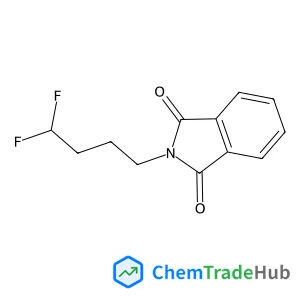
2-(4,4-Difluorobutyl)-1H-isoindole-1,3(2H)-dione
CAS Number:
1265341-14-7
Molecular Formula:
C12H11F2NO2
Shuguang Zhou, Shuang-Feng Dong, Xin Zhang, Shen-Yuan Zhang, Jie-Sheng Tian
This study outlines the development of an innovative tandem reaction involving [4 + 2] cyclization with 1,3-sulfonyl migration from N-allenylsulfonamides and enaminones, expanding the scope of synthetic methodologies for multifunctional 1,4-dihydropyridine derivatives. The outlined approach furnishes a broad spectrum of sulfonyl-substituted 1,4-dihydropyridine derivatives with good to excellent yields, which can be subsequently converted into diverse sulfonyl-substituted compounds such as pyridine, tetrahydropyridine, and piperidine derivatives through simplified operation. The methodological advancements achieved in this research not only demonstrate the versatility and applicability of the synthesized derivatives across varied substrates and conditions but also present promising potential for the development and diversification of unsymmetrical 1,4-dihydropyridine sulfones.
Aldilene Saraiva-Souza, Zachary Bullard, Dayvison Weber Maia, Antônio Gomes Souza Filho, Eduardo Costa Girão
DOI: 10.1039/C3CP54496F
Jing Qiu, Guangtong Zeng, Prathamesh Pavaskar, Zhen Li
DOI: 10.1039/C3CP54674H
Hong-Yan Wang, Jia Liu, Jiefang Zhu, Stenbjörn Styring, Sascha Ott, Anders Thapper
DOI: 10.1039/C3CP54500H
Sudip K. Saha, Asim Guchhait, Amlan J. Pal
DOI: 10.1039/C3CP52227J
Ameneh Gholami, Travis D. Fridgen
DOI: 10.1039/C3CP53716A
Xinru Li, Ying Dai, Yandong Ma, Shenghao Han, Baibiao Huang
DOI: 10.1039/C3CP54592J
S. A. Paniagua, E. L. Li, S. R. Marder
DOI: 10.1039/C3CP54637C
Richard P. Matthews, Tom Welton, Patricia A. Hunt
DOI: 10.1039/C3CP54672A
T. A. Nirmal Peiris, K. G. Upul Wijayantha, Jorge García-Cañadas
DOI: 10.1039/C3CP53260G
N-(4-Methoxybenzyl)-2-pyridinamine (CAS: 52818-63-0) is increasingly being used ...
When handling Ethyl 4-(2-chlorophenyl)-1,3-thiazole-2-carboxylate, appropriate p...
Diethyldiselane (CAS: 628-39-7) is classified under the Globally Harmonized Syst...
The market for oxocopper (CAS: 12053-18-8) is primarily driven by its use in cat...
The market for 5-{[(2-Methyl-2-propanyl)oxy]carbonyl}-5-azaspiro[2.4]heptane-7-c...
2-(1-Pyrrolidinyl)-4-pyridinamine is a chemical compound with the CAS number 359...
2-(3-Pyridinyl)-1-azabicyclo[2.2.2]octane (CAS: 91556-75-1) is a crystalline sol...
(S)-Alpha-allyl-proline hydrochloride is usually synthesized via a Wittig reacti...
3-Methyl-1,2-oxazole-5-carboxylic acid (CAS: 4857-42-5) is an organic compound w...
Lys-SMCC-DM1 is synthesized via a multi-step process involving the coupling of S...

Organic Chemistry Frontiers publishes high-quality research from across organic chemistry. Emphases are placed on studies that make significant contributions to the field of organic chemistry by reporting either new or significantly improved protocols or methodologies. Topics include, but are not limited to the following: Organic synthesis Development of synthetic methodologies Catalysis Natural products Functional organic materials Supramolecular and macromolecular chemistry Physical and computational organic chemistry
![N-{15-[(2,5-Dioxo-1-pyrrolidinyl)oxy]-15-oxo-3,6,9,12-tetraoxapentadec-1-yl}-2-(2-propyn-1-yloxy)acetamide structure](https://static.chemtradehub.com/structs/210/2101206-92-0-2eb5.webp "N-{15-[(2,5-Dioxo-1-pyrrolidinyl)oxy]-15-oxo-3,6,9,12-tetraoxapentadec-1-yl}-2-(2-propyn-1-yloxy)acetamide structure")