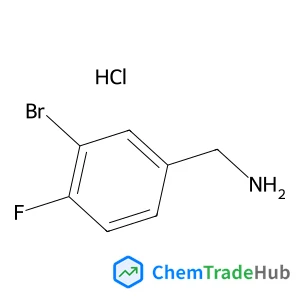
1-(3-Bromo-4-fluorophenyl)methanamine hydrochloride (1:1)
CAS Number:
202865-68-7
Molecular Formula:
C7H8BrClFN
Ming Hui Chua, Kang Le Osmund Chin, Xiaogang Liu
The discovery of the aggregation-induced emission (AIE) phenomenon in many classes of organic molecules has revolutionized our understanding of the photoluminescence properties of materials. These breakthroughs have opened up new possibilities for real-life applications and state-of-the-art technologies. AIE luminogens (AIEgens) have emerged as highly useful tools, effectively overcoming the limitations of conventional aggregation-caused quenching (ACQ) luminogens. They find applications in various fields such as biomedical uses, optoelectronics, stimuli-responsive materials, and chemosensing. In particular, the development of highly sensitive and selective AIE fluorescent probes has significantly complemented conventional instrumental analysis methods, offering low-cost, convenient, and rapid detection of target analytes. With intensive research efforts in this area, a wide range of small molecule analytes, including biologically important molecules, drug molecules, volatile organic compounds, and explosives, can now be detected. This review aims to provide an overview of the progress made in the development of AIE-based organic small molecule probes over the past five years.
Si-Min Kong, Yao-Hong Xue, Xiao-Li Liu, Xiao-Xi Jia, Feng-Chao Cui
DOI: 10.1039/C8CP03069C
Tan Li, Xiaochao Zhang, Changming Zhang, Rui Li, Jianxin Liu, Rui Lv, Hui Zhang, Peide Han, Caimei Fan, Zhanfeng Zheng
DOI: 10.1039/C8CP05671D
Masoud Aryanpour, Nassim Rafiefard, Seyed Hossein Hosseini-Shokouh, Somayeh Fardindoost
DOI: 10.1039/C8CP05026K
Evgenii Titov, Alexander Humeniuk, Roland Mitrić
DOI: 10.1039/C8CP05240A
DOI: 10.1039/C8CP06087H
Pierre Bräuer, Carmine D’Agostino
DOI: 10.1039/C8CP05001E
M. Kouyaté, G. Demouchy, G. Mériguet, S. Nakamae, V. Peyre, M. Roger, A. Cēbers, J. Depeyrot, E. Dubois, R. Perzynski
DOI: 10.1039/C8CP06858E
Atul D. Sontakke, Jean-Marie Mouesca, Victor Castaing, Mathieu Salaün, Isabelle Gautier-Luneau, Vincent Maurel, Alain Ibanez, Bruno Viana
DOI: 10.1039/C8CP03952F
Riccardo Checchetto, Paolo Bettotti, Gianfranco Carotenuto, Werner Egger, Christoph Hugenschmidt, Antonio Miotello
DOI: 10.1039/C8CP03879A
Qinye Li, Siyao Qiu, Lizhong He, Xiwang Zhang
DOI: 10.1039/C8CP04474K
When considering alternatives to 1-(4-Chlorophenyl)-N-hydroxymethanimine (CAS: 3...
This compound should be stored in a cool, dry place away from direct sunlight. I...
3-(4-Bromophenyl)-5-(2-fluorophenyl)-1,2,4-oxadiazole is synthesized through a m...
5-Chloro-2-(4-chlorophenyl)-4-methyl-6-[3-(1-piperidinyl)propoxy]pyrimidine (CAS...
2-Chloro-4-(difluoromethoxy)pyridine is used in the pharmaceutical industry for ...
3-Chloro-6-methylpyridazine (CAS: 1121-79-5) is classified under the Globally Ha...
Several alternatives can be used in the synthesis of Methyl 4,5-dimethyl-2-nitro...
Alternatives to (2E,2'E)-3,3'-(1,4-Phenylene)bisacrylaldehyde include other acry...
3-Amino-5-chloropyridin-2-ol hydrochloride is an organic compound with the CAS n...
When handling 6,7-Difluoro-2,3-dihydro-4H-chromen-4-one, it is essential to wear...