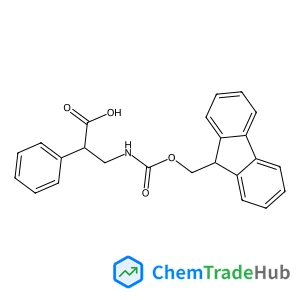
(S)-3-((((9H-Fluoren-9-yl)methoxy)carbonyl)amino)-2-phenylpropanoic acid
CAS Number:
1217663-60-9
Molecular Formula:
C24H21NO4
Pierre Bräuer, Carmine D’Agostino
Acidity of zeolites is a paramount property that determines their behaviour in catalytic and adsorption applications. Various techniques have been established over the years to characterise this property qualitatively and quantitatively, using different indicators able to reveal different insights. In this work, for the first time we have used the tapered element oscillating microbalance (TEOM) to study the quantitative aspects of the internal and external acidity of zeolites by measuring the sorption dynamics of pyridine and collidine over HZSM5 zeolites with different silica-to-alumina ratios (SAR). The method is able to easily quantify, with a rapid and robust calibration procedure, maximum, physisorbed and chemisorbed uptake of probe molecules. The results show that the uptake of both pyridine and collidine measured by the TEOM increases with decreasing SAR, that is, with the increase in Al content, consistent with the increase in acid site density at increasing Al content. Most importantly, by providing a robust and easy-to-interpret set of data, the experimental protocol reveals new fundamental insights into the adsorption mechanism as a function of the Al content, showing that at high Al content chemisorption is the major adsorption mechanism, whereas at low Al content physisorption becomes the dominant mechanism.
Sabine N. Neal, Dario Stacchiola, Samuel A. Tenney
DOI: 10.1039/D3CP03958G
Yufei Xue, Weina Ren, Xuxia Shai, Tingting Wei, Chunhua Zeng, Hua Wang
DOI: 10.1039/D3CP04397E
Xiao Han, Qi Zhao, Xiaodan Yan, Ting Meng, Jinlu He
DOI: 10.1039/D3CP05217F
Jarich Haitjema, Lianjia Wu, Laurent Nahon, Sonia Castellanos
DOI: 10.1039/D3CP90231E
Heng Sun, Yichen Tian, Yuna Fu, Yongrong Lei, Yani Wang, Xinrui Yan, Jianhua Wang
DOI: 10.1039/D3CP04351G
Kohei Tada, Yasutaka Kitagawa
DOI: 10.1039/D3CP04187E
W. Allison, S. Miret-Artés, E. Pollak
DOI: 10.1039/D3CP04559E
When considering alternatives to 1-(4-Chlorophenyl)-N-hydroxymethanimine (CAS: 3...
This compound should be stored in a cool, dry place away from direct sunlight. I...
3-(4-Bromophenyl)-5-(2-fluorophenyl)-1,2,4-oxadiazole is synthesized through a m...
5-Chloro-2-(4-chlorophenyl)-4-methyl-6-[3-(1-piperidinyl)propoxy]pyrimidine (CAS...
2-Chloro-4-(difluoromethoxy)pyridine is used in the pharmaceutical industry for ...
3-Chloro-6-methylpyridazine (CAS: 1121-79-5) is classified under the Globally Ha...
Several alternatives can be used in the synthesis of Methyl 4,5-dimethyl-2-nitro...
Alternatives to (2E,2'E)-3,3'-(1,4-Phenylene)bisacrylaldehyde include other acry...
3-Amino-5-chloropyridin-2-ol hydrochloride is an organic compound with the CAS n...
When handling 6,7-Difluoro-2,3-dihydro-4H-chromen-4-one, it is essential to wear...

Physical Chemistry Chemical Physics (PCCP) is an international journal co-owned by 19 physical chemistry and physics societies from around the world. This journal publishes original, cutting-edge research in physical chemistry, chemical physics and biophysical chemistry. To be suitable for publication in PCCP, articles must include significant innovation and/or insight into physical chemistry; this is the most important criterion that reviewers and Editors will judge against when evaluating submissions. The journal has a broad scope and welcomes contributions spanning experiment, theory, computation and data science. Topical coverage includes spectroscopy, dynamics, kinetics, statistical mechanics, thermodynamics, electrochemistry, catalysis, surface science, quantum mechanics, quantum computing and machine learning. Interdisciplinary research areas such as polymers and soft matter, materials, nanoscience, energy, surfaces/interfaces, and biophysical chemistry are welcomed if they demonstrate significant innovation and/or insight into physical chemistry. Joined experimental/theoretical studies are particularly appreciated when complementary and based on up-to-date approaches.
![[4-(Isobutyrylamino)phenyl]boronic acid structure](https://static.chemtradehub.com/structs/874/874219-50-8-6ab5.webp "[4-(Isobutyrylamino)phenyl]boronic acid structure")