


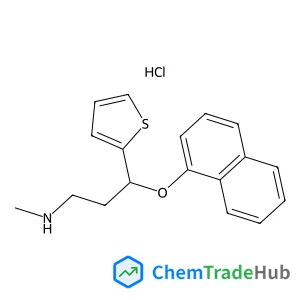
N-Methyl-3-(1-naphthyloxy)-3-(2-thienyl)-1-propanamine hydrochloride (1:1)
CAS Number:
1188266-11-6
Molecular Formula:
C18H20ClNOS
Jacopo Teotonico, Laura Ballester-Bayarri, Marta Ximenis
The rheological properties of vitrimer materials are largely controlled by the kinetics of covalent bond exchange and therefore a mechanistic understanding of bond exchange can provide insights into how the performance of vitrimers can be improved. In this work, density functional theory (DFT) calculations are combined with experimental measurements in order to understand the nature of the exchange reaction between boronic esters. Quantum chemical calculations show that both a metathesis and a nucleophile-mediated pathway are possible, although a significant increase in the rate of exchange in the presence of a nucleophile is observed. The DFT studies are supported by kinetic measurements of the exchange of small molecule dioxaborinanes in the presence and absence of nucleophile. Finally, the accelerating effect of nucleophiles is demonstrated in vitrimeric materials synthesized using a dioxaborinane-based crosslinker and a hydroxyl functional monomer as internal catalyst to produce vitrimers with significantly reduced relaxation times.

European Journal of Wood and Wood Products

Proceedings of the National Academy of Sciences of the United States of America

Journal of Catalysis

Planta Medica

Russian Chemical Reviews

Kinetics and Catalysis

Fibre Chemistry

Journal of Physics and Chemistry of Solids

Molecular Pharmacology

Organic Preparations and Procedures International
Jing-Hua Guo, Yoshiyuki Miyamoto
DOI: 10.1039/C3CP50492A
Jan Rongé, Dorien Nijs, Stef Kerkhofs, Kasper Masschaele, Johan A. Martens
DOI: 10.1039/C3CP50890K
Yang Yu, Günter Dlubek, Reinhard Krause-Rehberg, Jürgen Pionteck, Dirk Pfefferkorn, Safak Bulut, Dana Bejan, Christian Friedrich
DOI: 10.1039/C3CP43306D
Ying Dai, Baibiao Huang, Timo Jacob
DOI: 10.1039/C3CP51078F
Masatoshi Nakatani, Atsushi Nobuhiro, Nobuhiko Yokoshi, Hajime Ishihara
DOI: 10.1039/C3CP43834A
Deepthi Jose, A. Nijamudheen
DOI: 10.1039/C3CP51028J
Zhifeng Liu, Xinqiang Wang, Gaobin Liu, Jian Sui, Xuefang Wang, Hengjiang Zhu, Zhilin Hou
DOI: 10.1039/C3CP50814E
C. J. Benmore, M. C. Wilding, S. K. Tumber
DOI: 10.1039/C3CP44347G
Kwan Kim, Kyung Lock Kim, Kuan Soo Shin
DOI: 10.1039/C3CP51204E
Damien Thompson, Mateusz Sikora, Piotr Szymczak, Marek Cieplak
DOI: 10.1039/C3CP50523E
N-(4-Methoxybenzyl)-2-pyridinamine (CAS: 52818-63-0) is increasingly being used ...
When handling Ethyl 4-(2-chlorophenyl)-1,3-thiazole-2-carboxylate, appropriate p...
Diethyldiselane (CAS: 628-39-7) is classified under the Globally Harmonized Syst...
The market for oxocopper (CAS: 12053-18-8) is primarily driven by its use in cat...
The market for 5-{[(2-Methyl-2-propanyl)oxy]carbonyl}-5-azaspiro[2.4]heptane-7-c...
2-(1-Pyrrolidinyl)-4-pyridinamine is a chemical compound with the CAS number 359...
2-(3-Pyridinyl)-1-azabicyclo[2.2.2]octane (CAS: 91556-75-1) is a crystalline sol...
(S)-Alpha-allyl-proline hydrochloride is usually synthesized via a Wittig reacti...
3-Methyl-1,2-oxazole-5-carboxylic acid (CAS: 4857-42-5) is an organic compound w...
Lys-SMCC-DM1 is synthesized via a multi-step process involving the coupling of S...

Polymer Chemistry welcomes submissions in all areas of polymer science that have a strong focus on macromolecular chemistry. Manuscripts may cover a broad range of fields, yet no direct application focus is required.
![1,10-bis(3,5-dimethylphenyl)-12-hydroxy-4,5,6,7-tetrahydroiindeno[7,1-de:1',7'-fg][1,3,2]dioxaphosphocine 12-oxide structure](https://static.chemtradehub.com/structs/141/1412439-82-7-b9a9.webp "1,10-bis(3,5-dimethylphenyl)-12-hydroxy-4,5,6,7-tetrahydroiindeno[7,1-de:1',7'-fg][1,3,2]dioxaphosphocine 12-oxide structure")





