












![5'-Fluoro-[2,3'-biindolinylidene]-2',3-dione structure](https://static.chemtradehub.com/structs/251/251903-00-1-9cb1.webp "5'-Fluoro-[2,3'-biindolinylidene]-2',3-dione structure")
Synthesis and characterization of bio-based transesterification catalysts for green 3D-printable dynamic photopolymers
Literature Information
Publication Date
2023-10-19
DOI
10.1039/D3PY00989K
Impact Factor
5.582
Authors
Bernhard Sölle, Usman Shaukat, Elisabeth Rossegger, Sandra Schlögl
View Original
Abstract
To strive towards high-performance polymers with better sustainability, classical thermosets have to be replaced by materials that are recyclable, repairable or reusable whilst still retaining their excellent mechanical properties. The use of dynamic covalent polymers is one strategy to meet this ambitious aim. Herein, we synthesized organic phosphates derived from bio-based precursors, which efficiently promoted bond exchange reactions between hydroxyl ester links at elevated temperature. The new catalysts were obtained at high yields and were readily soluble in various commercially available photoreactive resins. However, in aiming at the preparation of fully bio-based dynamic photopolymers, the new catalysts were introduced in acrylated linseed oil (AELO). To reduce the viscosity and improve the printability of the AELO resin, acrylated eugenol (AEUG) was synthesized and added to the formulation as a bio-derived reactive diluent. The high cure rate and low viscosity of the resins enabled the fabrication of complex 3D objects via vat photopolymerization 3D printing. Once photocured, the 3D-printed photopolymers comprised ample –OH and ester moieties, which underwent thermo-activated transesterification in the presence of the new catalysts. In particular, photocured networks containing AELO and AEUG in a 1 : 1 weight ratio and 5 wt% of a eugenol-based phosphate exhibited high thermal stability (>200 °C) and were able to relax 63% of the original stress within 65 min at 180 °C. The related elastic material recovery was then exploited to thermally heal and re-shape 3D-printed objects, giving rise to the efficiency and versatility of the newly developed dynamic photopolymers.
Related Literature
Receptor-targeting fluorescence imaging and theranostics using a graphene oxide based supramolecular glycocomposite
Ding-Kun Ji, Yi Zang, Wang Liu, Xiongwen Zhang, Jia Li, Guo-Rong Chen, Tony D. James, Xiao-Peng He
2015-11-06
Paper
DOI: 10.1039/C5TB02057C
Balancing stability and specific energy in Li-rich cathodes for lithium ion batteries: a case study of a novel Li–Mn–Ni–Co oxide
Qi Li, Guangshe Li, Chaochao Fu, Dong Luo, Jianming Fan, Dongjiu Xie, Liping Li
2015-04-24
Paper
DOI: 10.1039/C5TA00929D
Graphene nanosheets, carbon nanotubes, graphite, and activated carbon as anode materials for sodium-ion batteries
Xu-Feng Luo, Cheng-Hsien Yang, You-Yu Peng, Nen-Wen Pu, Ming-Der Ger, Chien-Te Hsieh, Jeng-Kuei Chang
2015-04-15
Paper
DOI: 10.1039/C5TA00727E
Ratiometric fluorescent probes based on through-bond energy transfer of cyanine donors to near-infrared hemicyanine acceptors for mitochondrial pH detection and monitoring of mitophagy
Shuai Xia, Yibin Zhang, Nick Whisman, Jianheng Bi, Tessa E. Steenwinkel, Shulin Wan, Jerry Medford, Momoko Tajiri, Rudy L. Luck, Thomas Werner, Haiying Liu
2019-12-11
Paper
DOI: 10.1039/C9TB02302J
Self-defending additively manufactured bone implants bearing silver and copper nanoparticles
I. A. J. van Hengel, M. W. A. M. Tierolf, V. P. M. Valerio, M. Minneboo, A. C. Fluit, L. E. Fratila-Apachitei, I. Apachitei, A. A. Zadpoor
2019-12-13
Paper
DOI: 10.1039/C9TB02434D
Correction: Biodegradable nanoparticles bearing amine groups as a strategy to alter surface features, biological identity and accumulation in a lung metastasis model
Diletta Esposito, Claudia Conte, Giovanni Dal Poggetto, Annapina Russo, Antonio Barbieri, Francesca Ungaro, Claudio Arra, Giulia Russo, Paola Laurienzo, Fabiana Quaglia
2018-11-06
Correction
DOI: 10.1039/C8TB90153H
Rational design of stable heptamethine cyanines and development of a biomarker-activatable probe for detecting acute lung/kidney injuries via NIR-II fluorescence imaging
Juan Ouyang, Lihe Sun, Fang Zeng, Shuizhu Wu
2021-12-17
Paper
DOI: 10.1039/D1AN02183D
You might also like
Compound Q&A
What is the market or research trend for N-(4-Methoxybenzyl)-2-pyridinamine (CAS: 52818-63-0)?
N-(4-Methoxybenzyl)-2-pyridinamine (CAS: 52818-63-0) is increasingly being used ...
52818-63-0N-(4-Methoxybenzyl)-...
Compound Q&A
What precautions should be taken when handling Ethyl 4-(2-chlorophenyl)-1,3-thiazole-2-carboxylate (CAS: 1050507-06-6)?
When handling Ethyl 4-(2-chlorophenyl)-1,3-thiazole-2-carboxylate, appropriate p...
1050507-06-6Ethyl 4-(2-chlorophe...
Compound Q&A
What regulatory guidelines apply to diethyldiselane (CAS: 628-39-7)?
Diethyldiselane (CAS: 628-39-7) is classified under the Globally Harmonized Syst...
628-39-7Diethyldiselane
Compound Q&A
What is the market or research trend for oxocopper (CAS: 12053-18-8)?
The market for oxocopper (CAS: 12053-18-8) is primarily driven by its use in cat...
12053-18-8oxocopper; oxo-(oxoc...
Compound Q&A
What is the market or research trend for 5-{[(2-Methyl-2-propanyl)oxy]carbonyl}-5-azaspiro[2.4]heptane-7-carboxylic acid?
The market for 5-{[(2-Methyl-2-propanyl)oxy]carbonyl}-5-azaspiro[2.4]heptane-7-c...
1268519-54-55-{[(2-Methyl-2-prop...
Compound Q&A
What is 2-(1-Pyrrolidinyl)-4-pyridinamine (CAS: 35981-63-6)?
2-(1-Pyrrolidinyl)-4-pyridinamine is a chemical compound with the CAS number 359...
35981-63-62-(1-Pyrrolidinyl)-4...
Compound Q&A
What are the physical and chemical properties of 2-(3-Pyridinyl)-1-azabicyclo[2.2.2]octane (CAS: 91556-75-1)?
2-(3-Pyridinyl)-1-azabicyclo[2.2.2]octane (CAS: 91556-75-1) is a crystalline sol...
91556-75-12-(3-Pyridinyl)-1-az...
Compound Q&A
How is (S)-Alpha-allyl-proline hydrochloride (CAS: 129704-91-2) typically synthesized?
(S)-Alpha-allyl-proline hydrochloride is usually synthesized via a Wittig reacti...
129704-91-2(S)-Alpha-allyl-prol...
Compound Q&A
What is 3-Methyl-1,2-oxazole-5-carboxylic acid (CAS: 4857-42-5)?
3-Methyl-1,2-oxazole-5-carboxylic acid (CAS: 4857-42-5) is an organic compound w...
4857-42-53-Methyl-1,2-oxazole...
Compound Q&A
How is Lys-SMCC-DM1 (CAS: 1281816-04-3) typically synthesized?
Lys-SMCC-DM1 is synthesized via a multi-step process involving the coupling of S...
1281816-04-3Lys-SMCC-DM1
Source Journal
Polymer Chemistry

CiteScore:
8.6
Self-citation Rate:
7.3%
Articles per Year:
457
Polymer Chemistry welcomes submissions in all areas of polymer science that have a strong focus on macromolecular chemistry. Manuscripts may cover a broad range of fields, yet no direct application focus is required.
Recommended Compounds
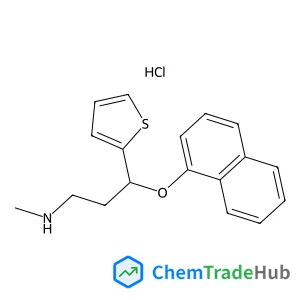
N-Methyl-3-(1-naphthyloxy)-3-(2-thienyl)-1-propanamine hydrochloride (1:1)
CAS Number:
1188266-11-6
Molecular Formula:
C18H20ClNOS

![1-(1-Benzyl-1,2,3,6-tetrahydropyridin-4-yl)-1H-benzo[d]imidazol-2(3H)-one structure](https://static.chemtradehub.com/structs/603/60373-71-9-7dfb.webp "1-(1-Benzyl-1,2,3,6-tetrahydropyridin-4-yl)-1H-benzo[d]imidazol-2(3H)-one structure")
1-(1-Benzyl-1,2,3,6-tetrahydropyridin-4-yl)-1H-benzo[d]imidazol-2(3H)-one
CAS Number:
60373-71-9
Molecular Formula:
C19H19N3O
![N-{15-[(2,5-Dioxo-1-pyrrolidinyl)oxy]-15-oxo-3,6,9,12-tetraoxapentadec-1-yl}-2-(2-propyn-1-yloxy)acetamide structure](https://static.chemtradehub.com/structs/210/2101206-92-0-2eb5.webp "N-{15-[(2,5-Dioxo-1-pyrrolidinyl)oxy]-15-oxo-3,6,9,12-tetraoxapentadec-1-yl}-2-(2-propyn-1-yloxy)acetamide structure")
N-{15-[(2,5-Dioxo-1-pyrrolidinyl)oxy]-15-oxo-3,6,9,12-tetraoxapentadec-1-yl}-2-(2-propyn-1-yloxy)acetamide
CAS Number:
2101206-92-0
Molecular Formula:
C20H30N2O10
Recommended Suppliers








Disclaimer
This page provides academic journal information for reference and research purposes only. We are not affiliated with any journal publishers and do not handle publication submissions. For publication-related inquiries, please contact the respective journal publishers directly.
If you notice any inaccuracies in the information displayed, please contact us at support@chemtradehub.com. We will promptly review and address your concerns.