












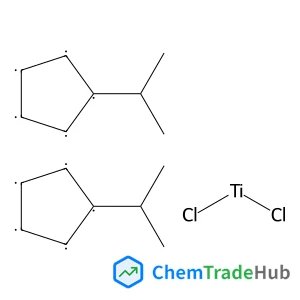
BIS(I-PROPYLCYCLOPENTADIENYL)TITANIUM DICHLORIDE
CAS Number:
12130-65-3
Molecular Formula:
C16H22Cl2Ti
A graphical abstract is available for this content
David J. Chadderdon, Le Xin, Ji Qi, Yang Qiu, Phani Krishna, Karren L. More, Wenzhen Li
DOI: 10.1039/C4GC00401A
Luigi Vaccaro, Daniela Lanari, Assunta Marrocchi, Giacomo Strappaveccia
DOI: 10.1039/C4GC00410H
Pranit S. Metkar, Mark A. Scialdone, Kenneth G. Moloy
DOI: 10.1039/C4GC01167H
Liyuan Zhang, Yangyang Wang, Wanting Yu, Baiwan Deng, Kai Zhang, Jiexi Wang
DOI: 10.1039/C4GC00761A
Kanagasabai Balamurugan, Noppadon Sathitsuksanoh, Sonny Zhang, Venkatesan Subramanian
DOI: 10.1039/C4GC00373J
Zhicheng Jiang, Ting He, Jianmei Li, Changwei Hu
DOI: 10.1039/C4GC00620H
Valeria Bugatti, Bluma Guenther Soares
DOI: 10.1039/C4GC00969J
Martin Trautmann, Yvonne Traa
DOI: 10.1039/C4GC00649F
Peter A. Bayliss, Eduardo Pérez, Sihai Yang, Chiu C. Tang, Martyn Poliakoff, Martin Schröder
DOI: 10.1039/C4GC00313F
Guangzheng Gao, Muzaffer A. Karaaslan, John F. Kadla, Frank Ko
DOI: 10.1039/C4GC00757C
2-Methylbenzene-1,4-diamine dihydrochloride (CAS: 615-45-2) should be stored in ...
(1S,4S)-2,5-Diazabicyclo[2.2.1]heptane dihydrobromide is generally considered sa...
(6-Chloropyridazin-3-YL)methanamine finds applications in the pharmaceutical ind...
2-Fluoro-3-methylphenol is primarily used in the synthesis of pharmaceuticals, p...
When handling 3-Methoxy-4-nitrobenzonitrile, it is important to wear appropriate...
When handling 1,3-Oxazolo[4,5-b]pyridine-2(3H)-thione (CAS: 211949-57-4), it is ...
4-Ethynylbenzamide (CAS: 90347-86-7) falls under various regulatory guidelines i...
3-(2-Ethylphenyl)-2-thioxo-4-imidazolidinone is primarily used as an intermediat...
(2-Fluoro-6-methoxyphenyl)acetic acid, also known as 4-fluoro-3-methoxybenzoic a...
Market trends for 2-[4-(Hydroxymethyl)phenoxy]ethanol (CAS: 102196-18-9) indicat...

Organic & Biomolecular Chemistry (OBC) publishes original and high impact research and reviews in organic chemistry. We welcome research that shows new or significantly improved protocols or methodologies in total synthesis, synthetic methodology or physical and theoretical organic chemistry as well as research that shows a significant advance in the organic chemistry or molecular design aspects of chemical biology, catalysis, supramolecular and macromolecular chemistry, theoretical chemistry, mechanism-oriented physical organic chemistry, medicinal chemistry or natural products. Articles published in the journal should report new work which makes a highly-significant impact in the field. Routine and incremental work is generally not suitable for publication in the journal. More details about key areas of our scope are below. In all cases authors should include in their article clear rationale for why their research has been carried out.

![(3R,4aR,7aS,9aR,10S,11R,13aR,13bS,15aS,15bR)-3,11-Dihydroxy-10-(hydroxymethyl)-4,4,7a,10,13a,15b-hexamethyl-1,2,3,4,4a,7,7a,8,9,9a,10,11,12,13,13a,13b,14,15,15a,15b-icosahydro-5H-naphtho[2',1':4,5]cyc
lohepta[1,2-a]naphthalen-5-one structure](https://static.chemtradehub.com/structs/538/53800-21-8-9f18.webp "(3R,4aR,7aS,9aR,10S,11R,13aR,13bS,15aS,15bR)-3,11-Dihydroxy-10-(hydroxymethyl)-4,4,7a,10,13a,15b-hexamethyl-1,2,3,4,4a,7,7a,8,9,9a,10,11,12,13,13a,13b,14,15,15a,15b-icosahydro-5H-naphtho[2',1':4,5]cyc
lohepta[1,2-a]naphthalen-5-one structure")




