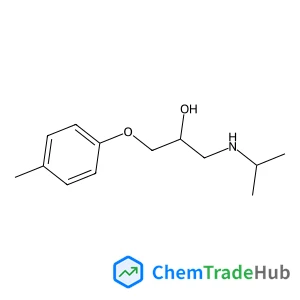
1-(4-Methylphenoxy)-3-(propan-2-ylamino)propan-2-ol
CAS Number:
5790-46-5
Molecular Formula:
C13H21NO2
Elmehdi Moumen, Khaireddin Boukayouht, Soraia Elmoutchou, Said Kounbach, Samir El Hankari
The exploration of metal–organic frameworks (MOFs) in the adsorption of phosphate is a growing research area. However, the manufacturing and processability of MOFs for practical applications are often hindered by their cost and their powder form. This study pioneers the use of water-soluble organic ligands, specifically disodium terephthalate (DST) sourced from waste plastic, in the design and assembly of different MOFs such as Fe-MOF, Zr-MOF and Al-MOF in an aqueous medium. The Fe-MOF had a superior phosphate adsorption capacity (72.16 mg g−1) which led us to process the Fe-MOF into PET composite chips to enhance its recovery and recycling processes. The effect of some parameters such as contact time, the initial concentration, pH, and temperature was investigated. This innovative approach showcases the potential of sustainable MOF materials in addressing phosphate removal challenges while promoting environmental awareness.

Pharmacological Reviews

Journal of Catalysis

Nature

Kinetics and Catalysis

Science

Israel Journal of Chemistry

Journal of Heterocyclic Chemistry

Proceedings of the National Academy of Sciences of the United States of America

Journal of Organometallic Chemistry

Organic Preparations and Procedures International
Jan Weiss, Ang Li, Erik Wischerhoff
DOI: 10.1039/C1PY00422K
Soma Mukherjee, Philip J. Costanzo
DOI: 10.1039/C1PY00451D
Hirofumi Tsuruta, Yoshihisa Fujii, Keiji Tanaka
DOI: 10.1039/C1PY00488C
Fei Cheng, Frieder Jäkle
DOI: 10.1039/C1PY00123J
Ozcan Altintas, Andrew P. Vogt, Christopher Barner-Kowollik, Umit Tunca
DOI: 10.1039/C1PY00249J
Costantino Creton
DOI: 10.1039/C1PY00341K
Jiacheng Wang, Yoichi Masui, Makoto Onaka
DOI: 10.1039/C2PY00002D
Charlotte Juel Fristrup, Katja Jankova, Rüya Eskimergen, Jens T. Bukrinsky, Søren Hvilsted
DOI: 10.1039/C1PY00347J
Aymeric Guinaudeau, Stéphane Mazières, D. James Wilson, Mathias Destarac
DOI: 10.1039/C1PY00373A
4-(4-tert-Butylphenyl)-1H-pyrazol-3-amine finds applications in various industri...
H3TATAB is used in the pharmaceutical industry for the synthesis of certain orga...
1-Ethyl-3-fluorobenzene (CAS: 696-39-9) is primarily used as a precursor in the ...
1-(tert-Butoxycarbonyl)-4-(4-methoxyphenyl)pyrrolidine-3-carboxylic acid is prim...
1-Cyclobutyl-4-piperidinone (CAS: 359880-05-0) is a colorless or white crystalli...
Pyridine-2,6-dicarboxylic acid mono-tert-butyl ester (CAS: 575433-76-0) is a che...
The market for 2,3-Difluorophenylalanine (CAS: 236754-62-4) is growing with incr...
(2-Hydroxy-1-naphthyl)boronic acid can be synthesized through the reduction of 2...
This compound is a crystalline solid with a molecular weight of approximately 52...
While 5,7-Dihydroxy-4-oxo-2-(3,4,5-trihydroxyphenyl)-4H-chromen-3-yl beta-D-gluc...

NJC (New Journal of Chemistry) is a broad-based primary journal encompassing all branches of chemistry and its sub-disciplines. It contains full research articles, communications, perspectives and focus articles. This well-established journal, owned by the Centre National de la Recherche Scientifique (CNRS) of France, has been co-published with the Royal Society of Chemistry since January 1998. NJC is the forum for the publication of high-quality, original and significant work that opens new directions in chemistry or other scientific disciplines. In addition to having a significant chemical component, work published in NJC must demonstrate that it will have an impact on areas of research other than that of the reported work.