












pH-dependent adsorption of the sulfamethoxazole antibiotic on HKUST-1@CNS nanocomposite corroborating efficiency, mechanistic, and kinetic studies
Literature Information
Publication Date
2024-01-05
DOI
10.1039/D3NJ04424F
Impact Factor
3.591
Authors
Geetika Jain, Puja Bhattacharyya, Mrinal Kanti Mandal, Rajib Ghosh Chaudhuri, Sandip Chakrabarti
View Original
Abstract
Sulfonamide antibiotics, such as sulfamethoxazole (SMX), are found to be pollutants mostly generated from pharmaceutical wastewater with very high detection levels. The stability of SMX in water poses potential risks to ecosystems and aquatic organisms. Thus, we have taken the initiative to remove SMX from wastewater using a metal–organic framework (MOF) based nanocomposite. Our research work presents the nanocomposite of carbon nanosheets (CNS) and HKUST-1 for the first time, which is a non-toxic and economically viable adsorbent having a good surface area. HKUST-1@CNS, for effective removal of SMX from aqueous solutions, was synthesized using a simple solvothermal process followed by calcination at elevated temperature. A detailed time-dependent adsorption study of the HKUST-1@CNS nanocomposite adsorbent discloses a high 96.1% removal efficiency in only 90 min for SMX. Significant improvements in adsorption behavior have been observed for HKUST-1@CNS compared to its parent analogues. The reaction kinetics fit the pseudo-second-order reaction and the experimental adsorption data complement the Langmuir isotherm model, indicating a chemisorption route for the adsorption. The pH of the medium plays a pivotal role in the adsorption process of SMX. The adsorption behavior of HKUST-1@CNS towards SMX remains almost unchanged even after four cycles of adsorption experiments. HKUST-1@CNS was further exposed to aqueous solutions of three other antibiotics, revealing its high adsorption efficiency towards these antibiotics. The overall results indicate the utility of HKUST-1@CNS as a potential material for wastewater treatment.
Related Literature
Synthesis of highly reactive polyisobutylene with FeCl3/ether complexes in hexane; kinetic and mechanistic studies
Rajeev Kumar, Priyadarsi De, Bin Zheng, Kuo-Wei Huang, Jack Emert, Rudolf Faust
2014-09-12
Paper
DOI: 10.1039/C4PY01039F
UV-triggered thiol–disulfide exchange reaction towards tailored biodegradable hydrogels
Linlin Wang, Lei Li, Xing Wang, Da Huang, Fei Yang, Hong Shen, Zichen Li, Decheng Wu
2016-01-08
Paper
DOI: 10.1039/C5PY01925G
Exploiting nucleobase-containing materials – from monomers to complex morphologies using RAFT dispersion polymerization
Yan Kang, Anaïs Pitto-Barry, Helen Willcock, Wen-Dong Quan, Nigel Kirby, Ana M. Sanchez, Rachel K. O'Reilly
2014-09-11
Paper
DOI: 10.1039/C4PY01074D
Dendrimer-like conjugated microporous polymers
Ting Wang, Wei Huang, Jia-Xing Jiang, Zhengkun Du, Fa-Kuen Shieh, Renqiang Yang
2016-01-04
Paper
DOI: 10.1039/C5PY01767J
Poly(2-cycloalkyl-2-oxazoline)s: high melting temperature polymers solely based on Debye and Keesom van der Waals interactions
Kathleen Lava, Bart Verbraeken, Richard Hoogenboom
2015-12-28
Paper
DOI: 10.1039/C5PY01755F
Efficient synthesis and photovoltaic properties of highly rigid perylene-embedded benzothiazolyls
Runfeng Chen, Chunhua Zheng, Cong Li, Huanhuan Li, Zhixiang Wang, Yuting Tang, Hongji Jiang, Zhanao Tan
2015-12-09
Communication
DOI: 10.1039/C5PY01791B
A 3-D multicellular tumor spheroid on ultrathin matrix coated single cancer cells provides a tumor microenvironment model to study epithelial-to-mesenchymal transitions
Tingting Zhao, Xiaoping Song, Wen Zhong, Lei Yu, Wenxi Hua, Malcolm M. Q. Xing, Xiaozhong Qiu
2014-09-10
Paper
DOI: 10.1039/C4PY01161A
pH dependent thermoresponsive behavior of acrylamide–acrylonitrile UCST-type copolymers in aqueous media
Beatriz A. Pineda-Contreras, Holger Schmalz, Seema Agarwal
2016-02-12
Paper
DOI: 10.1039/C6PY00162A
Synthesis, morphology, and electrical memory application of oligosaccharide-based block copolymers with π-conjugated pyrene moieties and their supramolecules
Han-Sheng Sun, Yougen Chen, Wen-Ya Lee, Yu-Cheng Chiu, Takuya Isono, Toshifumi Satoh, Toyoji Kakuchi, Wen-Chang Chen
2015-12-09
Paper
DOI: 10.1039/C5PY01697E
Novel poly(triphenylamine-alt-fluorene) with asymmetric hexaphenylbenzene and pyrene moieties: synthesis, fluorescence, flexible near-infrared electrochromic devices and theoretical investigation
Po-I. Wang, Wan-Ru Shie, Jyh-Chiang Jiang, Lain-Jong Li, Der-Jang Liaw
2016-01-13
Paper
DOI: 10.1039/C5PY01971K
You might also like
Compound Q&A
How should waste containing (6-Bromo-2-naphthyl)oxy](dimethyl)(2-methyl-2-propanyl)silane be handled?
Waste containing (6-Bromo-2-naphthyl)oxy](dimethyl)(2-methyl-2-propanyl)silane (...
100751-65-3[(6-Bromo-2-naphthyl...
Compound Q&A
How is 7-Fluoro-4-isoquinolinecarboxylic acid (CAS: 1841081-40-0) typically synthesized?
7-Fluoro-4-isoquinolinecarboxylic acid can be synthesized via a multi-step proce...
1841081-40-07-Fluoro-4-isoquinol...
Compound Q&A
What are the physical and chemical properties of 2,3,5,6-Tetrabromothieno[3,2-b]thiophene (CAS: 124638-53-5)?
2,3,5,6-Tetrabromothieno[3,2-b]thiophene is a crystalline compound with a high m...
124638-53-52,3,5,6-Tetrabromoth...
Compound Q&A
Is 1-[4-(Benzylamino)-7,8-dihydro-5H-pyrano[4,3-d]pyrimidin-2-yl]-2-methyl-1H-indole-4-carboxamide (CAS: 1542705-92-9) safe?
1-[4-(Benzylamino)-7,8-dihydro-5H-pyrano[4,3-d]pyrimidin-2-yl]-2-methyl-1H-indol...
1542705-92-91-[4-(Benzylamino)-7...
Compound Q&A
What is the market or research trend for imidazo[5,1-d]-1,2,3,5-tetrazine-8-carboxylic acid, 3,4-dihydro-3-methyl-4-oxo- (CAS: 113942-30-6)?
The market for imidazo[5,1-d]-1,2,3,5-tetrazine-8-carboxylic acid, 3,4-dihydro-3...
113942-30-6Imidazo[5,1-d]-1,2,3...
Compound Q&A
What is 3-(Triisopropylsilyl)propiolaldehyde (CAS: 163271-80-5)?
3-(Triisopropylsilyl)propiolaldehyde is a synthetic organic compound with the CA...
163271-80-53-(Triisopropylsilyl...
Compound Q&A
What regulatory guidelines apply to 6-Nitro-2H-1,4-benzoxazin-3(4H)-one (CAS: 81721-87-1)?
6-Nitro-2H-1,4-benzoxazin-3(4H)-one (CAS: 81721-87-1) is subject to various regu...
81721-87-16-Nitro-2H-1,4-benzo...
Compound Q&A
How should waste containing (3-Fluorophenyl)(4-{[(2-methyl-2-propanyl)oxy]carbonyl}-1-piperazinyl)acetic acid (CAS: 885272-91-3) be handled?
Waste containing (3-Fluorophenyl)(4-{[(2-methyl-2-propanyl)oxy]carbonyl}-1-piper...
885272-91-3(3-Fluorophenyl)(4-{...
Compound Q&A
What are the physical and chemical properties of N,N'-4,4'-Biphenyldiyldiisonicotinamide (CAS: 55119-40-9)?
N,N'-4,4'-Biphenyldiyldiisonicotinamide is a white crystalline solid with a mole...
55119-40-9N,N'-4,4'-Biphenyldi...
Compound Q&A
What industries use 6-Bromo-8-fluoro-2-quinazolinol (CAS: 1036756-15-6)?
6-Bromo-8-fluoro-2-quinazolinol is primarily used in the pharmaceutical industry...
1036756-15-66-Bromo-8-fluoro-2-q...
Source Journal
New Journal of Chemistry

CiteScore:
5.3
Self-citation Rate:
3.7%
Articles per Year:
2153
NJC (New Journal of Chemistry) is a broad-based primary journal encompassing all branches of chemistry and its sub-disciplines. It contains full research articles, communications, perspectives and focus articles. This well-established journal, owned by the Centre National de la Recherche Scientifique (CNRS) of France, has been co-published with the Royal Society of Chemistry since January 1998. NJC is the forum for the publication of high-quality, original and significant work that opens new directions in chemistry or other scientific disciplines. In addition to having a significant chemical component, work published in NJC must demonstrate that it will have an impact on areas of research other than that of the reported work.
Recommended Compounds
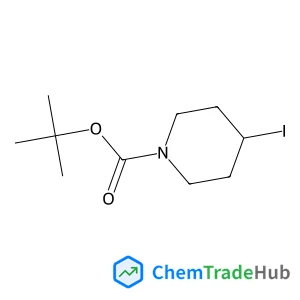
2-Methyl-2-propanyl 4-iodo-1-piperidinecarboxylate
CAS Number:
301673-14-3
Molecular Formula:
C10H18INO2


Recommended Suppliers






Disclaimer
This page provides academic journal information for reference and research purposes only. We are not affiliated with any journal publishers and do not handle publication submissions. For publication-related inquiries, please contact the respective journal publishers directly.
If you notice any inaccuracies in the information displayed, please contact us at support@chemtradehub.com. We will promptly review and address your concerns.