












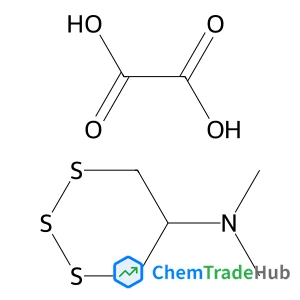
Oxalic acid compound with cyclohexylsulfamothioic O-acid (11)
CAS Number:
31895-22-4
Molecular Formula:
C7H13NO4S3
Kathleen Lava, Bart Verbraeken, Richard Hoogenboom
The synthesis of new 2-cycloalkyl-2-oxazoline monomers, namely 2-cyclobutyl (cBuOx), 2-cyclopentyl (cPentOx) and 2-cyclohexyl-2-oxazoline (cHexOx) is described. Their microwave-assisted cationic ring-opening polymerisation allowed the synthesis of well-defined homopolymers. The resulting homopolymers are crystalline and have high chemical resistance to organic solvents. The highest melting point was registered for cPentOx (306 °C), followed by cHexOx (251 °C) and cBuOx (243 °C). The crystal structure of the homopolymers was put into evidence by X-ray diffraction and appeared to be similar to that of the poly(2-isopropyl-2-oxazoline). The absence of any hydrogen bonding or π–π interactions, makes these compounds a special class of high performance polymers which possess high Tm solely based on Debye and Keesom van der Waals interactions of the side-chains. The copolymerization of cPentOx with 2-ethyl-2-oxazoline (EtOx) and cBuOx, respectively are also reported indicating the formation of near ideal random copolymers. Furthermore, the copolymers of cPentOx with cBuOx with compositions in the range from 0 to 100% revealed a linear dependence of melting temperature with the weight fraction of comonomer. For cPentOx-EtOx copolymers containing up to 25 wt% EtOx a linear decrease of the melting temperature with composition was registered, most likely due to the disturbance of the cPentOx crystalline domains. Further, increasing the EtOx wt% revealed a complex non-linear dependence of glass transition temperature on composition, whereby the glass transition temperature of some copolymers was lower than for pure PEtOx.
James Hudson, Anthony E. G. Cass, B. S. Prabhananda
DOI: 10.1039/B110495K
Takashi Yamamoto, Tsunehiro Tanaka, Ryoji Kuma, Sosuke Suzuki, Fumiaki Amano, Yutaka Shimooka, Yoshiumi Kohno, Takuzo Funabiki, Satohiro Yoshida
DOI: 10.1039/B201120B
M. Benjelloun, P. Cool, P. Van Der Voort, E. F. Vansant
DOI: 10.1039/B108361A
DOI: 10.1039/B110517E
Lavina C. Snoek, Romano T. Kroemer, John P. Simons
DOI: 10.1039/B200059H
Yoshikazu Miyake, Toshimi Yumoto, Hajime Kitamura, Taichi Sugimoto
DOI: 10.1039/B200074C
DOI: 10.1039/B110996K
Tsuneo Okubo, Hiroshi Kimura, Tohru Hatta, Takaharu Kawai
DOI: 10.1039/B109963A
Waste containing (6-Bromo-2-naphthyl)oxy](dimethyl)(2-methyl-2-propanyl)silane (...
7-Fluoro-4-isoquinolinecarboxylic acid can be synthesized via a multi-step proce...
2,3,5,6-Tetrabromothieno[3,2-b]thiophene is a crystalline compound with a high m...
1-[4-(Benzylamino)-7,8-dihydro-5H-pyrano[4,3-d]pyrimidin-2-yl]-2-methyl-1H-indol...
The market for imidazo[5,1-d]-1,2,3,5-tetrazine-8-carboxylic acid, 3,4-dihydro-3...
3-(Triisopropylsilyl)propiolaldehyde is a synthetic organic compound with the CA...
6-Nitro-2H-1,4-benzoxazin-3(4H)-one (CAS: 81721-87-1) is subject to various regu...
Waste containing (3-Fluorophenyl)(4-{[(2-methyl-2-propanyl)oxy]carbonyl}-1-piper...
N,N'-4,4'-Biphenyldiyldiisonicotinamide is a white crystalline solid with a mole...
6-Bromo-8-fluoro-2-quinazolinol is primarily used in the pharmaceutical industry...

Polymer Chemistry welcomes submissions in all areas of polymer science that have a strong focus on macromolecular chemistry. Manuscripts may cover a broad range of fields, yet no direct application focus is required.
![5-Bromoimidazo[1,2-a]pyridine structure](https://static.chemtradehub.com/structs/692/69214-09-1-d8e2.webp "5-Bromoimidazo[1,2-a]pyridine structure")





