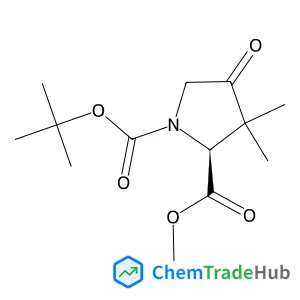
2-Methyl 1-(2-methyl-2-propanyl) (2S)-3,3-dimethyl-4-oxo-1,2-pyrrolidinedicarboxylate
CAS Number:
478698-30-5
Molecular Formula:
C13H21NO5
Abhishek Shibu, Sean Jones, P. Lane Tolley, David Diaz, Carly O. Kwiatkowski, Daniel S. Jones, Jessica M. Shivas, Jonathan J. Foley, IV, Thomas A. Schmedake, Michael G. Walter
There is a growing demand for new fluorescent small molecule dyes for solid state applications in the photonics and optoelectronics industry. Thiazolo[5,4-d]thiazole (TTz) is an organic heterocycle moiety which has previously shown remarkable properties as a conjugated polymer and in solution-based studies. For TTz-based small molecules to be incorporated in solid-state fluorescence-based optical devices, a thorough elucidation of their structure–photophysical properties needs to be established. Herein, we have studied four TTz-based materials functionalized with alkyl appendages of varying carbon chain lengths. We report the single crystal structures of the TTz derivatives, three of which were previously unknown. The packing modes of the crystals reveal that molecular arrangements are largely governed by a chorus of synergistic intermolecular non-covalent interactions. Three crystals packed in herringbone mode and one crystal packed in slipped stacks proving that alkyl appendages modulate structural organization in TTz-based materials. Steady state and time-resolved photophysical properties of these crystals were studied via diffuse-reflectance, micro-Raman, and photoluminescence spectroscopy. The crystals fluoresce from orange-red to blue spanning through the whole gamut of the visible spectrum. We have established that photophysical properties are a function of crystal packing in symmetrically substituted TTz-based materials. This correlation was then utilized to fabricate crystalline blends. We demonstrate, for the first time, that symmetrically substituted donor–acceptor–donor TTz-based materials can be used for phosphor-converted color-tuning and white-light emission. Given the cost effectiveness, ease of synthesis and now a structure–photophysics correlation, we present a compelling case for the adoption of TTz-based materials in solid-state photonic and fluorescence-based optical devices.
Zeyang Zhang, Weidong Zhu, Dandan Chen, Wenming Chai, Dazheng Chen, He Xi, Jincheng Zhang, Chunfu Zhang, Yue Hao
DOI: 10.1039/D0SE00774A
Simon Fleischmann, Petr Formanek, Lars Borchardt
DOI: 10.1039/C6SE00034G
Zhong-Yue Wang, Rui Zheng, Wen-Jun Li, Yu-Jie Ma, Ke-Han Yu, Peng Lv, Wei Wei
DOI: 10.1039/D0SE00347F
Tais da C. Soares, Paulo R. M. Silva, Gilberto A. Romeiro, Mauricio G. Fonseca, Luciano N. Batista
DOI: 10.1039/C6SE00017G
Zhengjun Wu, Zhihong Liu
DOI: 10.1039/C5AN00357A
Jessica A. Ragas, Tracey A. Simmons, Patrick A. Limbach
DOI: 10.1039/A909709K
Clara Aranda, Cesar Cristobal, Cheng Li, Sven Huettner, Antonio Guerrero
DOI: 10.1039/C6SE00077K
Mau-Shiun Li, Pradip Kumar Roy, C. T. Wu
DOI: 10.1039/C5AN00546A
Rui Lu, Wen-Wei Li, Abraham Katzir, Yosef Raichlin, Han-Qing Yu, Boris Mizaikoff
DOI: 10.1039/C4AN01495B
Jérémie Courtois, Bin Wang, Isaac N. Abonee, Xiong Kun, Qiang Tian, Minhao Yan
DOI: 10.1039/D0SE00785D
2-(2-Chloroacetamido)-3-phenylpropanoic acid (CAS: 7765-11-9) is generally consi...
2-(Benzyloxy)-5-bromobenzoic acid can be handled safely if appropriate precautio...
(4-Methyl-1,2,5-oxadiazol-3-yl)methanamine hydrochloride is a chemical compound ...
2-(5-Hexylthiophen-2-yl)-4,4,5,5-tetramethyl-1,3,2-dioxaborolane (CAS: 917985-54...
While 4-(8-Methyl-9H-1,3-dioxolo[4,5-h][2,3]benzodiazepin-5-yl)benzenamine (CAS:...
The market for tert-butyl 3-hydroxy-4,5,7,8-tetrahydro-2H-pyrazolo[3,4-d]azepine...
Waste containing 3,5-Diamino-1H-pyrazole-4-carbonitrile (CAS: 6844-58-2) should ...
(6-Fluoro-3-pyridinyl)boronic acid can be synthesized through the reaction of 6-...
Dibenzyl carbonimidoylbiscarbamate (CAS: 10065-79-9) finds applications in vario...
The market for (beta,beta,2,3,4,5,6-~2~H_7_)Phenylalanine (CAS: 74228-83-4) is g...
![2-(5-Bromo-1H-pyrrolo[2,3-B]pyridin-3-YL)acetic acid structure](https://static.chemtradehub.com/structs/106/1060795-03-0-0589.webp "2-(5-Bromo-1H-pyrrolo[2,3-B]pyridin-3-YL)acetic acid structure")