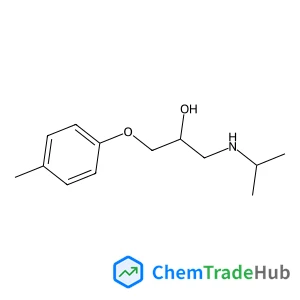
1-(4-Methylphenoxy)-3-(propan-2-ylamino)propan-2-ol
CAS Number:
5790-46-5
Molecular Formula:
C13H21NO2
Amjad Ali Pasha, Hukam Khan, Mohammad Sohail, Nasir Rahman, Rajwali Khan, Omar H. Alsalmi, Dilsora Abduvalieva, Khamael M. Abualnaja, Atef El Jery, Mouataz Adrdery
SiMO3 (M = Sn, Ge) silicon-based oxide perovskite compounds are studied using density functional theory (DFT) and Wien2k software to examine their structural, elastic, optical, and electronic properties. The Birch–Murnaghan equation is used to optimize SiSnO3 and SiGeO3 compounds and deliver structural stability, whereas the IRelast program is used to find elastic constants to confirm the flexible stability as well as the elastic behavior of the presented compounds. These compounds resist plastic strain and are ductile, scratch resistant, anisotropic, and mechanically stable. The Trans-Blaha modified Becke–Johnson potential approximation calculations demonstrate that the band structure of SiSnO3 is intermetallic, whereas the second compound, SiGeO3, is a semiconductor. The evidence obtained from the band structure and density of states of the these compounds demonstrates that SiSnO3 has an indirect band gap, and the minima of the conduction band are at evenness point X, whereas the maxima of the valence band are at symmetry points M, resulting in an indirect band gap (X–M). Meanwhile, SiGeO3 has a direct band gap, and the minima of the valence band and maxima of the conduction band occur at symmetry points X. These crystals have low-energy absorption. If we examine the reflectance of ternary molecules SiGeO3 has a low absorption of up to 2 eV with fluctuations and the absorption increases to a maximum value of 40.0 at 6.50 eV. In contrast, SiSnO3 exhibits a different increase, and the absorption coefficient decreases to the lowest value of 12.4 eV. Our optical property analysis showed that SiSnO3 and SiGeO3 can be used in high-frequency ultraviolet devices. To the best of our knowledge, this is the first DFT-based examination of the characteristics of these crystals.

Russian Chemical Reviews

Journal of Physics and Chemistry of Solids

Science

European Journal of Wood and Wood Products

Organic Preparations and Procedures International

Kinetics and Catalysis

Helvetica Chimica Acta

Journal of Catalysis

Proceedings of the National Academy of Sciences of the United States of America

Pure and Applied Chemistry
Fei Cheng, Frieder Jäkle
DOI: 10.1039/C1PY00123J
Boris Estrine, Norbert Hoffmann, Jean Le Bras, Siniša Marinković, Jacques Muzart
DOI: 10.1039/C5RE00004A
Minoru Sohmiya, Shingo Omata
DOI: 10.1039/C2PY00465H
Jose Ramos, Ainara Imaz, Jacqueline Forcada
DOI: 10.1039/C2PY00485B
Zhongmin Dong, Zhibin Ye
DOI: 10.1039/C1PY00368B
Issam Blidi, Roland Geagea, Olivier Coutelier, Stéphane Mazières, Frédéric Violleau, Mathias Destarac
DOI: 10.1039/C2PY00541G
Julia N. Dobish, Sharon K. Hamilton, Eva Harth
DOI: 10.1039/C2PY00606E
4-(4-tert-Butylphenyl)-1H-pyrazol-3-amine finds applications in various industri...
H3TATAB is used in the pharmaceutical industry for the synthesis of certain orga...
1-Ethyl-3-fluorobenzene (CAS: 696-39-9) is primarily used as a precursor in the ...
1-(tert-Butoxycarbonyl)-4-(4-methoxyphenyl)pyrrolidine-3-carboxylic acid is prim...
1-Cyclobutyl-4-piperidinone (CAS: 359880-05-0) is a colorless or white crystalli...
Pyridine-2,6-dicarboxylic acid mono-tert-butyl ester (CAS: 575433-76-0) is a che...
The market for 2,3-Difluorophenylalanine (CAS: 236754-62-4) is growing with incr...
(2-Hydroxy-1-naphthyl)boronic acid can be synthesized through the reduction of 2...
This compound is a crystalline solid with a molecular weight of approximately 52...
While 5,7-Dihydroxy-4-oxo-2-(3,4,5-trihydroxyphenyl)-4H-chromen-3-yl beta-D-gluc...
![6-[2-(Trifluoromethoxy)phenyl]-2-pyridinecarboxylic acid structure](https://static.chemtradehub.com/structs/887/887983-48-4-f6ac.webp "6-[2-(Trifluoromethoxy)phenyl]-2-pyridinecarboxylic acid structure")