













Method for growing edible Euglena gracilis in an inexpensive medium with tomato juice to a high cell density equivalent to the density in KH medium
Literature Information
Publication Date
2023-08-14
DOI
10.1039/D3FB00086A
Impact Factor
0
Authors
Kyohei Yamashita, Koji Yamada, Kengo Suzuki, Eiji Tokunaga
View Original
Abstract
This paper proposes a low-cost technology for growing Euglena gracilis using beverages that people consume on a daily basis as a nutrient source. Among the 13 beverages tested, the most suitable one for growing E. gracilis was tomato juice. In four different brands of tomato juice, E. gracilis was grown to a cell density (107 cells per mL) comparable to that in KH medium, a conventional heterotrophic medium. The cost is only 1/6 of KH medium. In addition, growth of 100 times the initial cell density was observed in a medium containing tomato juice even without essential vitamins. Since this method does not use genetic modification or genome editing techniques and animal products, it expands the potential for the use of E. gracilis as a food.
Related Literature
Towards understanding the behavior of polyelectrolyte–surfactant mixtures at the water/vapor interface closer to technologically-relevant conditions
Sara Llamas, Laura Fernández-Peña, Víctor Ortega, Aurelio G. Csaky, Richard A. Campbell
2017-12-18
Paper
DOI: 10.1039/C7CP05528E
Fragmentation of a dioxolanyl radical via nonstatistical reaction dynamics: characterization of the vinyloxy radical by ns time-resolved laser flash photolysis
Götz Bucher, Mukul Lal, Anup Rana, Michael Schmittel
2018-07-18
Paper
DOI: 10.1039/C8CP03311K
Study of light-induced formation of photodimers in the i-motif nucleic acid structure by rapid-scan FTIR difference spectroscopy and hybrid hard- and soft-modelling
Sanae Benabou, Cyril Ruckebusch, Michel Sliwa, Anna Aviñó, Ramon Eritja, Raimundo Gargallo, Anna de Juan
2018-07-10
Paper
DOI: 10.1039/C8CP00850G
Flue gas adsorption on periodic mesoporous phenylene-silica: a DFT approach
Mirtha A. O. Lourenço, Paula Ferreira, José R. B. Gomes
2018-05-29
Paper
DOI: 10.1039/C8CP02589D
Efficient interfacial charge transfer through plasmon sensitized Ag@Bi2O3 hierarchical photoanodes for photoelectrocatalytic degradation of chlorinated phenols
Neerugatti KrishnaRao Eswar, Sangeeta Adhikari, Praveen C. Ramamurthy, Giridhar Madras
2018-01-02
Paper
DOI: 10.1039/C7CP04888B
Approximate DFT-based methods for generating diabatic states and calculating electronic couplings: models of two and more states
ChiYung Yam
2017-12-20
Paper
DOI: 10.1039/C7CP06660K
Dynamics of acetylene dimers hosted in helium droplets
M. Briant, M.-A. Gaveau, B. Soep, J.-M. Mestdagh, L. Poisson
2018-01-02
Paper
DOI: 10.1039/C7CP07741F
Viscous field-aligned water exhibits cubic-ice-like structural motifs
J. Matthias Kahk, Beng Hau Tan, Claus-Dieter Ohl
2018-06-27
Paper
DOI: 10.1039/C8CP02697A
A remarkable two-dimensional membrane for multifunctional gas separation: halogenated metal-free fused-ring polyphthalocyanine
Yadong Zhang, Qi Shi, Yuzhen Liu, Aijun Du, Ruifeng Lu
2018-06-04
Paper
DOI: 10.1039/C8CP01648H
You might also like
Compound Q&A
What industries use (1R,3S)-1,3-Cyclopentanediol (CAS: 16326-97-9)?
(1R,3S)-1,3-Cyclopentanediol finds applications in various industries. In the ph...
16326-97-9(1R,3S)-1,3-Cyclopen...
Compound Q&A
What precautions should be taken when handling N'-[4-(Dimethylamino)phenyl]-N,N-dimethyl-1,4-benzenediamine (CAS: 637-31-0)?
When handling N'-[4-(Dimethylamino)phenyl]-N,N-dimethyl-1,4-benzenediamine, it i...
637-31-0N'-[4-(Dimethylamino...
Compound Q&A
Are there alternatives to 5-(2,4-Difluorophenyl)-2-methoxypyrimidine (CAS: 1352318-16-1) in synthesis?
There are several alternatives to 5-(2,4-Difluorophenyl)-2-methoxypyrimidine in ...
1352318-16-15-(2,4-Difluoropheny...
Compound Q&A
What regulatory guidelines apply to 1-(3-Methoxyphenoxy)propan-2-ol (CAS: 382141-68-6)?
1-(3-Methoxyphenoxy)propan-2-ol (CAS: 382141-68-6) must comply with the Globally...
382141-68-61-(3-Methoxyphenoxy)...
Compound Q&A
Is Tetrodotoxin Citrate (CAS: 18660-81-6) safe?
Tetrodotoxin Citrate is extremely dangerous and should be handled with extreme c...
18660-81-6Tetrodotoxin Citrate
Compound Q&A
What are the main uses of 2-Methyl-2-propanyl [(1R,3S)-3-hydroxycyclopentyl]carbamate (CAS: 225641-84-9)?
2-Methyl-2-propanyl [(1R,3S)-3-hydroxycyclopentyl]carbamate (CAS: 225641-84-9) i...
225641-84-92-Methyl-2-propanyl ...
Compound Q&A
How should waste containing 4-(2-Hydroxyhexafluoroisopropyl)Benzoic Acid (CAS: 16261-80-6) be handled?
Waste containing 4-(2-Hydroxyhexafluoroisopropyl)Benzoic Acid (CAS: 16261-80-6) ...
16261-80-64-(2-Hydroxyhexafluo...
Compound Q&A
How is 2-Methyl-2-proanyl {(2S)-1-[(benzyloxy)amino]-3-hydroxy-3-methyl-1-oxo-2-butanyl}carbamate (CAS: 102507-19-7) typically synthesized?
2-Methyl-2-proanyl {(2S)-1-[(benzyloxy)amino]-3-hydroxy-3-methyl-1-oxo-2-butanyl...
102507-19-72-Methyl-2-propanyl ...
Compound Q&A
What is Benzeneethanamine, α-ethyl-, hydrochloride (1:1) (CAS: 20735-15-3)?
Benzeneethanamine, α-ethyl-, hydrochloride (1:1) is an organic compound with the...
20735-15-3Benzeneethanamine, α...
Compound Q&A
Are there alternatives to 3-{(E)-[4-(Dimethylamino)phenyl]diazenyl}benzoic acid (CAS: 20691-84-3) in synthesis?
In the synthesis of compounds similar to 3-{(E)-[4-(Dimethylamino)phenyl]diazeny...
20691-84-33-{(E)-[4-(Dimethyla...
Source Journal
Recommended Compounds
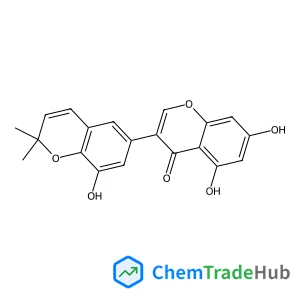
5,7,8'-Trihydroxy-2',2'-dimethyl-2'H,4H-3,6'-bichromen-4-one
CAS Number:
129280-33-7
Molecular Formula:
C20H16O6


Recommended Suppliers






Disclaimer
This page provides academic journal information for reference and research purposes only. We are not affiliated with any journal publishers and do not handle publication submissions. For publication-related inquiries, please contact the respective journal publishers directly.
If you notice any inaccuracies in the information displayed, please contact us at support@chemtradehub.com. We will promptly review and address your concerns.