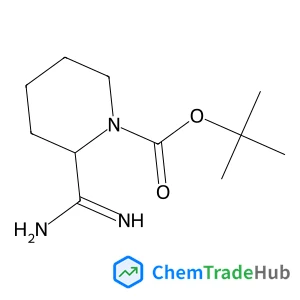
2-Methyl-2-propanyl 2-carbamimidoyl-1-piperidinecarboxylate
CAS Number:
1258640-98-0
Molecular Formula:
C11H21N3O2
I-Yun Hsiao, Yoshiaki Teranishi, Hiroki Nakamura
An accurate method is proposed to deal with such nonadiabatic transitions as those energetically inaccessible, namely, classically forbidden transitions. This is formulated by using the corresponding Zhu–Nakamura formulas and finding the optimal paths in the classically forbidden tunneling regions that maximize the overall transition probabilities. This can be done for both the nonadiabatic tunneling type (so-called normal case in electron transfer) in which two diabatic potentials have opposite signs of slopes and the Landau–Zener type (inverted case) in which two diabatic potentials have the same sign of slopes. The method is numerically demonstrated to be useful for clarifying chemical and biological dynamics.
Koffi P. C. Yao, Yi-Chun Lu, Chibueze V. Amanchukwu, David G. Kwabi, Marcel Risch, Jigang Zhou, Alexis Grimaud, Paula T. Hammond, Fanny Bardé
DOI: 10.1039/C3CP53330A
Stefan Taubert, Kari Laasonen
DOI: 10.1039/C3CP54491E
Li-Min Liu, Shi-Jin Zhao
DOI: 10.1039/C3CP54333A
DOI: 10.1039/C3CP54065K
Yuqi Wu, Gongxuan Lu
DOI: 10.1039/C3CP54461C
Jingde Li, Eric Croiset, Luis Ricardez-Sandoval
DOI: 10.1039/C3CP54376E
Kohei Oka, M. Hashinokuchi, Akitaka Yoshigoe, Yuden Teraoka
DOI: 10.1039/C3CP54709D
S. Martinez, I. Sobrados, D. Tonti, J. M. Amarilla, J. Sanz
DOI: 10.1039/C3CP54386B
Jing Qiu, Guangtong Zeng, Prathamesh Pavaskar, Zhen Li
DOI: 10.1039/C3CP54674H
Motoi Oshima, Atsushi Tani, Takeshi Sugahara, Katsuhisa Kitano, Kazunari Ohgaki
DOI: 10.1039/C3CP54680B
N-(4-Methoxybenzyl)-2-pyridinamine (CAS: 52818-63-0) is increasingly being used ...
When handling Ethyl 4-(2-chlorophenyl)-1,3-thiazole-2-carboxylate, appropriate p...
Diethyldiselane (CAS: 628-39-7) is classified under the Globally Harmonized Syst...
The market for oxocopper (CAS: 12053-18-8) is primarily driven by its use in cat...
The market for 5-{[(2-Methyl-2-propanyl)oxy]carbonyl}-5-azaspiro[2.4]heptane-7-c...
2-(1-Pyrrolidinyl)-4-pyridinamine is a chemical compound with the CAS number 359...
2-(3-Pyridinyl)-1-azabicyclo[2.2.2]octane (CAS: 91556-75-1) is a crystalline sol...
(S)-Alpha-allyl-proline hydrochloride is usually synthesized via a Wittig reacti...
3-Methyl-1,2-oxazole-5-carboxylic acid (CAS: 4857-42-5) is an organic compound w...
Lys-SMCC-DM1 is synthesized via a multi-step process involving the coupling of S...

Physical Chemistry Chemical Physics (PCCP) is an international journal co-owned by 19 physical chemistry and physics societies from around the world. This journal publishes original, cutting-edge research in physical chemistry, chemical physics and biophysical chemistry. To be suitable for publication in PCCP, articles must include significant innovation and/or insight into physical chemistry; this is the most important criterion that reviewers and Editors will judge against when evaluating submissions. The journal has a broad scope and welcomes contributions spanning experiment, theory, computation and data science. Topical coverage includes spectroscopy, dynamics, kinetics, statistical mechanics, thermodynamics, electrochemistry, catalysis, surface science, quantum mechanics, quantum computing and machine learning. Interdisciplinary research areas such as polymers and soft matter, materials, nanoscience, energy, surfaces/interfaces, and biophysical chemistry are welcomed if they demonstrate significant innovation and/or insight into physical chemistry. Joined experimental/theoretical studies are particularly appreciated when complementary and based on up-to-date approaches.