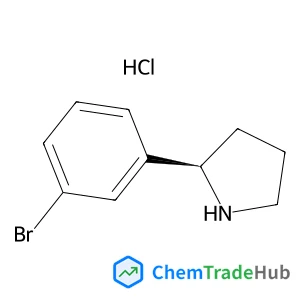
(2R)-2-(3-Bromophenyl)pyrrolidine hydrochloride (1:1)
CAS Number:
1391550-13-2
Molecular Formula:
C10H13BrClN
Jingde Li, Eric Croiset, Luis Ricardez-Sandoval
To understand the nucleation of carbon atoms to form carbon clusters on transition metal substrates during chemical vapor deposition (CVD) synthesis, the structure, energetics, and mobility of carbon intermediates up to 6 atoms on the Ni(111) surface were investigated using Density Functional Theory (DFT). Carbon clusters were found to be more thermodynamically stable than adsorbed atomic carbon, with linear carbon structures being more stable than branched and ring structures. Carbon chains were also found to have higher mobility than branched configurations. The interaction energy between carbon clusters and the Ni surface shows that branched carbon clusters have stronger interaction with the Ni substrate when compared with the carbon chains, supporting that carbon chains generally have higher mobility than branched clusters. The transition states and energy barriers for the formation of different carbon clusters were also studied. The results show that the formation of the branched configurations is kinetically favored as it presents lower energy barriers than those obtained for carbon chains.

Polycyclic Aromatic Compounds

Journal of Chemical Sciences

Biocatalysis and Biotransformation

Chinese Journal of Chemistry

Heteroatom Chemistry

Medicinal Chemistry Research

Main Group Chemistry

Critical Reviews in Solid State and Materials Sciences

Journal of the Indian Institute of Science

Atomization and Sprays
Kalyan V. Vasudevan, Michael Findlater, Alan H. Cowley
DOI: 10.1039/B719251G
Suobo Zhang, Zhaohui Su
DOI: 10.1039/B801784K
Lidong Shao, Tsung-Wu Lin, Gerard Tobias, Malcolm L. H. Green
DOI: 10.1039/B800881G
Shinobu Takizawa, Tomomi Katayama, Chiaki Kameyama, Kiyotaka Onitsuka, Takeyuki Suzuki, Takeshi Yanagida, Tomoji Kawai, Hiroaki Sasai
DOI: 10.1039/B717068H
Shik Chi Tsang, Stan Golunski, Paul Collier
DOI: 10.1039/B718956G
Curtis J. Rieder, Ryan J. Fradette, F. G. West
DOI: 10.1039/B800800K
Takaaki Tsuruoka, Rena Takahashi, Toshihiro Nakamura, Minoru Fujii, Kensuke Akamatsu, Hidemi Nawafune
DOI: 10.1039/B717732A
Patrick Eisenberger, Iris Kieltsch, Nicolas Armanino, Antonio Togni
DOI: 10.1039/B801424H
Ruth I. J. Amos, Brendon S. Gourlay, Brian F. Yates
DOI: 10.1039/B719570B
Engelbert Redel, Ralf Thomann, Christoph Janiak
DOI: 10.1039/B718055A
N-(4-Methoxybenzyl)-2-pyridinamine (CAS: 52818-63-0) is increasingly being used ...
When handling Ethyl 4-(2-chlorophenyl)-1,3-thiazole-2-carboxylate, appropriate p...
Diethyldiselane (CAS: 628-39-7) is classified under the Globally Harmonized Syst...
The market for oxocopper (CAS: 12053-18-8) is primarily driven by its use in cat...
The market for 5-{[(2-Methyl-2-propanyl)oxy]carbonyl}-5-azaspiro[2.4]heptane-7-c...
2-(1-Pyrrolidinyl)-4-pyridinamine is a chemical compound with the CAS number 359...
2-(3-Pyridinyl)-1-azabicyclo[2.2.2]octane (CAS: 91556-75-1) is a crystalline sol...
(S)-Alpha-allyl-proline hydrochloride is usually synthesized via a Wittig reacti...
3-Methyl-1,2-oxazole-5-carboxylic acid (CAS: 4857-42-5) is an organic compound w...
Lys-SMCC-DM1 is synthesized via a multi-step process involving the coupling of S...

Physical Chemistry Chemical Physics (PCCP) is an international journal co-owned by 19 physical chemistry and physics societies from around the world. This journal publishes original, cutting-edge research in physical chemistry, chemical physics and biophysical chemistry. To be suitable for publication in PCCP, articles must include significant innovation and/or insight into physical chemistry; this is the most important criterion that reviewers and Editors will judge against when evaluating submissions. The journal has a broad scope and welcomes contributions spanning experiment, theory, computation and data science. Topical coverage includes spectroscopy, dynamics, kinetics, statistical mechanics, thermodynamics, electrochemistry, catalysis, surface science, quantum mechanics, quantum computing and machine learning. Interdisciplinary research areas such as polymers and soft matter, materials, nanoscience, energy, surfaces/interfaces, and biophysical chemistry are welcomed if they demonstrate significant innovation and/or insight into physical chemistry. Joined experimental/theoretical studies are particularly appreciated when complementary and based on up-to-date approaches.
![1-(1-Benzyl-1,2,3,6-tetrahydropyridin-4-yl)-1H-benzo[d]imidazol-2(3H)-one structure](https://static.chemtradehub.com/structs/603/60373-71-9-7dfb.webp "1-(1-Benzyl-1,2,3,6-tetrahydropyridin-4-yl)-1H-benzo[d]imidazol-2(3H)-one structure")
![N-{[(2-Methyl-2-propanyl)oxy]carbonyl}-L-methionylglycine structure](https://static.chemtradehub.com/structs/234/23446-03-9-e1e5.webp "N-{[(2-Methyl-2-propanyl)oxy]carbonyl}-L-methionylglycine structure")