












Electronic, optoelectronic, and thermoelectric properties of single molecular devices of 2D fullerenes with zigzag graphene nanoribbons as electrodes
Literature Information
Publication Date
2023-10-31
DOI
10.1039/D3CP04725C
Impact Factor
3.676
Authors
Ping Zhou, Guohao Li, Mengtao Sun
View Original
Abstract
Zigzag graphene nanoribbons (GNRs) were selected as electrodes, and the electron transport properties, optical properties, and thermoelectric properties of four fullerene cluster-based molecular devices were studied. By applying different voltages on them, their I–V curves exhibited the multiple negative differential resistance (NDR) effect and the platform effect, which are described in more detail using their density of states (DOS) and projected density of states (PDOS). The results of rotating two types of (C60)4 molecules verify that both the NDR and the platform effects are essential characteristics of them. Furthermore, an examination is conducted on the photocurrent of the devices at the point of maximum light absorption, revealing that α-(C60)4 connected by a [2+2] ring addition bond in the transport direction exhibits superior optical properties and works better as a photoelectric device than β-(C60)4 connected via a C–C single bond in the transport direction. Finally, the thermoelectric current of the devices was studied. Our results contribute to the understanding and the potential application of single devices based on fullerene clusters in the area of molecular electronics.
Related Literature
Controlled fabrication of mesoporous TiO2 hierarchical structures as scattering layers to enhance the power conversion efficiency of dye-sensitized solar cells
Dae-Kue Hwang, Shi-Joon Sung
2016-09-21
Paper
DOI: 10.1039/C6CP05999F
The influences of operating conditions and design configurations on the performance of symmetric electrochemical capacitors
Sunny E. Iyuke
2016-09-23
Paper
DOI: 10.1039/C6CP06214H
Correction: Facile solvothermal synthesis of a high-efficiency CNNs/Ag/AgCl plasmonic photocatalyst
Youliang Wang, Mingzhu Xia, Kebin Li, Xinlin Shen, Tahir Muhmood, Fengyun Wang
2016-10-18
Correction
DOI: 10.1039/C6CP90250B
Growth mechanism of Ge-doped CZTSSe thin film by sputtering method and solar cells
Jinze Li, Jieyi Chen, Jiale Yang
2016-09-27
Paper
DOI: 10.1039/C6CP05671G
A comparison of the experimental and theoretical charge density distributions in two polymorphic modifications of piroxicam
Felcia Lai, Jonathan J. Du, Linda Váradi, Daniel Baker, Paul W. Groundwater, Jacob Overgaard, James A. Platts, David E. Hibbs
2016-10-10
Paper
DOI: 10.1039/C6CP02690G
Tuning electronic structures of the stanene monolayer via defects and transition-metal-embedding: spin–orbit coupling
Wenqi Xiong, Congxin Xia, Tianxing Wang, Juan Du, Yuting Peng, Xu Zhao, Yu Jia
2016-09-16
Paper
DOI: 10.1039/C6CP04794G
Enhancing cycling durability of Li-ion batteries with hierarchical structured silicon–graphene hybrid anodes
Melanie J. Loveridge, Michael J. Lain, Qianye Huang, Chaoying Wan, Alexander J. Roberts, George S. Pappas, Rohit Bhagat
2016-10-21
Paper
DOI: 10.1039/C6CP06788C
Insights into the effect of CO2 absorption on the ionic mobility of ionic liquids
Shubhankar Bhattacharyya, Faiz Ullah Shah
2016-09-15
Paper
DOI: 10.1039/C6CP05804C
Magneto-conductance characteristics of trapped triplet–polaron and triplet–trapped polaron interactions in anthracene-based organic light emitting diodes
Weiyao Jia, Qiusong Chen, Yingbing Chen, Lixiang Chen, Zuhong Xiong
2016-10-10
Paper
DOI: 10.1039/C6CP06322E
You might also like
Compound Q&A
Are there alternatives to 1-(4-Chlorophenyl)-N-hydroxymethanimine (CAS: 3848-36-0) in synthesis?
When considering alternatives to 1-(4-Chlorophenyl)-N-hydroxymethanimine (CAS: 3...
3848-36-01-(4-Chlorophenyl)-N...
Compound Q&A
How should (1R,9S,10S,12S,14E,16S,19R,20R,21S,22R)-3,9,21-Trihydroxy-5,10,12,14,16,20,22-heptamethyl-23,24-dioxatetracyclo[17.3.1.1~6,9~.0~2,7~]tetracosa-2,5,7,14-tetraen-4-one (CAS: 183202-73-5) be stored?
This compound should be stored in a cool, dry place away from direct sunlight. I...
183202-73-5(1R,9S,10S,12S,14E,1...
Compound Q&A
How is 3-(4-Bromophenyl)-5-(2-fluorophenyl)-1,2,4-oxadiazole (CAS: 419553-16-5) typically synthesized?
3-(4-Bromophenyl)-5-(2-fluorophenyl)-1,2,4-oxadiazole is synthesized through a m...
419553-16-53-(4-Bromophenyl)-5-...
Compound Q&A
How is 5-Chloro-2-(4-chlorophenyl)-4-methyl-6-[3-(1-piperidinyl)propoxy]pyrimidine (CAS: 1639220-19-1) typically synthesized?
5-Chloro-2-(4-chlorophenyl)-4-methyl-6-[3-(1-piperidinyl)propoxy]pyrimidine (CAS...
1639220-19-15-Chloro-2-(4-chloro...
Compound Q&A
What industries use 2-Chloro-4-(difluoromethoxy)pyridine (CAS: 1206978-15-5)?
2-Chloro-4-(difluoromethoxy)pyridine is used in the pharmaceutical industry for ...
1206978-15-52-Chloro-4-(difluoro...
Compound Q&A
What regulatory guidelines apply to 3-Chloro-6-methylpyridazine (CAS: 1121-79-5)?
3-Chloro-6-methylpyridazine (CAS: 1121-79-5) is classified under the Globally Ha...
1121-79-53-Chloro-6-methylpyr...
Compound Q&A
Are there alternatives to Methyl 4,5-dimethyl-2-nitrobenzoate in synthesis?
Several alternatives can be used in the synthesis of Methyl 4,5-dimethyl-2-nitro...
90922-74-0Methyl 4,5-dimethyl-...
Compound Q&A
Are there alternatives to (2E,2'E)-3,3'-(1,4-Phenylene)bisacrylaldehyde in synthesis?
Alternatives to (2E,2'E)-3,3'-(1,4-Phenylene)bisacrylaldehyde include other acry...
63405-68-5(2E,2'E)-3,3'-(1,4-P...
Compound Q&A
What is 3-Amino-5-chloropyridin-2-ol hydrochloride (CAS: 1261906-29-9)?
3-Amino-5-chloropyridin-2-ol hydrochloride is an organic compound with the CAS n...
1261906-29-93-Amino-5-chloropyri...
Compound Q&A
What precautions should be taken when handling 6,7-Difluoro-2,3-dihydro-4H-chromen-4-one (CAS: 1092349-93-3)?
When handling 6,7-Difluoro-2,3-dihydro-4H-chromen-4-one, it is essential to wear...
1092349-93-36,7-Difluoro-2,3-dih...
Source Journal
Physical Chemistry Chemical Physics

CiteScore:
5.5
Self-citation Rate:
10.3%
Articles per Year:
3036
Physical Chemistry Chemical Physics (PCCP) is an international journal co-owned by 19 physical chemistry and physics societies from around the world. This journal publishes original, cutting-edge research in physical chemistry, chemical physics and biophysical chemistry. To be suitable for publication in PCCP, articles must include significant innovation and/or insight into physical chemistry; this is the most important criterion that reviewers and Editors will judge against when evaluating submissions. The journal has a broad scope and welcomes contributions spanning experiment, theory, computation and data science. Topical coverage includes spectroscopy, dynamics, kinetics, statistical mechanics, thermodynamics, electrochemistry, catalysis, surface science, quantum mechanics, quantum computing and machine learning. Interdisciplinary research areas such as polymers and soft matter, materials, nanoscience, energy, surfaces/interfaces, and biophysical chemistry are welcomed if they demonstrate significant innovation and/or insight into physical chemistry. Joined experimental/theoretical studies are particularly appreciated when complementary and based on up-to-date approaches.
Recommended Compounds
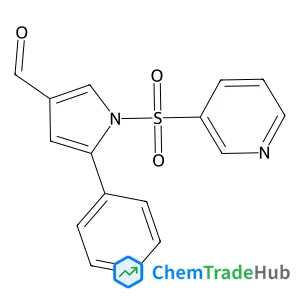
5-Phenyl-1-(pyridin-3-ylsulfonyl)-1H-pyrrole-3-carbaldehyde
CAS Number:
881676-90-0
Molecular Formula:
C16H12N2O3S
Recommended Suppliers




Disclaimer
This page provides academic journal information for reference and research purposes only. We are not affiliated with any journal publishers and do not handle publication submissions. For publication-related inquiries, please contact the respective journal publishers directly.
If you notice any inaccuracies in the information displayed, please contact us at support@chemtradehub.com. We will promptly review and address your concerns.