












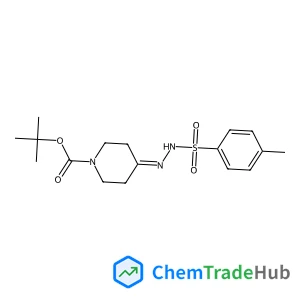
tert-Butyl 4-(2-(p-Tolylsulfonyl)hydrazono)piperidine-1-carboxylate
CAS Number:
1046478-89-0
Molecular Formula:
C17H25N3O4S
Shubhankar Bhattacharyya, Faiz Ullah Shah
We investigate a comparative effect of CO2 absorption on the ionic mobility of two choline based ionic liquids comprising two different anions such as threonine and imidazole. The synthesized ionic liquids were characterized using 1H and 13C NMR and other spectroscopic techniques. By keeping a common cation and changing the anion from threonine to imidazole both the viscosity and density reduced drastically. We found that [N1,1,6,2OH][Imi] exhibits the highest CO2 capture capacity at 20 °C of 5.27 mol of CO2 per kg of ionic liquid (1.27 mol of CO2 per mol of ionic liquid, 23.26 wt% of CO2) whereas [N1,1,6,2OH][Threo] exhibits 3.6 mol of CO2 per kg of ionic liquid (1.05 mol of CO2 per mol of ionic liquid, 15.87 wt% of CO2). The activation energy for diffusion is calculated using the Vogel-Fulcher-Tamman (VFT) equation in the form of diffusivity. It was found that the activation energy for the diffusion of [N1,1,6,2OH][Threo] is ∼10 times higher than that of [N1,1,6,2OH][Imi]. 1H diffusion NMR data revealed that the diffusivity of [N1,1,6,2OH][Imi] is increased after CO2 absorption whereas a decrease in diffusivity was observed in the case of [N1,1,6,2OH][Threo]. This anomalous behavior of [N1,1,6,2OH][Imi] was further explained by using DFT calculations.
Paweł Piotr Michałowski, Piotr Knyps, Paweł Ciepielewski, Piotr Caban, Ewa Dumiszewska, Jacek Baranowski
DOI: 10.1039/C9CP00613C
E. Kathleen Carter, Thomas Dodd, W. David Wilson, Ivaylo Ivanov
DOI: 10.1039/C8CP05537H
Shuchang Wu, Yangming Lin, Bingwei Zhong, Guodong Wen, Hongyang Liu, Dang Sheng Su
DOI: 10.1039/C8CP06175K
Md Habib, Ritabrata Sarkar, Santu Biswas, Anup Pramanik, Pranab Sarkar, Sougata Pal
DOI: 10.1039/C9CP00133F
Mauro Boero
DOI: 10.1039/C8CP07467D
Prateek Goel, Xiao-Gang Wang, Bo Chen, Xue-Bin Wang, Tao Zeng
DOI: 10.1039/C9CP01352K
Juan P. Aranguren-Abrate, Claude Dedonder-Lardeux, Christophe Jouvet
DOI: 10.1039/C8CP07162D
Qimin Liu, Hua Li, K. Y. Lam
DOI: 10.1039/C8CP06556J
Tao Yang, Zhen Lei, Shuang Yang, Er-Qiang Chen
DOI: 10.1039/C8CP06679E
Weiliang Wang
DOI: 10.1039/C9CP01232J
When considering alternatives to 1-(4-Chlorophenyl)-N-hydroxymethanimine (CAS: 3...
This compound should be stored in a cool, dry place away from direct sunlight. I...
3-(4-Bromophenyl)-5-(2-fluorophenyl)-1,2,4-oxadiazole is synthesized through a m...
5-Chloro-2-(4-chlorophenyl)-4-methyl-6-[3-(1-piperidinyl)propoxy]pyrimidine (CAS...
2-Chloro-4-(difluoromethoxy)pyridine is used in the pharmaceutical industry for ...
3-Chloro-6-methylpyridazine (CAS: 1121-79-5) is classified under the Globally Ha...
Several alternatives can be used in the synthesis of Methyl 4,5-dimethyl-2-nitro...
Alternatives to (2E,2'E)-3,3'-(1,4-Phenylene)bisacrylaldehyde include other acry...
3-Amino-5-chloropyridin-2-ol hydrochloride is an organic compound with the CAS n...
When handling 6,7-Difluoro-2,3-dihydro-4H-chromen-4-one, it is essential to wear...

Physical Chemistry Chemical Physics (PCCP) is an international journal co-owned by 19 physical chemistry and physics societies from around the world. This journal publishes original, cutting-edge research in physical chemistry, chemical physics and biophysical chemistry. To be suitable for publication in PCCP, articles must include significant innovation and/or insight into physical chemistry; this is the most important criterion that reviewers and Editors will judge against when evaluating submissions. The journal has a broad scope and welcomes contributions spanning experiment, theory, computation and data science. Topical coverage includes spectroscopy, dynamics, kinetics, statistical mechanics, thermodynamics, electrochemistry, catalysis, surface science, quantum mechanics, quantum computing and machine learning. Interdisciplinary research areas such as polymers and soft matter, materials, nanoscience, energy, surfaces/interfaces, and biophysical chemistry are welcomed if they demonstrate significant innovation and/or insight into physical chemistry. Joined experimental/theoretical studies are particularly appreciated when complementary and based on up-to-date approaches.
![[4-(Isobutyrylamino)phenyl]boronic acid structure](https://static.chemtradehub.com/structs/874/874219-50-8-6ab5.webp "[4-(Isobutyrylamino)phenyl]boronic acid structure")






