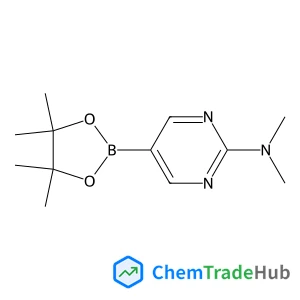
N,N-Dimethyl-5-(4,4,5,5-tetramethyl-1,3,2-dioxaborolan-2-yl)-2-pyrimidinamine
CAS Number:
1032759-30-0
Molecular Formula:
C12H20BN3O2
Youliang Wang, Mingzhu Xia, Kebin Li, Xinlin Shen, Tahir Muhmood, Fengyun Wang
Correction for ‘Facile solvothermal synthesis of a high-efficiency CNNs/Ag/AgCl plasmonic photocatalyst’ by Youliang Wang et al., Phys. Chem. Chem. Phys., 2016, DOI: 10.1039/c6cp04655j.
Michael D. LaCount, Mark T. Lusk
DOI: 10.1039/C9CP00329K
Takashi Aizawa
DOI: 10.1039/C8CP06438E
Jia Liu, Anping Wang, Kaisong Pu, Shaozheng Zhang, Terence Musho, Liang Chen
DOI: 10.1039/C9CP00151D
Adebayo A. Adeleke, Yansun Yao
DOI: 10.1039/C8CP07288D
Yuki Takeuchi, Tetsuya Fujita, Nobuyuki Takeyasu
DOI: 10.1039/C9CP00129H
Enamul Haque, M. Anwar Hossain, Catherine Stampfl
DOI: 10.1039/C8CP07634K
E. Kathleen Carter, Thomas Dodd, W. David Wilson, Ivaylo Ivanov
DOI: 10.1039/C8CP05537H
Kit McColl, Furio Corà
DOI: 10.1039/C9CP00170K
Raunak Kumar Tamrakar, Kanchan Upadhyay, D. P. Bisen
DOI: 10.1039/C9CP90011J
Donghyeon Kim, Jae Ryeol Jeong, Yujin Jang, Jong-Seong Bae, In Chung, Runli Liang, Dong-Kyun Seo, Seung-Joo Kim, Jung-Chul Park
DOI: 10.1039/C8CP06470A
When considering alternatives to 1-(4-Chlorophenyl)-N-hydroxymethanimine (CAS: 3...
This compound should be stored in a cool, dry place away from direct sunlight. I...
3-(4-Bromophenyl)-5-(2-fluorophenyl)-1,2,4-oxadiazole is synthesized through a m...
5-Chloro-2-(4-chlorophenyl)-4-methyl-6-[3-(1-piperidinyl)propoxy]pyrimidine (CAS...
2-Chloro-4-(difluoromethoxy)pyridine is used in the pharmaceutical industry for ...
3-Chloro-6-methylpyridazine (CAS: 1121-79-5) is classified under the Globally Ha...
Several alternatives can be used in the synthesis of Methyl 4,5-dimethyl-2-nitro...
Alternatives to (2E,2'E)-3,3'-(1,4-Phenylene)bisacrylaldehyde include other acry...
3-Amino-5-chloropyridin-2-ol hydrochloride is an organic compound with the CAS n...
When handling 6,7-Difluoro-2,3-dihydro-4H-chromen-4-one, it is essential to wear...

Physical Chemistry Chemical Physics (PCCP) is an international journal co-owned by 19 physical chemistry and physics societies from around the world. This journal publishes original, cutting-edge research in physical chemistry, chemical physics and biophysical chemistry. To be suitable for publication in PCCP, articles must include significant innovation and/or insight into physical chemistry; this is the most important criterion that reviewers and Editors will judge against when evaluating submissions. The journal has a broad scope and welcomes contributions spanning experiment, theory, computation and data science. Topical coverage includes spectroscopy, dynamics, kinetics, statistical mechanics, thermodynamics, electrochemistry, catalysis, surface science, quantum mechanics, quantum computing and machine learning. Interdisciplinary research areas such as polymers and soft matter, materials, nanoscience, energy, surfaces/interfaces, and biophysical chemistry are welcomed if they demonstrate significant innovation and/or insight into physical chemistry. Joined experimental/theoretical studies are particularly appreciated when complementary and based on up-to-date approaches.
![[4-(Isobutyrylamino)phenyl]boronic acid structure](https://static.chemtradehub.com/structs/874/874219-50-8-6ab5.webp "[4-(Isobutyrylamino)phenyl]boronic acid structure")
![4-[(3-Chloro-2-fluorophenyl)amino]-7-methoxy-6-quinazolinyl acetate structure](https://static.chemtradehub.com/structs/740/740081-22-5-f58f.webp "4-[(3-Chloro-2-fluorophenyl)amino]-7-methoxy-6-quinazolinyl acetate structure")