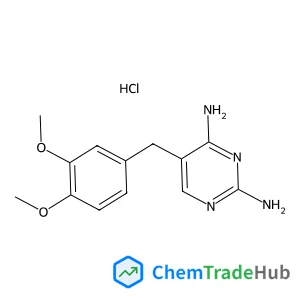
5-(3,4-Dimethoxybenzyl)-2,4-pyrimidinediamine hydrochloride (1:1)
CAS Number:
2507-23-5
Molecular Formula:
C13H17ClN4O2
Ghulam Hasnain Tariq, Ghulam Asghar, M. Shahzad Shifa, M. Anis-Ur-Rehman, Sana Ullah, Zulfiqar Ali Shah, Ahmed M. Tawfeek, Farooq Sher
In the current era, alternative but environment-friendly sources of energy have gained attention to meet the growing energy demands. In particular, the focus of research has been solar energy and using it to fulfill energy demands. Solar energy is either directly converted into electrical energy or stored for later use. Solar cells are a practical way to turn solar energy into electrical energy. Various materials are being investigated to manufacture solar cell devices that can absorb a maximum number of photons present in sunlight. The present study reports thermally evaporated in situ Cu-doped SnS photon absorber thin films with tunable physical properties. This study mainly explored the effects of changing Cu concentrations on the physical features of light absorption of SnS thin films. The thin films were formed by simultaneous resistive heating of Cu and SnS powders on glass substrates at 150 °C. The X-ray diffraction patterns revealed pure SnS thin films having orthorhombic polycrystalline crystal structures oriented preferentially along the (111) plane. Raman spectroscopy confirmed this phase purity. Photoconductivity studies showed phase dependence on Cu content that improved with increasing concentrations of Cu. The optical bandgap energy was also found to be dependent on Cu content and was observed at 1.10–1.47 eV for SnS thin films with variation in the Cu content, i.e., 0–18%. According to the hot probe method, all films displayed p-type conductivity for the substitution of Cu metal atoms. These findings demonstrated that the prepared thin films are substantial candidates as low-cost, suitably efficient, thin-film solar cells featuring environmentally-friendly active layers that absorb sunlight.
Alexander K. Foote, Lydia H. Manger, Michael R. Holden, Martin Margittai, Randall H. Goldsmith
DOI: 10.1039/C8CP06971A
Mohammad Aarabi, Reza Omidyan, Satchin Soorkia, Gilles Grégoire, Maria-Elisa Crestoni, Aurélien de la Lande, Benoît Soep, Niloufar Shafizadeh
DOI: 10.1039/C8CP06210B
Raunak Kumar Tamrakar, Kanchan Upadhyay, D. P. Bisen
DOI: 10.1039/C9CP90011J
David Fuks, Yaniv Gelbstein
DOI: 10.1039/C9CP00764D
Sean M. Ryno, Chad Risko
DOI: 10.1039/C9CP00777F
Barbora Tarabová, Petr Lukeš, Malte U. Hammer, Helena Jablonowski, Thomas von Woedtke, Stephan Reuter, Zdenko Machala
DOI: 10.1039/C9CP00871C
DOI: 10.1039/C8CP06702C
William D. Hong, Christopher N. Lam, Yangyang Wang, Youjun He, Luis E. Sánchez-Díaz, Changwoo Do
DOI: 10.1039/C8CP07520D
Haosheng Pang, Peng Huang, Weirong Zhuo, Chenghui Gao, Dan Guo
DOI: 10.1039/C8CP07158F
Ting Wang, Guangtao Yu, Jingwei Liu, Xuri Huang, Wei Chen
DOI: 10.1039/C8CP06011H
When considering alternatives to 1-(4-Chlorophenyl)-N-hydroxymethanimine (CAS: 3...
This compound should be stored in a cool, dry place away from direct sunlight. I...
3-(4-Bromophenyl)-5-(2-fluorophenyl)-1,2,4-oxadiazole is synthesized through a m...
5-Chloro-2-(4-chlorophenyl)-4-methyl-6-[3-(1-piperidinyl)propoxy]pyrimidine (CAS...
2-Chloro-4-(difluoromethoxy)pyridine is used in the pharmaceutical industry for ...
3-Chloro-6-methylpyridazine (CAS: 1121-79-5) is classified under the Globally Ha...
Several alternatives can be used in the synthesis of Methyl 4,5-dimethyl-2-nitro...
Alternatives to (2E,2'E)-3,3'-(1,4-Phenylene)bisacrylaldehyde include other acry...
3-Amino-5-chloropyridin-2-ol hydrochloride is an organic compound with the CAS n...
When handling 6,7-Difluoro-2,3-dihydro-4H-chromen-4-one, it is essential to wear...

Physical Chemistry Chemical Physics (PCCP) is an international journal co-owned by 19 physical chemistry and physics societies from around the world. This journal publishes original, cutting-edge research in physical chemistry, chemical physics and biophysical chemistry. To be suitable for publication in PCCP, articles must include significant innovation and/or insight into physical chemistry; this is the most important criterion that reviewers and Editors will judge against when evaluating submissions. The journal has a broad scope and welcomes contributions spanning experiment, theory, computation and data science. Topical coverage includes spectroscopy, dynamics, kinetics, statistical mechanics, thermodynamics, electrochemistry, catalysis, surface science, quantum mechanics, quantum computing and machine learning. Interdisciplinary research areas such as polymers and soft matter, materials, nanoscience, energy, surfaces/interfaces, and biophysical chemistry are welcomed if they demonstrate significant innovation and/or insight into physical chemistry. Joined experimental/theoretical studies are particularly appreciated when complementary and based on up-to-date approaches.
![(2S)-2-{[(9H-Fluoren-9-ylmethoxy)carbonyl]amino}-4-(methylselanyl)butanoic acid structure](https://static.chemtradehub.com/structs/121/1217852-49-7-f252.webp "(2S)-2-{[(9H-Fluoren-9-ylmethoxy)carbonyl]amino}-4-(methylselanyl)butanoic acid structure")