












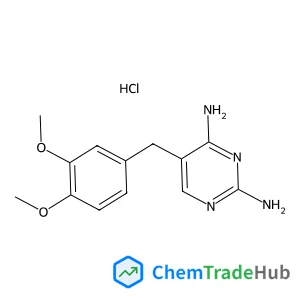
5-(3,4-Dimethoxybenzyl)-2,4-pyrimidinediamine hydrochloride (1:1)
CAS Number:
2507-23-5
Molecular Formula:
C13H17ClN4O2
Ting Wang, Guangtao Yu, Jingwei Liu, Xuri Huang, Wei Chen
Inspired by the fascinating result that NbN-related species can possess a similar electronic structure to noble metal atoms (e.g. Pt), in this work we have proposed for the first time a new strategy, through embedding the transition metal (TM) Nb atom in the in-plane cavity of g-C3N4, for constructing the nonprecious Nb–C3N4 configuration comprising the NbN unit exhibiting noble-metal-like characteristics. Our computed results reveal that embedding Nb can significantly improve the catalytic activity for the hydrogen evolution reaction (HER) of g-C3N4, and even that the formed Nb–C3N4 can exhibit a considerably high HER catalytic activity over a wide range of hydrogen coverage. Similarly, such a high HER activity can also be observed in the analogous V- or Ta-doped g-C3N4 systems. Furthermore, a series of new hybrid systems TM–C3N4@G (TM = V, Nb or Ta) is constructed by coupling the single-layered TM–C3N4 with graphene, and all of them can also possess a considerably high HER catalytic activity over a wide range of hydrogen coverage. Moreover, all these composite TM–C3N4 and TM–C3N4@G systems possess high structural stability and metallic conductivity. Thus, all of them can be viewed as a new class of promising HER catalysts, and this work can also provide new strategies for designing low-cost and high-performance electrocatalysts.
Chen-Hsiung Hung, Gao-Fong Chang, Anil Kumar, Geng-Fong Lin, Wei-Min Ching, Eric Wei-Guang Diau
DOI: 10.1039/B714412A
Sensuke Ogoshi, Tomoya Arai, Masato Ohashi, Hideo Kurosawa
DOI: 10.1039/B717261C
Pradeep S. Pallan, Damian Ittig, Annie Héroux, Zdzislaw Wawrzak, Christian J. Leumann, Martin Egli
DOI: 10.1039/B716390H
S. M. Holmes, B. E. Graniel-Garcia, P. Foran, P. Hill, E. P. L. Roberts, B. H. Sakakini, J. M. Newton
DOI: 10.1039/B600708B
Jun-Young Lee, Colin D. Wood, Darren Bradshaw, Matthew J. Rosseinsky, Andrew I. Cooper
DOI: 10.1039/B604625H
Othman Bouloussa
DOI: 10.1039/B716026G
Michael R. Reithofer, Mathea S. Galanski, Vladimir B. Arion, Bernhard K. Keppler
DOI: 10.1039/B715680D
Li Shang, Shaojun Dong
DOI: 10.1039/B717728C
Stephen G. Davies, A. Christopher Garner, Euan C. Goddard, Dennis Kruchinin, Paul M. Roberts, Humberto Rodriguez-Solla, Andrew D. Smith
DOI: 10.1039/B604835H
Karl Fisher, David J. Lowe, Jan Petersen
DOI: 10.1039/B605133B
When considering alternatives to 1-(4-Chlorophenyl)-N-hydroxymethanimine (CAS: 3...
This compound should be stored in a cool, dry place away from direct sunlight. I...
3-(4-Bromophenyl)-5-(2-fluorophenyl)-1,2,4-oxadiazole is synthesized through a m...
5-Chloro-2-(4-chlorophenyl)-4-methyl-6-[3-(1-piperidinyl)propoxy]pyrimidine (CAS...
2-Chloro-4-(difluoromethoxy)pyridine is used in the pharmaceutical industry for ...
3-Chloro-6-methylpyridazine (CAS: 1121-79-5) is classified under the Globally Ha...
Several alternatives can be used in the synthesis of Methyl 4,5-dimethyl-2-nitro...
Alternatives to (2E,2'E)-3,3'-(1,4-Phenylene)bisacrylaldehyde include other acry...
3-Amino-5-chloropyridin-2-ol hydrochloride is an organic compound with the CAS n...
When handling 6,7-Difluoro-2,3-dihydro-4H-chromen-4-one, it is essential to wear...

Physical Chemistry Chemical Physics (PCCP) is an international journal co-owned by 19 physical chemistry and physics societies from around the world. This journal publishes original, cutting-edge research in physical chemistry, chemical physics and biophysical chemistry. To be suitable for publication in PCCP, articles must include significant innovation and/or insight into physical chemistry; this is the most important criterion that reviewers and Editors will judge against when evaluating submissions. The journal has a broad scope and welcomes contributions spanning experiment, theory, computation and data science. Topical coverage includes spectroscopy, dynamics, kinetics, statistical mechanics, thermodynamics, electrochemistry, catalysis, surface science, quantum mechanics, quantum computing and machine learning. Interdisciplinary research areas such as polymers and soft matter, materials, nanoscience, energy, surfaces/interfaces, and biophysical chemistry are welcomed if they demonstrate significant innovation and/or insight into physical chemistry. Joined experimental/theoretical studies are particularly appreciated when complementary and based on up-to-date approaches.
![[4-(Isobutyrylamino)phenyl]boronic acid structure](https://static.chemtradehub.com/structs/874/874219-50-8-6ab5.webp "[4-(Isobutyrylamino)phenyl]boronic acid structure")






