













Correlation-driven topological phase transition in 2D valleytronic materials: a mini-review
Literature Information
Publication Date
2023-06-19
DOI
10.1039/D3CP01368E
Impact Factor
3.676
Authors
Xiao-Shu Guo, San-Dong Guo
View Original
Abstract
Electronic correlation combined with spin–orbit coupling (SOC) may have a significant impact on the physical properties of two-dimensional (2D) transition metal magnetic compounds. Moreover, magnetic anisotropy (MA) is very important in determining magnetic, ferrovalley (FV) and topological properties of these 2D systems. Based on a density-functional theory (DFT) + U approach, it is found that the electronic correlation can induce topological phase transition in some special 2D valleytronic materials (for example FeCl2 and VSi2P4) with out-of-plane MA, and a novel valley-polarized quantum anomalous Hall insulator (VQAHI) and half-valley-metal (HVM) can be produced. These topological phase transitions are connected with a sign-reversible Berry curvature and band inversion between dxy/dx2−y2 and dz2 orbitals. However, for in-plane MA, the FV and nontrivial topological properties will be suppressed. For a given material, the correlation strength is fixed, but these novel electronic states and topological phase transitions can still be exhibited by strain in practice. The mini-review sheds light on the possible role of correlation effects in some special 2D valleytronic materials.
Related Literature
Structure prediction of the solid forms of methanol: an ab initio random structure searching approach
Tzu-Jen Lin, Cheng-Rong Hsing, Ching-Ming Wei, Jer-Lai Kuo
2015-12-14
Paper
DOI: 10.1039/C5CP06583F
ZnO modified ZSM-5 and Y zeolites fabricated by atomic layer deposition for propane conversion
Ting Gong, Lijun Qin, Jian Lu, Hao Feng
2015-11-20
Paper
DOI: 10.1039/C5CP05043J
Unexpectedly large impact of van der Waals interactions on the description of heterogeneously catalyzed reactions: the water gas shift reaction on Cu(321) as a case example
Hèctor Prats, Pablo Gamallo, Ramón Sayós, Francesc Illas
2015-12-17
Paper
DOI: 10.1039/C5CP06863K
A simulation study of the electrostriction effects in dielectric elastomer composites containing polarizable inclusions with different spatial distributions
Hartmut Löwen, Lei Zhu
2015-11-13
Paper
DOI: 10.1039/C5CP05522A
Singular analysis and coupled cluster theory
Heinz-Jürgen Flad, Gohar Harutyunyan, Bert-Wolfgang Schulze
2015-06-15
Paper
DOI: 10.1039/C5CP01183C
Multipole-preserving quadratures for the discretization of functions in real-space electronic structure calculations
2015-09-03
Paper
DOI: 10.1039/C5CP01236H
Kinetics stabilized doping: computational optimization of carbon-doped anatase TiO2 for visible-light driven water splitting
Yi-Yang Sun, Shengbai Zhang
2015-12-15
Paper
DOI: 10.1039/C5CP07109G
A slowing down of proton motion from HPTS to water adsorbed on the MCM-41 surface
Noemí Alarcos, Boiko Cohen, Abderrazzak Douhal
2015-12-16
Paper
DOI: 10.1039/C5CP04548G
Defect chemistry and lithium transport in Li3OCl anti-perovskite superionic conductors
Chi Chen, Zarah Medina Baiyee, Xin Chen, Chunming Niu
2015-10-28
Paper
DOI: 10.1039/C5CP05722A
You might also like
Compound Q&A
What are the main uses of 1H-Indazole-6-carbonitrile (CAS: 141290-59-7)?
1H-Indazole-6-carbonitrile finds applications in pharmaceuticals, where it serve...
141290-59-71H-Indazole-6-carbon...
Compound Q&A
How should waste containing Dioctyl (2E)-2-butenedioate (CAS: 2997-85-5) be handled?
Waste containing Dioctyl (2E)-2-butenedioate (CAS: 2997-85-5) should be collecte...
2997-85-5Dioctyl (2E)-2-buten...
Compound Q&A
What industries use Sodium [(1,2-benzoxazol-3-ylmethyl)sulfonyl]azanide (CAS: 68291-98-5)?
Sodium [(1,2-benzoxazol-3-ylmethyl)sulfonyl]azanide is primarily used in pharmac...
68291-98-5Sodium [(1,2-benzoxa...
Compound Q&A
Are there alternatives to Dimethyl 4-(4,4,5,5-tetramethyl-1,3,2-dioxaborolan-2-yl)-2,6-pyridinedicarboxylate (CAS: 741709-66-0) in synthesis?
Dimethyl 4-(4,4,5,5-tetramethyl-1,3,2-dioxaborolan-2-yl)-2,6-pyridinedicarboxyla...
741709-66-0Dimethyl 4-(4,4,5,5-...
Compound Q&A
How should waste containing 2-Fluoro-6-hydrazinopyridine (CAS: 80714-39-2) be handled?
Waste containing 2-Fluoro-6-hydrazinopyridine (CAS: 80714-39-2) should be manage...
80714-39-22-Fluoro-6-hydrazino...
Compound Q&A
What is 6-Formyl-2-pyridinecarboxylic acid (CAS: 499214-11-8)?
6-Formyl-2-pyridinecarboxylic acid is an organic compound with the molecular for...
499214-11-86-Formyl-2-pyridinec...
Compound Q&A
What is the market or research trend for 3-(3,4-dimethoxyphenyl)-2,5-dimethyl-N-(2-morpholin-4-ylethyl)pyrazolo[1,5-a]pyrimidin-7-amine (CAS: 900874-91-1)?
Research trends for this compound indicate a focus on its potential applications...
900874-91-13-(3,4-dimethoxyphen...
Compound Q&A
How is 9H-Tribenzo[b,d,f]azepine (CAS: 29875-73-8) typically synthesized?
9H-Tribenzo[b,d,f]azepine is typically synthesized via a multi-step process invo...
29875-73-89H-Tribenzo[b,d,f]az...
Compound Q&A
How is 1-Cyclopropyl-7-ethoxy-6-fluoro-8-methoxy-4-oxo-1,4-dihydro-3-quinolinecarboxylic acid (CAS: 1797982-51-4) typically synthesized?
1-Cyclopropyl-7-ethoxy-6-fluoro-8-methoxy-4-oxo-1,4-dihydro-3-quinolinecarboxyli...
1797982-51-41-Cyclopropyl-7-etho...
Compound Q&A
How should waste containing Methyl 3-oxo-1,2,3,4-tetrahydro-6-quinoxalinecarboxylate (CAS: 671820-52-3) be handled?
Waste containing Methyl 3-oxo-1,2,3,4-tetrahydro-6-quinoxalinecarboxylate (CAS: ...
671820-52-3Methyl 3-oxo-1,2,3,4...
Source Journal
Physical Chemistry Chemical Physics

CiteScore:
5.5
Self-citation Rate:
10.3%
Articles per Year:
3036
Physical Chemistry Chemical Physics (PCCP) is an international journal co-owned by 19 physical chemistry and physics societies from around the world. This journal publishes original, cutting-edge research in physical chemistry, chemical physics and biophysical chemistry. To be suitable for publication in PCCP, articles must include significant innovation and/or insight into physical chemistry; this is the most important criterion that reviewers and Editors will judge against when evaluating submissions. The journal has a broad scope and welcomes contributions spanning experiment, theory, computation and data science. Topical coverage includes spectroscopy, dynamics, kinetics, statistical mechanics, thermodynamics, electrochemistry, catalysis, surface science, quantum mechanics, quantum computing and machine learning. Interdisciplinary research areas such as polymers and soft matter, materials, nanoscience, energy, surfaces/interfaces, and biophysical chemistry are welcomed if they demonstrate significant innovation and/or insight into physical chemistry. Joined experimental/theoretical studies are particularly appreciated when complementary and based on up-to-date approaches.
Recommended Compounds



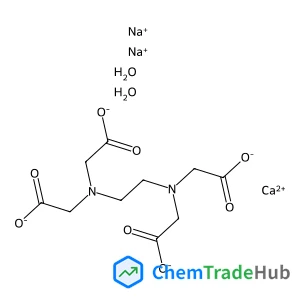
EthylenediaminetetraaceticacidcalciumDisodiumsalthydrate
CAS Number:
23411-34-9
Molecular Formula:
C10H16CaN2Na2O10
Recommended Suppliers






Disclaimer
This page provides academic journal information for reference and research purposes only. We are not affiliated with any journal publishers and do not handle publication submissions. For publication-related inquiries, please contact the respective journal publishers directly.
If you notice any inaccuracies in the information displayed, please contact us at support@chemtradehub.com. We will promptly review and address your concerns.