












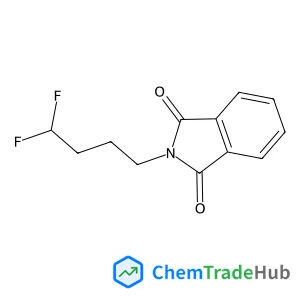
2-(4,4-Difluorobutyl)-1H-isoindole-1,3(2H)-dione
CAS Number:
1265341-14-7
Molecular Formula:
C12H11F2NO2
The first page of this article is displayed as the abstract.
Marc Cretin, Lingxue Kong, Luke A. O'Dell, Andrea Merenda
DOI: 10.1039/D1RE00091H
Lilivet Ubiera, Isabelle Polaert, Michel Delmotte, Lokmane Abdelouahed, Bechara Taouk
DOI: 10.1039/D1RE00146A
Ram Ji Dixit, Aditya Singh, Vijay K. Ramani
DOI: 10.1039/D1RE00080B
Bobak Gholamkhass, Timothy J. Peckham, Steven Holdcroft
DOI: 10.1039/B9PY00384C
Bruno Lacerda de Oliveira Campos, Karla Herrera Delgado, Stefan Wild, Stephan Pitter, Jörg Sauer
DOI: 10.1039/D1RE90031E
Han Zhang, Xinlin Yang
DOI: 10.1039/B9PY00372J
Ping Luo, Zhi Xu, Qiankun Zheng, Jinkun Tan, Zhicheng Zhang, Zhengkun Liu, Guangru Zhang, Wanqin Jin
DOI: 10.1039/D1RE00103E
Jinxia Fu, Kuo Zhou, Shimin Kang, Zhuodi Cai, Yongjun Xu, Peigao Duan
DOI: 10.1039/D1RE00164G
Akihiro Otani, Masaya Kuroda, Satoshi Suganuma, Etsushi Tsuji, Naonobu Katada
DOI: 10.1039/D1RE00186H
N-(4-Methoxybenzyl)-2-pyridinamine (CAS: 52818-63-0) is increasingly being used ...
When handling Ethyl 4-(2-chlorophenyl)-1,3-thiazole-2-carboxylate, appropriate p...
Diethyldiselane (CAS: 628-39-7) is classified under the Globally Harmonized Syst...
The market for oxocopper (CAS: 12053-18-8) is primarily driven by its use in cat...
The market for 5-{[(2-Methyl-2-propanyl)oxy]carbonyl}-5-azaspiro[2.4]heptane-7-c...
2-(1-Pyrrolidinyl)-4-pyridinamine is a chemical compound with the CAS number 359...
2-(3-Pyridinyl)-1-azabicyclo[2.2.2]octane (CAS: 91556-75-1) is a crystalline sol...
(S)-Alpha-allyl-proline hydrochloride is usually synthesized via a Wittig reacti...
3-Methyl-1,2-oxazole-5-carboxylic acid (CAS: 4857-42-5) is an organic compound w...
Lys-SMCC-DM1 is synthesized via a multi-step process involving the coupling of S...

ChemComm publishes urgent research which is of outstanding significance and interest to experts in the field, while also appealing to the journal’s broad chemistry readership. Our communication format is ideally suited to short, urgent studies that are of such importance that they require accelerated publication. Our scope covers all topics in chemistry, and research at the interface of chemistry and other disciplines (such as materials science, nanoscience, physics, engineering and biology) where there is a significant novelty in the chemistry aspects. Major topic areas covered include: Analytical Chemistry Catalysis Chemical Biology and medicinal chemistry Computational Chemistry and Machine Learning Energy and sustainable chemistry Environmental Chemistry Green Chemistry Inorganic Chemistry Materials Chemistry Nanoscience Organic Chemistry Physical Chemistry Polymer Chemistry Supramolecular Chemistry
![1-(1-Benzyl-1,2,3,6-tetrahydropyridin-4-yl)-1H-benzo[d]imidazol-2(3H)-one structure](https://static.chemtradehub.com/structs/603/60373-71-9-7dfb.webp "1-(1-Benzyl-1,2,3,6-tetrahydropyridin-4-yl)-1H-benzo[d]imidazol-2(3H)-one structure")
![1-[6-(1H-Imidazol-1-yl)-3-pyridinyl]methanamine structure](https://static.chemtradehub.com/structs/914/914637-08-4-8825.webp "1-[6-(1H-Imidazol-1-yl)-3-pyridinyl]methanamine structure")





