












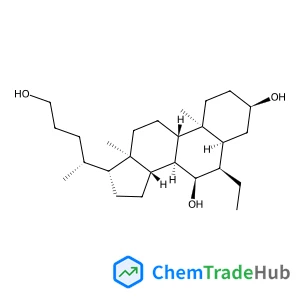
(3alpha,5beta,6alpha,7alpha)-6-Ethylcholane-3,7,24-triol
CAS Number:
1537866-49-1
Molecular Formula:
C26H46O3
Han Zhang, Xinlin Yang
Hollow poly(ethyleneglycol dimethacrylate) (PEGDMA) microspheres with Au nanoparticle functionalized movable cores were prepared by selective removal of the sandwiched silica mid-layer from the corresponding poly(ethyleneglycol dimethacrylate-co-methacrylic acid)/poly(ethyleneglycol dimethacrylate-co-vinylpyridine)@gold/silica/PEGDMA (P(EGDMA-co-MAA)/P(EGDMA-co-VPy)@Au/SiO2/PEGDMA) tetra-layer composite microspheres, in which the Au nanoparticles were stabilized by the pyridyl groups on the surface and gel-layer of P(EGDMA-co-MAA)/P(EGDMA-co-VPy) particles during the reduction of HAuCl4 with sodium borohydride. The tetra-layer polymer composite microspheres were synthesized via the combination of distillation precipitation polymerization for the preparation of the polymer core and outer shell layer together with the modified Stöber sol–gel process for the formation of the sandwiched silica mid-layer. The primary results indicated that the Au nanoparticle functionalized movable cores enabled the hollow polymer microspheres to act as efficient catalysts for the reduction of 4-nitrophenol to 4-aminophenol with sodium borohydride as the reductant.
Jing Xu, Da-Jun Zheng, Mi-Mi Su, Yan-Chi Chen, Qing-Cai Jiao
DOI: 10.1039/C8OB01908H
Gennaro Pescitelli, Nina Berova, Tom L. Xiao, Roman V. Rozhkov, Richard C. Larock, Daniel W. Armstrong
DOI: 10.1039/B207652G
Hien The Ho, Alexandre Bénard, Gwenaël Forcher, Maël Le Bohec, Véronique Montembault, Sagrario Pascual, Laurent Fontaine
DOI: 10.1039/C8OB01807C
Ruby Nagelkerke, Gregory R. J. Thatcher, Erwin Buncel
DOI: 10.1039/B208408B
Michael Harding, Robert Hodgson, Tahir Majid, Kenneth J. McDowall
DOI: 10.1039/B208781B
Ben Bradshaw, David Collison, C. David Garner, John A. Joule
DOI: 10.1039/B209217D
Yuping Zhu, Tianqi Liu, Bingxin Liu, Houguang Shi, Qitao Tan
DOI: 10.1039/D1QO01574E
Leslie J. Oates, Richard F. W. Jackson, Michael H. Block
DOI: 10.1039/B208632H
N-(4-Methoxybenzyl)-2-pyridinamine (CAS: 52818-63-0) is increasingly being used ...
When handling Ethyl 4-(2-chlorophenyl)-1,3-thiazole-2-carboxylate, appropriate p...
Diethyldiselane (CAS: 628-39-7) is classified under the Globally Harmonized Syst...
The market for oxocopper (CAS: 12053-18-8) is primarily driven by its use in cat...
The market for 5-{[(2-Methyl-2-propanyl)oxy]carbonyl}-5-azaspiro[2.4]heptane-7-c...
2-(1-Pyrrolidinyl)-4-pyridinamine is a chemical compound with the CAS number 359...
2-(3-Pyridinyl)-1-azabicyclo[2.2.2]octane (CAS: 91556-75-1) is a crystalline sol...
(S)-Alpha-allyl-proline hydrochloride is usually synthesized via a Wittig reacti...
3-Methyl-1,2-oxazole-5-carboxylic acid (CAS: 4857-42-5) is an organic compound w...
Lys-SMCC-DM1 is synthesized via a multi-step process involving the coupling of S...

Polymer Chemistry welcomes submissions in all areas of polymer science that have a strong focus on macromolecular chemistry. Manuscripts may cover a broad range of fields, yet no direct application focus is required.
![N-{15-[(2,5-Dioxo-1-pyrrolidinyl)oxy]-15-oxo-3,6,9,12-tetraoxapentadec-1-yl}-2-(2-propyn-1-yloxy)acetamide structure](https://static.chemtradehub.com/structs/210/2101206-92-0-2eb5.webp "N-{15-[(2,5-Dioxo-1-pyrrolidinyl)oxy]-15-oxo-3,6,9,12-tetraoxapentadec-1-yl}-2-(2-propyn-1-yloxy)acetamide structure")



