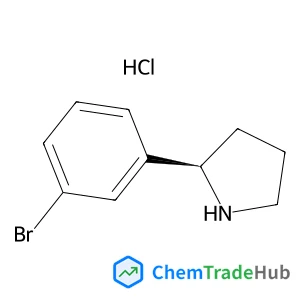
(2R)-2-(3-Bromophenyl)pyrrolidine hydrochloride (1:1)
CAS Number:
1391550-13-2
Molecular Formula:
C10H13BrClN
Jeffrey M. Ting, Teresa Tamayo-Mendoza, Shannon R. Petersen, Jared Van Reet, Usman Ali Ahmed, Nathaniel J. Snell, John D. Fisher, Mitchell Stern, Felipe Oviedo
Materials informatics (MI) has immense potential to accelerate the pace of innovation and new product development in biotechnology. Close collaborations between skilled physical and life scientists with data scientists are being established in pursuit of leveraging MI tools in automation and artificial intelligence (AI) to predict material properties in vitro and in vivo. However, the scarcity of large, standardized, and labeled materials data for connecting structure–function relationships represents one of the largest hurdles to overcome. In this Highlight, focus is brought to emerging developments in polymer-based therapeutic delivery platforms, where teams generate large experimental datasets around specific therapeutics and successfully establish a design-to-deployment cycle of specialized nanocarriers. Three select collaborations demonstrate how custom-built polymers protect and deliver small molecules, nucleic acids, and proteins, representing ideal use-cases for machine learning to understand how molecular-level interactions impact drug stabilization and release. We conclude with our perspectives on how MI innovations in automation efficiencies and digitalization of data—coupled with fundamental insight and creativity from the polymer science community—can accelerate translation of more gene therapies into lifesaving medicines.

Journal of Enzyme inhibition and Medicinal Chemistry

European Journal of Organic Chemistry

Angewandte Chemie International Edition

Faraday Discussions

Coloration Technology

Contact Lens & Anterior Eye

Nature Reviews Drug Discovery

Current Pharmaceutical Biotechnology

Lab on a Chip

Mini-Reviews in Medicinal Chemistry
Paulo Alliprandini Filho, Gustavo G. Dalkiranis, Raigna A. S. Z. Armond, Eralci M. Therézio, Ivan H. Bechtold, André A. Vieira, Rodrigo Cristiano, Hugo Gallardo, Osvaldo N. Oliveira, Jr.
DOI: 10.1039/C3CP53803F
Shih-Yun Chen, Ren-Jie Chen, William Lee, Chung-Li Dong, Alexandre Gloter
DOI: 10.1039/C3CP54613F
J. D. Rodríguez, M. G. González, L. Rubio-Lago, L. Bañares
DOI: 10.1039/C3CP54362E
DOI: 10.1039/C3CP54065K
Yunxi Yao, D. Wayne Goodman
DOI: 10.1039/C3CP54997F
Matthieu Sala, Oliver M. Kirkby, Stéphane Guérin, Helen H. Fielding
DOI: 10.1039/C3CP54418D
Li-Min Liu, Shi-Jin Zhao
DOI: 10.1039/C3CP54333A
Yan Qin, Yang Ren, Steve M. Heald, Chengjun Sun, Dehua Zhou, Bryant J. Polzin, Steve E. Trask, Khalil Amine, Yinjin Wei, Gang Chen, Ira Bloom, Zonghai Chen
DOI: 10.1039/C3CP54588A
Charles A. English, Angel E. García
DOI: 10.1039/C3CP54339K
N-(4-Methoxybenzyl)-2-pyridinamine (CAS: 52818-63-0) is increasingly being used ...
When handling Ethyl 4-(2-chlorophenyl)-1,3-thiazole-2-carboxylate, appropriate p...
Diethyldiselane (CAS: 628-39-7) is classified under the Globally Harmonized Syst...
The market for oxocopper (CAS: 12053-18-8) is primarily driven by its use in cat...
The market for 5-{[(2-Methyl-2-propanyl)oxy]carbonyl}-5-azaspiro[2.4]heptane-7-c...
2-(1-Pyrrolidinyl)-4-pyridinamine is a chemical compound with the CAS number 359...
2-(3-Pyridinyl)-1-azabicyclo[2.2.2]octane (CAS: 91556-75-1) is a crystalline sol...
(S)-Alpha-allyl-proline hydrochloride is usually synthesized via a Wittig reacti...
3-Methyl-1,2-oxazole-5-carboxylic acid (CAS: 4857-42-5) is an organic compound w...
Lys-SMCC-DM1 is synthesized via a multi-step process involving the coupling of S...

ChemComm publishes urgent research which is of outstanding significance and interest to experts in the field, while also appealing to the journal’s broad chemistry readership. Our communication format is ideally suited to short, urgent studies that are of such importance that they require accelerated publication. Our scope covers all topics in chemistry, and research at the interface of chemistry and other disciplines (such as materials science, nanoscience, physics, engineering and biology) where there is a significant novelty in the chemistry aspects. Major topic areas covered include: Analytical Chemistry Catalysis Chemical Biology and medicinal chemistry Computational Chemistry and Machine Learning Energy and sustainable chemistry Environmental Chemistry Green Chemistry Inorganic Chemistry Materials Chemistry Nanoscience Organic Chemistry Physical Chemistry Polymer Chemistry Supramolecular Chemistry
![(2R,6S)-6-[(Benzyloxy)methyl]-4-{[(2-methyl-2-propanyl)oxy]carbonyl}-2-morpholinecarboxylic acid structure](https://static.chemtradehub.com/structs/109/1093085-91-6-3382.webp "(2R,6S)-6-[(Benzyloxy)methyl]-4-{[(2-methyl-2-propanyl)oxy]carbonyl}-2-morpholinecarboxylic acid structure")
![N-{15-[(2,5-Dioxo-1-pyrrolidinyl)oxy]-15-oxo-3,6,9,12-tetraoxapentadec-1-yl}-2-(2-propyn-1-yloxy)acetamide structure](https://static.chemtradehub.com/structs/210/2101206-92-0-2eb5.webp "N-{15-[(2,5-Dioxo-1-pyrrolidinyl)oxy]-15-oxo-3,6,9,12-tetraoxapentadec-1-yl}-2-(2-propyn-1-yloxy)acetamide structure")