












Reversing the ion transport selectivity through arm modification of an artificial molecular hourglass
Literature Information
Publication Date
2023-11-17
DOI
10.1039/D3CC04573K
Impact Factor
6.222
Authors
Wen-Long Huang, Xu-Dong Wang
View Original
Abstract
An arm modification strategy, by replacing relatively rigid, electron-deficient side arms with flexible ether chain arms and linking them onto a tetraoxacalix[2]arene[2]triazine skeleton, was utilized to design an artificial molecular hourglass. The planar bilayer experiments confirmed the unimolecular channel mechanism and suggested reversed ion selectivity from the previously reported anion selectivity to weak cation selectivity.
Recommended Journals
Related Literature
Copper(i)-catalysed stereoselective debromoborylation of aliphatic 1,1-dibromo-1-alkenes with bis(pinacolato)diboron
Yadong Pang, Ryoto Kojima, Hajime Ito
2018-08-15
Communication
DOI: 10.1039/C8OB01778F
Aminative Umpolung cyclization for synthesis of chiral exocyclic vicinal diamines
Feng Liu, Guoqing Zhao, Weiqi Cai, Dongfang Xu, Baoguo Zhao
2018-09-26
Paper
DOI: 10.1039/C8OB02000K
Synthesis of novel chiral phosphinocyrhetrenyloxazoline ligands and their application in asymmetric catalysis
Carsten Bolm, Li Xiao, Martin Kesselgruber
2002-11-26
Paper
DOI: 10.1039/B208345K
Synthesis and application of a new chiral monodentate spiro phosphoramidite ligand based on hexamethyl-1,1′-spirobiindane backbone in asymmetric hydroamination/arylation of alkenes
Huanyu Shan, Rihuang Pan, Xufeng Lin
2018-08-16
Communication
DOI: 10.1039/C8OB01785A
Synthesis and evaluation of N,S-compounds as chiral ligands for transfer hydrogenation of acetophenone
Jenny K. Ekegren, Peter Roth, Klas Källström, Tibor Tarnai, Pher G. Andersson
2002-12-09
Paper
DOI: 10.1039/B208907F
Iron-catalysed carbene-transfer reactions of diazo acetonitrile
Claire Empel, Katharina J. Hock, Rene M. Koenigs
2018-09-20
Communication
DOI: 10.1039/C8OB01991F
Azodicarboxylate-free esterification with triphenylphosphine mediated by flavin and visible light: method development and stereoselectivity control
Michal März, Michal Kohout, Tomáš Neveselý, Josef Chudoba, Dorota Prukała, Stanislaw Niziński, Marek Sikorski, Gotard Burdziński, Radek Cibulka
2018-09-03
Paper
DOI: 10.1039/C8OB01822G
Preparation and characterization of pyrene modified uridine derivatives as potential electron donors in RNA
Jennifer Frommer, Beatrice Karg, Klaus Weisz, Sabine Müller
2018-09-27
Paper
DOI: 10.1039/C8OB02246A
Chemoselective synthesis of isolated and fused fluorenones and their photophysical and antiviral properties
Ismail Althagafi, Ranjay Shaw, Rahul Panwar, Shally, Chanda Sinha, Amit Kumar, Yong-Tang Zheng, Ramendra Pratap
2018-09-19
Paper
DOI: 10.1039/C8OB01733F
You might also like
Compound Q&A
What is the market or research trend for N-(4-Methoxybenzyl)-2-pyridinamine (CAS: 52818-63-0)?
N-(4-Methoxybenzyl)-2-pyridinamine (CAS: 52818-63-0) is increasingly being used ...
52818-63-0N-(4-Methoxybenzyl)-...
Compound Q&A
What precautions should be taken when handling Ethyl 4-(2-chlorophenyl)-1,3-thiazole-2-carboxylate (CAS: 1050507-06-6)?
When handling Ethyl 4-(2-chlorophenyl)-1,3-thiazole-2-carboxylate, appropriate p...
1050507-06-6Ethyl 4-(2-chlorophe...
Compound Q&A
What regulatory guidelines apply to diethyldiselane (CAS: 628-39-7)?
Diethyldiselane (CAS: 628-39-7) is classified under the Globally Harmonized Syst...
628-39-7Diethyldiselane
Compound Q&A
What is the market or research trend for oxocopper (CAS: 12053-18-8)?
The market for oxocopper (CAS: 12053-18-8) is primarily driven by its use in cat...
12053-18-8oxocopper; oxo-(oxoc...
Compound Q&A
What is the market or research trend for 5-{[(2-Methyl-2-propanyl)oxy]carbonyl}-5-azaspiro[2.4]heptane-7-carboxylic acid?
The market for 5-{[(2-Methyl-2-propanyl)oxy]carbonyl}-5-azaspiro[2.4]heptane-7-c...
1268519-54-55-{[(2-Methyl-2-prop...
Compound Q&A
What is 2-(1-Pyrrolidinyl)-4-pyridinamine (CAS: 35981-63-6)?
2-(1-Pyrrolidinyl)-4-pyridinamine is a chemical compound with the CAS number 359...
35981-63-62-(1-Pyrrolidinyl)-4...
Compound Q&A
What are the physical and chemical properties of 2-(3-Pyridinyl)-1-azabicyclo[2.2.2]octane (CAS: 91556-75-1)?
2-(3-Pyridinyl)-1-azabicyclo[2.2.2]octane (CAS: 91556-75-1) is a crystalline sol...
91556-75-12-(3-Pyridinyl)-1-az...
Compound Q&A
How is (S)-Alpha-allyl-proline hydrochloride (CAS: 129704-91-2) typically synthesized?
(S)-Alpha-allyl-proline hydrochloride is usually synthesized via a Wittig reacti...
129704-91-2(S)-Alpha-allyl-prol...
Compound Q&A
What is 3-Methyl-1,2-oxazole-5-carboxylic acid (CAS: 4857-42-5)?
3-Methyl-1,2-oxazole-5-carboxylic acid (CAS: 4857-42-5) is an organic compound w...
4857-42-53-Methyl-1,2-oxazole...
Compound Q&A
How is Lys-SMCC-DM1 (CAS: 1281816-04-3) typically synthesized?
Lys-SMCC-DM1 is synthesized via a multi-step process involving the coupling of S...
1281816-04-3Lys-SMCC-DM1
Source Journal
Chemical Communications

CiteScore:
8.6
Self-citation Rate:
4.7%
Articles per Year:
2458
ChemComm publishes urgent research which is of outstanding significance and interest to experts in the field, while also appealing to the journal’s broad chemistry readership. Our communication format is ideally suited to short, urgent studies that are of such importance that they require accelerated publication. Our scope covers all topics in chemistry, and research at the interface of chemistry and other disciplines (such as materials science, nanoscience, physics, engineering and biology) where there is a significant novelty in the chemistry aspects. Major topic areas covered include: Analytical Chemistry Catalysis Chemical Biology and medicinal chemistry Computational Chemistry and Machine Learning Energy and sustainable chemistry Environmental Chemistry Green Chemistry Inorganic Chemistry Materials Chemistry Nanoscience Organic Chemistry Physical Chemistry Polymer Chemistry Supramolecular Chemistry
Recommended Compounds
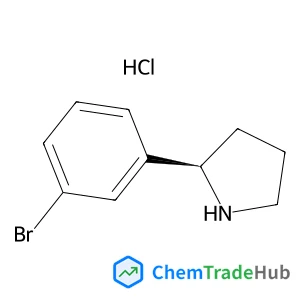
(2R)-2-(3-Bromophenyl)pyrrolidine hydrochloride (1:1)
CAS Number:
1391550-13-2
Molecular Formula:
C10H13BrClN
Recommended Suppliers





Disclaimer
This page provides academic journal information for reference and research purposes only. We are not affiliated with any journal publishers and do not handle publication submissions. For publication-related inquiries, please contact the respective journal publishers directly.
If you notice any inaccuracies in the information displayed, please contact us at support@chemtradehub.com. We will promptly review and address your concerns.