












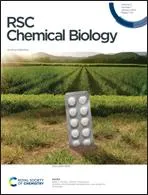

A strategy for orthogonal deubiquitination using a bump-and-hole approach
Literature Information
Publication Date
2023-10-02
DOI
10.1039/D3CB00095H
Impact Factor
0
Authors
Takumi Suzuki, Yuki Utsugi, Satoshi Yamanaka, Hirotaka Takahashi, Tatsuya Sawasaki, Yusaku Miyamae
View Original
Abstract
We have successfully applied a bump-and-hole approach to establish orthogonal deubiquitination in which a ubiquitin substrate variant is specifically targeted by an engineered deubiquitinating enzyme (DUB). This makes it possibe to selectively observe and measure a single type of DUB activity in living cells.
Related Literature
Dearomative C–C and C–N bond cleavage of 2-arylindoles: transition-metal-free access to 2-aminoarylphenones
Shuang Luo, Ziwei Hu, Qiang Zhu
2016-01-15
Research Article
DOI: 10.1039/C5QO00394F
Rhenium and base co-catalyzed [3 + 2] annulations of N–H ketimines and alkynes to access unprotected tertiary indenamines through C–H bond activation
Xiqing Jin, Xiaoxu Yang, Yunhui Yang, Congyang Wang
2015-12-24
Research Article
DOI: 10.1039/C5QO00336A
Asymmetric transfer hydrogenation of seven membered tricyclic ketones: N-substituted dibenzo[b,e]azepine-6,11-dione driven by nonclassical CH/O interactions
Vijyesh K. Vyas, Bhalchandra M. Bhanage
2016-03-09
Research Article
DOI: 10.1039/C6QO00036C
A novel zinc based binary catalytic system for CO2 utilization under mild conditions
Willi Desens, Christina Kohrt, Anke Spannenberg, Thomas Werner
2016-01-07
Research Article
DOI: 10.1039/C5QO00356C
Copper-catalyzed tandem A3-coupling–isomerization–hydrolysis reactions of aldehydes and terminal alkynes leading to chalcones
Yingwei Zhao, Qiuling Song
2015-12-29
Research Article
DOI: 10.1039/C5QO00282F
Photoredox sheds new light on nickel catalysis: from carbon–carbon to carbon–heteroatom bond formation
Yong-Yuan Gui, Liang Sun, Zhi-Peng Lu, Da-Gang Yu
2016-02-03
Highlight
DOI: 10.1039/C5QO00437C
Selectfluor promoted NHC–oxazoline gold(i) complex catalyzed cycloaddition/oxidation reaction of enynones with alkenes
Qin Xu, Peng Gu, Feijun Wang
2015-09-02
Research Article
DOI: 10.1039/C5QO00155B
Rapid access to bicyclic δ-lactones via carbene-catalyzed activation and cascade reaction of unsaturated carboxylic esters
Zhenqian Fu, Xingxing Wu
2015-12-03
Research Article
DOI: 10.1039/C5QO00348B
You might also like
Compound Q&A
What is Ethyl 3-cyclohexylpropanoate (CAS: 10094-36-7)?
Ethyl 3-cyclohexylpropanoate is a clear, colorless to light yellow liquid with a...
10094-36-7Ethyl 3-cyclohexylpr...
Compound Q&A
How should waste containing 2-(Hydroxymethyl)-5-(methoxycarbonyl)-6-methyl-4-(2-nitrophenyl)nicotinic acid (CAS: 34783-31-8) be handled?
Waste containing 2-(Hydroxymethyl)-5-(methoxycarbonyl)-6-methyl-4-(2-nitrophenyl...
34783-31-82-(Hydroxymethyl)-5-...
Compound Q&A
How should waste containing 2,4,6-Tris(pentafluoroethyl)-1,3,5-triazine (CAS: 858-46-8) be handled?
Waste containing 2,4,6-Tris(pentafluoroethyl)-1,3,5-triazine (CAS: 858-46-8) sho...
858-46-82,4,6-Tris(pentafluo...
Compound Q&A
What precautions should be taken when handling Chloroac-nle-oh (CAS: 56787-36-1)?
When handling Chloroac-nle-oh (CAS: 56787-36-1), it is essential to wear appropr...
56787-36-1Chloroac-nle-oh
Compound Q&A
What industries use Ethyl 6-phenylimidazo[2,1-b][1,3]thiazole-3-carboxylate (CAS: 752244-05-6)?
Ethyl 6-phenylimidazo[2,1-b][1,3]thiazole-3-carboxylate is primarily used in the...
752244-05-6Ethyl 6-phenylimidaz...
Compound Q&A
Are there alternatives to alpha-(2-Bromophenyl)benzylamine (CAS: 55095-15-3) in synthesis?
Alternatives to alpha-(2-Bromophenyl)benzylamine (CAS: 55095-15-3) in synthesis ...
55095-15-3alpha-(2-Bromophenyl...
Compound Q&A
How should waste containing 2-Chloro-5-methoxypyridine (CAS: 139585-48-1) be handled?
Waste containing 2-Chloro-5-methoxypyridine (CAS: 139585-48-1) should be managed...
139585-48-12-Chloro-5-methoxypy...
Compound Q&A
What industries use 1-(4-Methoxyphenyl)-2,5-dimethyl-1H-pyrrole (CAS: 5044-27-9)?
1-(4-Methoxyphenyl)-2,5-dimethyl-1H-pyrrole (CAS: 5044-27-9) is used in various ...
5044-27-91-(4-Methoxyphenyl)-...
Compound Q&A
Are there alternatives to 3-Bromo-5-(N-Boc)aminomethylisoxazole (CAS: 903131-45-3) in synthesis?
There are alternative reagents and compounds that can be used in the synthesis o...
903131-45-33-Bromo-5-(N-Boc)ami...
Compound Q&A
What is Tungsten(IV) oxide (CAS: 12036-22-5)?
Tungsten(IV) oxide, also known as tungsten dioxide, is a chemical compound with ...
12036-22-5Tungsten(IV) oxide
Source Journal
Recommended Compounds



Recommended Suppliers






Disclaimer
This page provides academic journal information for reference and research purposes only. We are not affiliated with any journal publishers and do not handle publication submissions. For publication-related inquiries, please contact the respective journal publishers directly.
If you notice any inaccuracies in the information displayed, please contact us at support@chemtradehub.com. We will promptly review and address your concerns.